

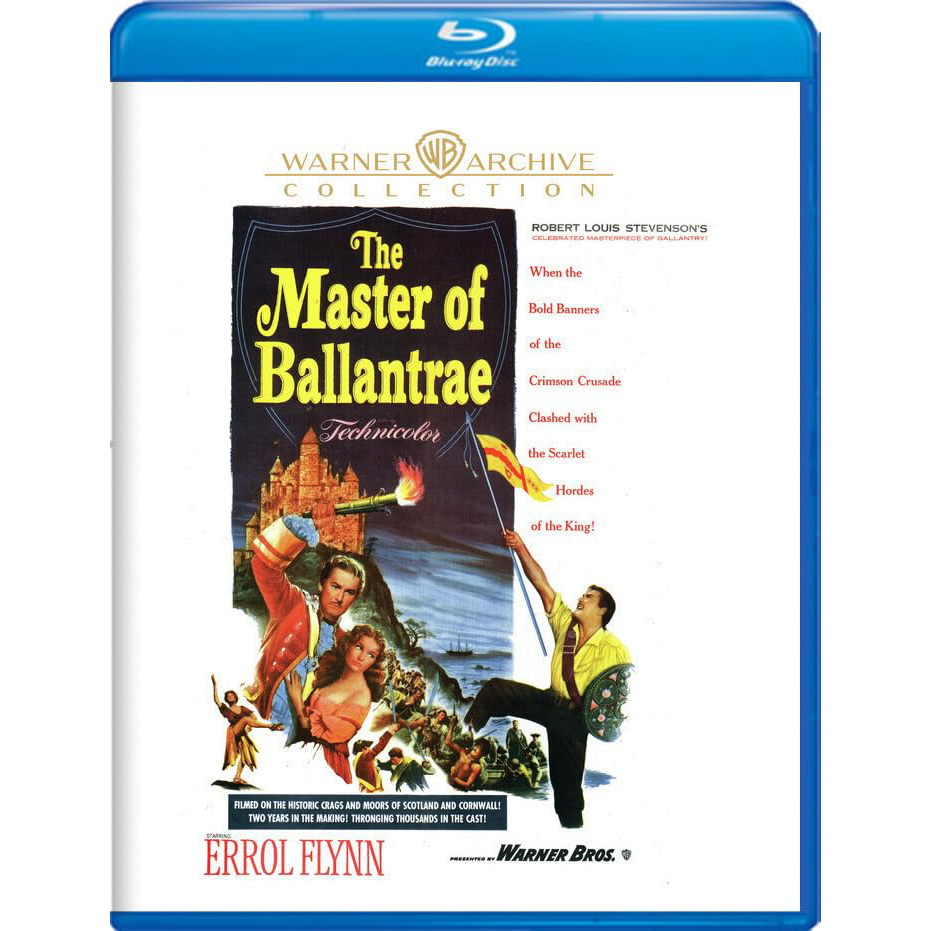

We’re always happy when a new Errol Flynn epic shows up, even when it isn’t a top title. Not all of them can be as great as his classic They Died with their Boots On, from just last September.
The Master of Ballantrae is one of Flynn’s last pictures that has maintained a decent reputation, although that judgment is usually modified with, ‘but it’s not as good as his earlier work.’ At 44 years Flynn looks more like 54, not at all dissipated or terribly out of shape … just not the same sleek guy he had been just a few years before. The 1950s would be rough on Flynn. His attempt to produce his own picture — about William Tell — came to naught and destroyed his finances. We like his contribution to John Huston’s The Roots of Heaven, in which he puts a lot of himself into the character of a wasted adventurer making one last stand with some idealistic eco-activists.

Ballantrae apparently came about because Warners had money tied up in England, frozen assets that could only be spent there. The okay production gives Errol Flynn two male co-stars with low profiles in America — the great Roger Livesey of I Know Where I’m Going! and the promising Anthony Steel, whose career was picking up steam. Even when the movies weren’t terrific, Errol Flynn still attracted fairly high-profile leading ladies — Gina Lollobrigida, Micheline Presle, Ruth Roman, Maureen O’Hara. For Ballantrae he was paired opposite two very good actresses, but their names were barely mentioned in the advertising.

The film has no credited producer, something we don’t expect to see in a major studio production. Shooting took place in English studios and on location in the Mediterranean, with (we think) a second unit sent to Scotland. The director William Keighley was likely chosen for his history with the star, as he had a co-directing credit on The Adventures of Robin Hood and directed two other Flynn pictures as well. The smartest hire was surely the cinematographer Jack Cardiff, whose skill with Technicolor was already a legend. Cardiff had been noted for shooting the big hit The African Queen on a very difficult location. The Master of Ballantrae would also require a lot of matching between distant locations and studio work in 3-Strip Technicolor.
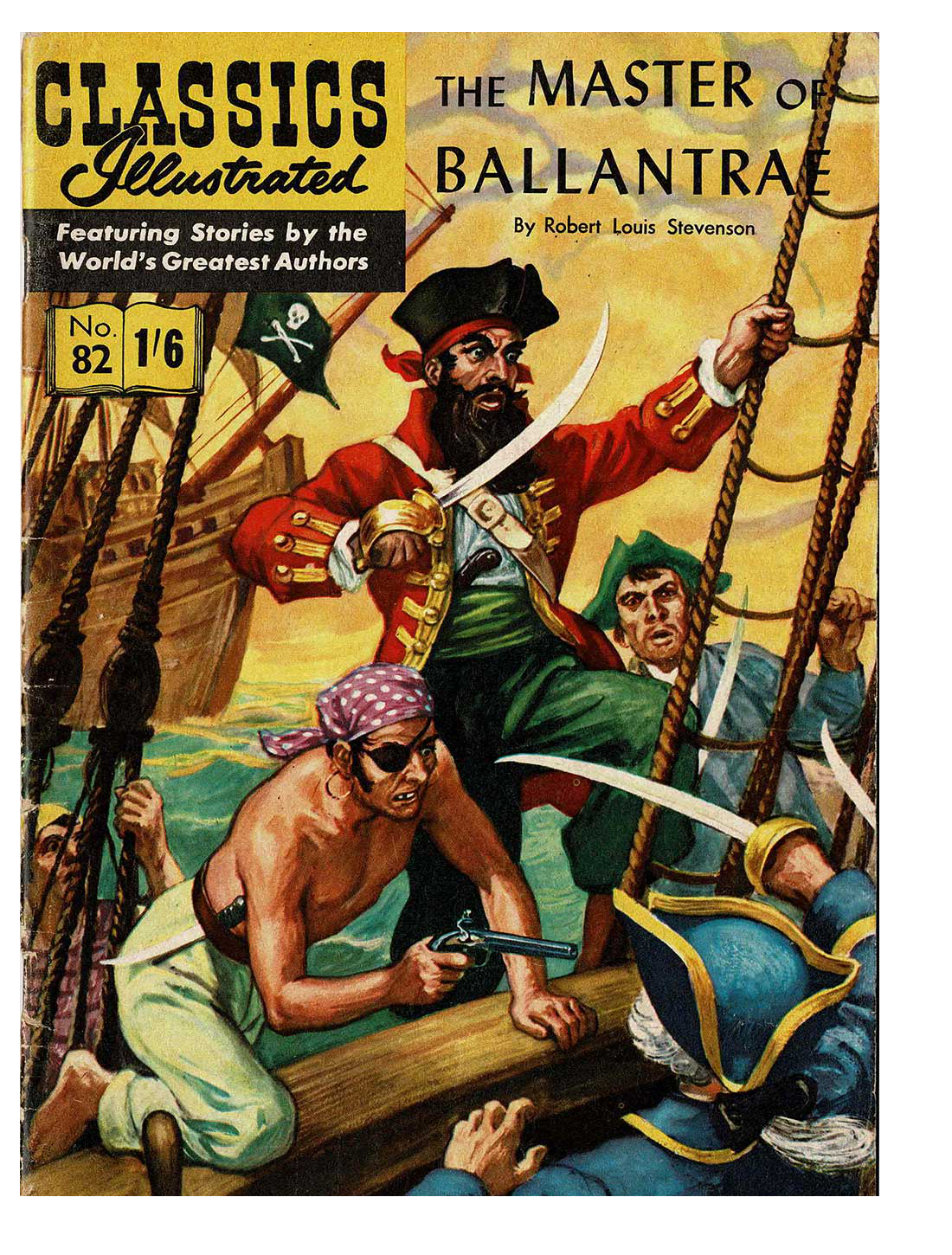
We had all read a certain Classics Illustrated comic without knowing that Robert Louis Stevenson’s 1889 story had been filmed; the adaptation tries to keep Stevenson’s historical context intact. The narrative rushes from one episodic adventure to the next, held together with narration by Robert Beatty. Titled Scotsman Jamie Durie (Errol Flynn) is a rascal who lets his younger brother Henry (Anthony Steele) tend to the hard work at the castle. Jamie is promised to Lady Alison (Beatrice Campbell) but has an affair going with Jessie Brown (Yvonne Furneaux), a ‘town girl.’ Bonnie Prince Charlie has returned to Scotland, with the idea of raising an army to drive out the Brits and retake the throne of England. Jamie and Henry’s father Lord Durrisdeer (Felix Aylmer) approves of Jamie’s plan to survive the civil war: Jamie will go fight for the Jacobites as a rebel, while Henry will stay at home, a loyalist. That way no matter how the war goes, they’ll keep their castle and lands.
Defeat at the Battle of Culloden (1746) turns Jamie into a traitor with a price on his head. He teams up with a fellow fugitive, Irish colonel Francis Burke (Roger Livesey). Their survival plan is to escape to France. But they are betrayed, and Jamie almost killed. The logical turncoat is his own brother Henry. Jamie leaves swearing vengeance, and to someday return to reclaim the hand of Lady Alison.
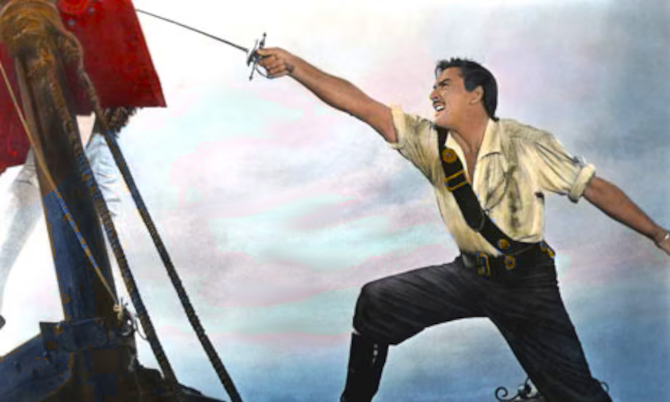
Once at sea, the show becomes a pirate adventure. Henry and Francis are captured by the brigand Captain Arnaud (Jacques Berthier), who keeps them alive but takes them to the New World and Tortuga. Along with the devious Arnaud’s first mate Matthew Bull (Francis De Wolff), they manage to steal the galleon and the treasure of the more successful pirate Mendoza (Charles Goldner). More complications ensue before Jamie can return to Scotland, to settle family accounts and claim his fiefdom.
The general verdict on The Master of Ballantrae is that it is well produced, very well acted, indifferently directed … and redeemed by the handsome Technicolor images of Jack Cardiff. Errol Flynn is not at all subdued as Jamie Durie; it’s the action direction that fails to make him seem as dashing as he once was. Keighley and Cardiff film a daunting production with as few setups as possible. The gambit often works out well, but there aren’t as many master shot set-pieces; that monster Technicolor camera doesn’t move as much as it might.
There are good action moments — a battle royal on a staircase impresses — but cutting between medium shots of fencers doesn’t bring out much personality in the fighting. For instance, Jacques Berthier’s French pirate Arnaud ↓ is established as an artist with a sword blade, more or less winning against Jamie in their first set-to. When it comes time for a final showdown, Flynn’s Jamie is suddenly much better, with the only explanation an overdubbed line, “I learned from you.”
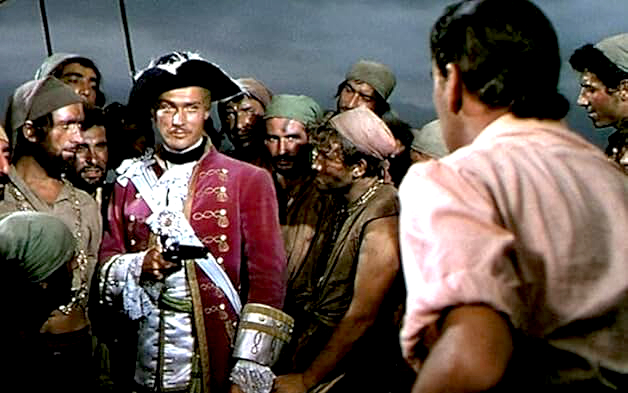
Also, the villains are lacking in personality. Captain Arnaud looks the part of a foppish cutthroat, but his voice appears to be dubbed and his line readings lack oomph. Charles Goldner’s buccaneer Mendoza is all wig and no fun — he’s supposed to be the most successful thief on the seas, but if that’s the case he’s far too easily outfoxed. Francis De Wolff looks twice as big as we expect him to — we at first thought Bull was being played by the giant Buddy Baer.
Another smart move was the hiring of the young, creative art director Ken Adam, without credit. The film’s credited art director Ralph Brinton stayed in England while Adam took charge of everything on location and at sea. Adam earned his first reputation redressing live-action ships for a trio of WB films starting with Captain Horatio Hornblower and The Crimson Pirate, all filmed between France and Italy. Adam’s specialty was making alterations to the working sailing ships, to change their character for the next movie. It must have been quite an adventure, traveling with those picture boats from Naples to Palermo. He remembers Errol Flynn being a great guy, who sometimes had a hard time in public. Strangers would try to provoke the star, hoping to goad him into behaving badly.
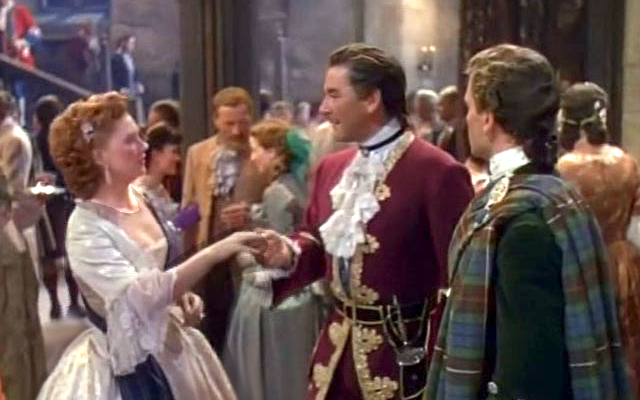
A number of traveling mattes are used to put Flynn and others in boats against pre-filmed backdrops; they have the same unsightly matte lines as were seen on The African Queen. English directors were noted for incredible matching using doubles, which is what we see in the scenes set in Scotland. The camera has to stay wide to show Flynn’s double riding across a bridge or galloping up to meet Lady Alison; the reverse shot with the dialogue is invariably taken on a good but somewhat artificial studio set back in London. Keighly and Cardiff’s biggest problem was matching these shots taken so far apart.
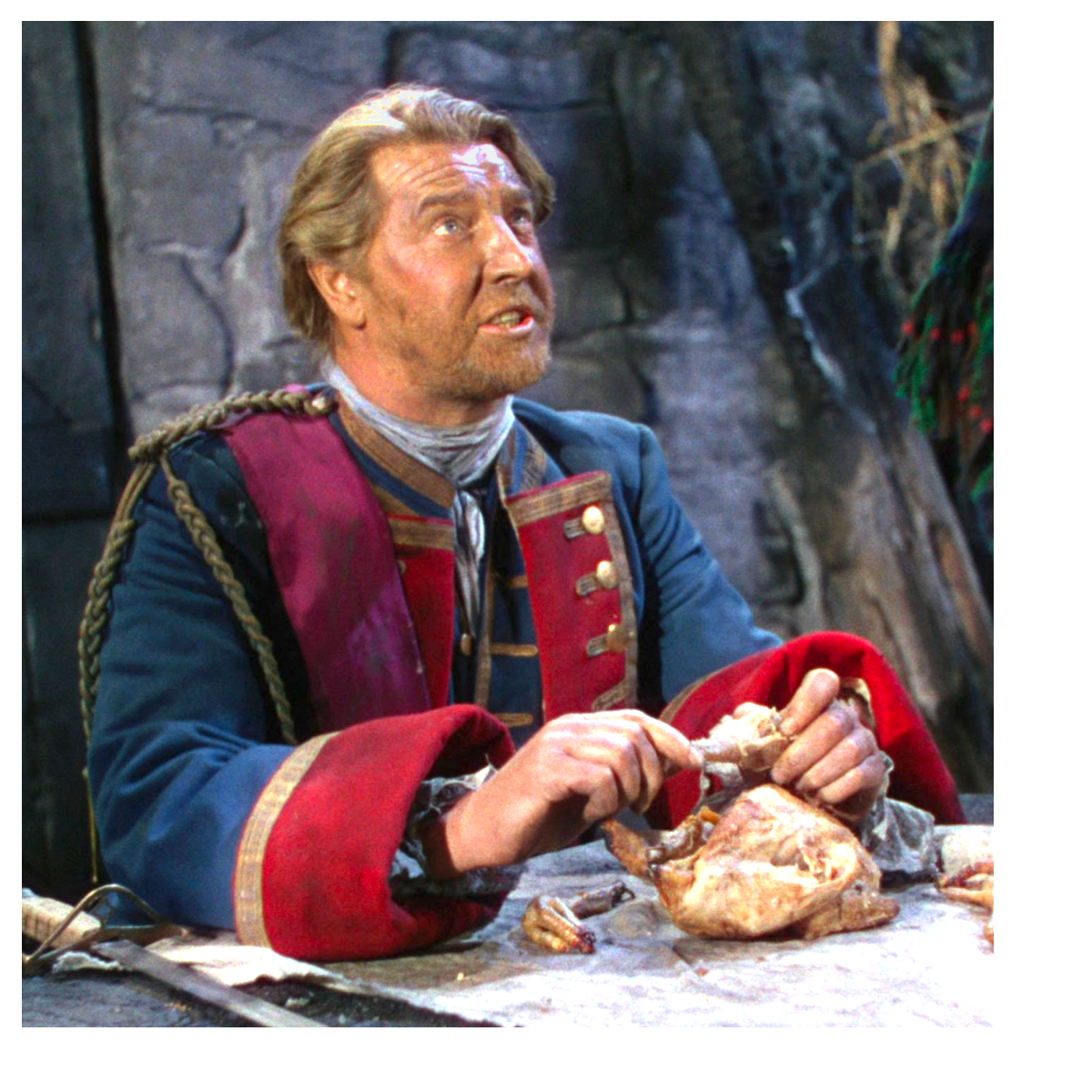
With so much story to get through in 90 minutes, we hear a lot of rushed narration. Important moments pass by rather quickly. We wonder why Henry Durie doesn’t proclaim his innocence, instead of entering into a fight that convinces Jamie that he’s a villain. Later on, we’re convinced that the filmmakers just skipped a few chapters of storytelling. How do Jamie and Francis convince a shipload of uncooperative pirates to sail back to the British Isles? The transition is less elegant than that in King Kong, when we dissolve from an island beach to New York City months later, without a clue of how they got the monkey to cooperate with the trip.
←
After Flynn, good-guy best friend Roger Livesey makes the best on-screen impression, but even Livesey is cramped with too many quips about the superiority of Ireland over Scotland. With his hoarse voice, Livesey always made us want to see a scene where he excuses himself, clears his throat, and then starts talking with the smooth tones of Ronald Colman. Anthony Steel isn’t given enough time to establish a character … all he does is keep the plot mechanics working, and wait for Flynn’s Jamie to insult him for the 10th time.
But the actresses suffer the most. Nobody expect Olivia de Havilland chemistry, but Beatrice Campbell comes off as lacking in personality. We really don’t remember her. We never forget Yvonne Furneaux, just for her arresting looks. We’ve only seen a few of her pictures, the most impressive being Antonioni’s Le amiche, Terence Fisher’s The Mummy and her small role in Roman Polanski’s Repulsion. Furneaux’s Jessie Brown really gets the short end of the stick here. As Jamie’s lover she has no kisses. She just hovers on the periphery of a few scenes long enough to provide a plot twist. The Jessie Brown – Jamie Durie relationship is actually rather icky. He apparently woos (beds?) her as a side diversion, when she’s also a commoner under his ruling family’s protection. What a slimeball.
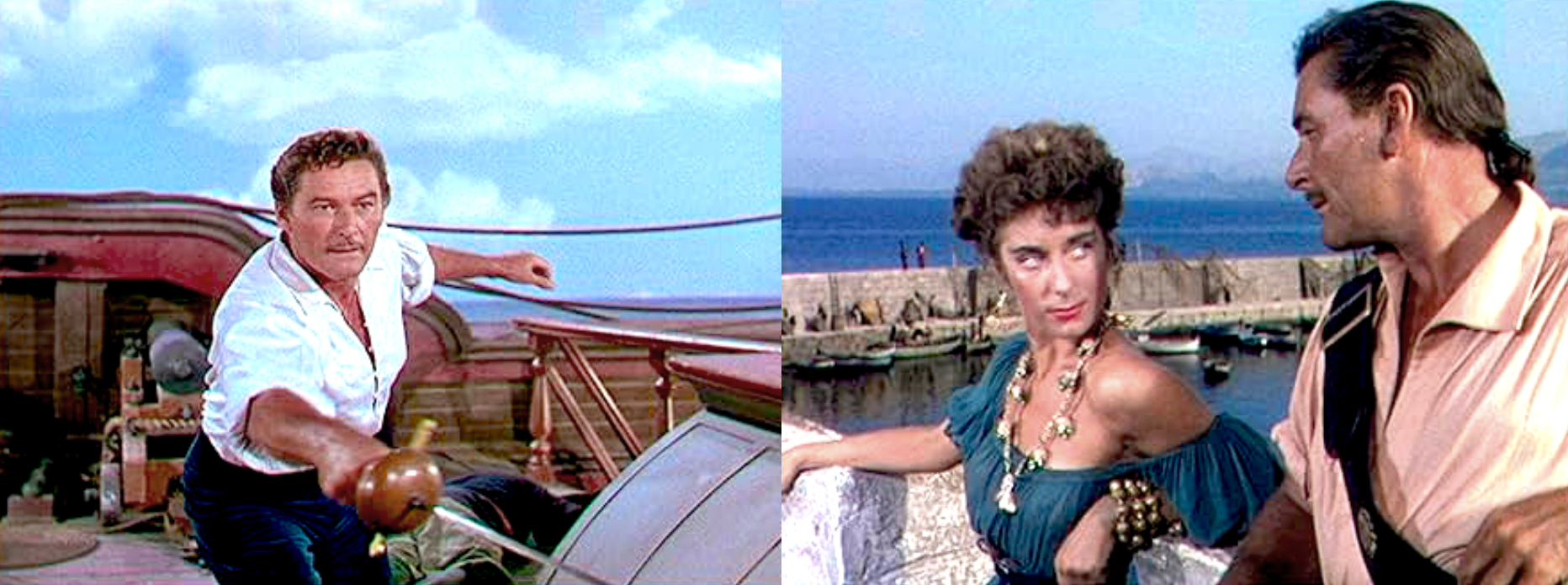
The really odd un-billed performance is that of dancer-choreographer Gillian Lynne. ↗ She performs a full dance to a big audience Atop a castle wall in Palermo. She also exchanges some good dialogue with Flynn, but her name isn’t on the film. Ms Lynne would later become a big-time choreographer, creating dances for Half a Sixpence, Man of La Mancha, Yentl, some Muppet productions and the stage shows Cats and Phantom of the Opera.
There’s nothing wrong with Master of Ballantrae yet it doesn’t have the full spirit or the finesse of Errol Flynn’s best work — not because he’s over the hill but because the show doesn’t distinguish itself in any aspect except the way it looks. When Jack Cardiff sets up a close-up with any of his actresses, they always look their best — Beatrice Campbell and Yvonne Furneaux’s eyes really jump off the screen.
Ballantrae became Errol Flynn’s last picture for Warners. He then put together his ambitious William Tell project, with Jack Cardiff as director . . . but lost his personal fortune when Italian financiers backed out just as the shoot began. Filming ceased when only a third of the film had been shot. The debacle of the unfinished movie explains how Flynn became something of a vagabond, taking what film work he could get. The one major possession he didn’t lose was his beloved yacht Zaca, which was still his when he died in 1959.


Having recently read the book I can testify that this fairly enjoyable picture bears very little resemblance to Stevenson’s plot, really only the bare bones of the premise and hardly even that. I watched the picture on the WB Archive DVD and Cardiff’s work looks pretty darn good there, too. It’s clear from Cardiff’s memoir that he saw the film as a stepping stone to a directing gig on William Tell, which never happened, but he liked Erroll Flynn.
I would like to give credit to the added cartoon, “Bully for Bugs”, as one of director Chuck Jones and composer Carl Stallings’ best non-opera efforts. For once, Bugs has a formidable villain with the Bull, who manages to get in a few licks beyond the initial attack. Stallings’ orchestrations take the WB Studio orchestra through the gamut. The two artists combine their talents with the build of the Mexican Hat Dance through to the Bull’s great frustration and the climactic, perfectly coordinated, crescendo of the Bull sailing through Bugs’ clever thrill ride to the villain’s ultimate fate.
I may be overstating my admiration for this cartoon. But watch it with the volume at 11 and you’ll see (and hear) what I mean,
I heartily agree. My favorite Bugs Bunny short. #gullibull
I’ve always liked Master of Ballantrae, by far Flynn’s best film of the ’50s, and one of the better films of his career, in my opinion.
Gillian Lynne, who had played the dancer Marianne is the film (unbilled), spoke with affection about the actor years later. “I would never have been chosen for the role if he hadn’t liked me because they were looking for a blonde woman with big boobs and then they saw me dancing at the Palladium. I was thin with tiny boobs and dark hair but I was sexy. I’m a sexy dancer. Most dancers are sexy. We had a lot of quite steamy scenes, nothing in the bedroom, thank God. All out in the sun.”
Flynn and Lynne also had an affair while making the film. “It was very difficult for it not to come about! He was a gorgeous man and he was very witty, very funny and well educated actually. It wasn’t all about sex, it was all about fun. We liked each other.
Their on-set fling lasted for two months, with the couple enjoying drinks in the bar of Palermo’s exclusive Villa Igiea and taking boat trips up and down the Sicilian coast.
Yvette Furneaux had a prominent role as Marcello Mastroianni’s girlfriend in “La Dolce Vita”.