



It’s so good that the Warner organization has opened the flood gates for these superb digital remasters. Old Technicolor films show the most dramatic improvement, but the studios’ B&W output looks better as well, optimized and rejuvenated. This romantic tale is so convoluted that it could be a part-supernatural fantasy. It charmed previous generations, and deserves rediscovery by new blood.
Savant enjoys old sentimental romance stories for the same reason everyone else does, but he often tunes in just to see how different filmmakers solve (or don’t solve) familiar narrative problems. Making a serious romantic tale come together satisfactorily is no easy task. Most of the movies ask us to set aside the problems of the world to concentrate on two individuals separated by chance, misunderstanding, prejudice and even time itself. A picture like Portrait of Jennie places its lovers in an insoluble time-warp. They’re a perfect pair, unfortunately born in different eras. It creates an entire illusory world just to make the subjective romantic experience seem that much more magical. For this reviewer, the 2004 Eternal Sunshine of the Spotless Mind labors too hard in the same vein. Its elaborate science fiction premise eventually becomes an irrelevant annoyance. The real movie hidden in there somewhere is about the simple feelings between two interestingly ordinary lovers.
Random Harvest is a superior romantic melodrama, an expertly crafted MGM “women’s film” made at a time when the subgenre was already recycling tired plots and tasking big-star chemistry to do the heavy lifting. An attempt to describe Harvest might make it sound like a bad movie idea, which is one good reason not to get too deeply into the plot. The story hook is amnesia, the basis for some of the most hackneyed movies ever. But the writers, director Mervyn LeRoy and actors Ronald Colman & Greer Garson make it work beautifully. When we first saw this one it really took us by surprise.

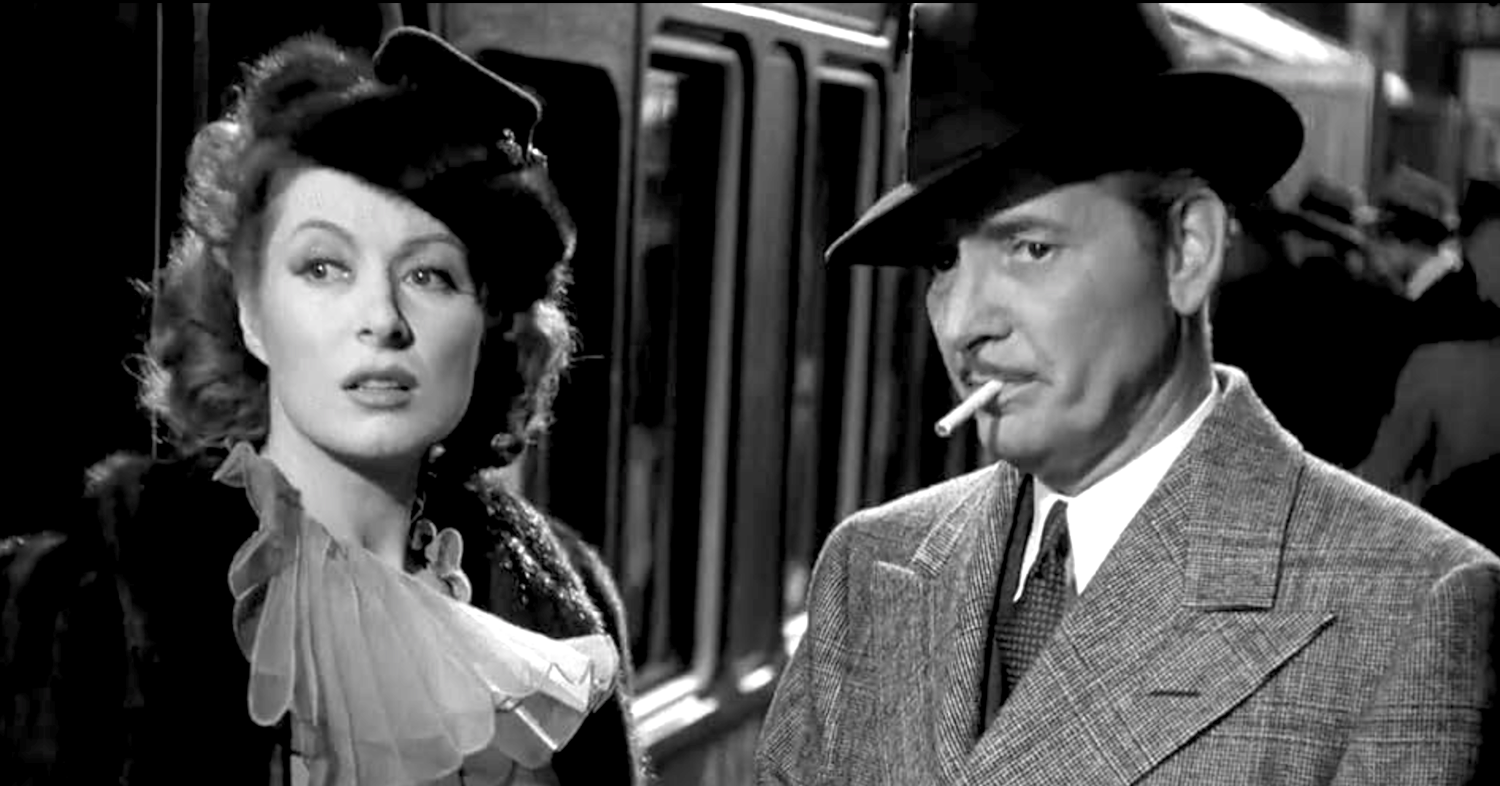
Shell-shocked WW1 vet “John Smith” (Ronald Colman) has a cloud of amnesia covering his past. He is grateful to begin a new life with ex-performer Paula Ridgeway (Greer Garson). They marry and have a baby while he starts a new career as a writer. But the first time he leaves Paula’s side to go to Liverpool to see about a newspaper job, fate deals him a terrible twist.
Your standard garden-variety amnesia movie can be a pretty sad affair. A man shows up with no identity and no memory of a past life. Or he wakes up in a hospital to find people insisting that he’s a person he never heard of. Memory loss is frequently used to suppress a few facts long enough to create a mystery where there really isn’t one. For instance, John Hodiak in Somewhere in the Night finds himself in act two of a murder drama. Amnesia victims never turn out to be ordinary people. It’s always some psychic trigger that brings them back to lucidity, just in time to thwart whatever evil plot happens to be underway. The more modern thriller Shattered mixes amnesia with plastic surgery, a case of two bad plot elements straining to concoct a too-clever mystery.
Random Harvestis an impressive exception to this norm. It is from a book by James Hilton, the author of Lost Horizon and Goodbye, Mr. Chips. All three stories are obsessed with the experience of WW1. Harvest begins as the sad story of an ex-soldier (Ronald Colman) living unhappily in a gloomy asylum in the English countryside, hoping some relative will show up to help him remember his identity. The mood and tone are no sooner established than the story switches to an Armistice party in the village. ‘John Smith’ has just escaped the asylum and is picked up by Paula (Greer Garson), a travelling music-hall performer who almost immediately falls in love with him. Various minor characters aid Smith’s progress toward freedom and happiness, in ways we don’t expect. For instance, Smith injures a man who might reveal his status as an escaped looney. The surprise is that the film doesn’t opt for the expected desperate manhunt. We instead settle in for an episode of happiness between ‘Smithy’ and Paula.

Unlike most old studio films we have no idea where Random Harvest is going. It seems to be a theraputic story, the recovery of a good man through the love of a good woman. But Smitty’s identity remains a mystery. No telltale clues poke through — when things happen we’re just as surprised as the characters are.
This is the LAST film we’d want to spoil for anyone.
That’s as far as we will go with the actual story. What happens to these people becomes something of intense personal importance for the audience. The actors make the initial connection. Ronald Colman and Greer Garson are glamorous stars but come across as good people we’d like to know. MGM didn’t scrimp on telling a tale that requires the creation of several completely different sets of characters and locations. Finally, the script makes it possible for us to invest in a series of unlikely events without feeling like gullible fools. We will often accept a simple-minded story idea just to enjoy the resulting emotional dramatics. John Cromwell’s The Enchanted Cottage comes to mind. Random Harvest has some jolting surprises, but none of them ask us to ignore logic or common sense.
But it is safe to offer other non-spoiler observations:
Random Harvest sidesteps MGM’s standard class snobbery when dealing with any story set in England. Events stay focused on the central mystery. We naturally tend to interpret what’s going on. The one thought we got is that Smithy’s progress toward mental clarity might represent a sick England coming out of WW1 and finding its way toward sanity and enlightenment.
There is one jaw-dropping story development begging to be pointed out (but not spoiled). It bridges the gap between Alfred Hitchcock trickery and narrative abstraction. Surrealists love an unconventional old movie called Peter Ibbetson because its romance blurs the line between fantasy and reality. Its separated lovers are granted the ability to meet in dreams where they live out their entire romantic lives. It’s a delirious romantic nightmare.
Random’s big plot development pulls the rug out from under our expectations. Initially perceived as a logical impossibility, the narrative rupture is like something from a Luis Buñuel film. For a minute we think this might be the most stupid plot twist ever in a movie. Then we realize that it makes sense after all. You’ll see.

There are no outright narrative gimmicks. Nothing melodramatic or pulpy: Smithy doesn’t turn out to be the dupe of thought-control experts or the Kaiser’s son sent as a master spy. In the first half of the movie, the amnesia issue is the only problem. Nobody must flee the law, nobody is being blackmailed. How many forgettable pictures have we seen that start with an intriguing premise, and then waste it as a springboard to the same-old car chases or shoot-outs?
The plotting is also not lazy. Leo McCarey’s An Affair to Remember narrows its romantic statement to an aggravating view of self-sacrifice… as if one can’t prove one’s love without suffering something terrible, like chopping off a finger. Random Harvest doesn’t have make its characters into saints, just so we’ll cry when things go bad for them.
Remember Vertigo, when James Stewart suddenly has a burst of memory upon seeing Kim Novak place a certain piece of jewelry around her neck? Random Harvest has a similar scene that points up its superior use of the amnesia gimmick. There are no tricks, no memory triggers. Smithy is confronted with several objects that in an ordinary story would send him into a psychic tailspin, like Marnie going bonkers over the color red. Nothing of that sort happens. It’s refreshing to see a Hollywood show of this vintage in which psychological problems are not solved with knee-jerk magic.
The ultimate appeal of Random Harvest is that it engenders a feeling of, for lack of a better term, social utopianism. The movie has no malice and no villain. Smithy and Paula are met with kindness wherever they go. A potentially troublesome group of aristocrats also cause no problems for our lovers. Smithy wants to do the right thing. Paula is a trusting saint ready to risk her life and future on a romantic gamble, which to me sounds like the only way to enter a love relationship. Peripheral characters — a doctor, an office worker — are interested in Paula but remain respectful of her lack of response to their overtures. There’s only one other major romantic role. That person ends up backing out of an advantageous marriage for purely altruistic reasons. If only more people we meet in life were half as virtuous as the characters we meet here.

There is another really arresting performance in this film: Susan Peters is terrific in a role that …. well, we promised no spoilers. She has an interesting face and a slight curl to her lip that reminds us a bit of Liv Tyler. Her story is one of the saddest in Hollywood. Were it not for a bad accident, she would have been a big star. Reading about Susan Peters brings another weird twist to Random Harvest.
This is surely one of Ronald Colman’s strongest screen roles. He has better luck here than in Frank Capra’s Lost Horizon, where he supported on his acting shoulders the full weight of a shaky premise. Greer Garson is the bigger surprise. Her standard MGM vehicles trade heavily on her genteel manner and sincere smile, such as her most famous character Mrs. Miniver. This picture’s difficult acting moments show Garson to be as natural and fresh as Irene Dunne or Carole Lombard.
How to be accurate, yet spoil nothing:
The amnesia story weaves several possible ‘lives’ of the romantic leads into a pattern that some will dismiss as sentimental hokum. More adventurous viewers may compare John Smith’s alternate lives and shifting memories to the work of author Philip K. Dick, whose science fiction is replete with people living with false memory implants, etc. Viewers that have accumulated sufficient life experience, will realize that the relationships depicted are not shallow. Major life changes can leave the past feeling as if it was a life lived by another person entirely.
The supporting cast is nicely chosen, with Henry Travers, Rhys Williams, Reginald Owen, Una O’Connor and Margaret Wycherly in solid bits. Hidden somewhere is Peter Lawford. If Savant has perhaps oversold Random Harvest, it’s because so many Hollywood dramas from this era offer ‘life lessons’ that are poorly conceived or patently false. This one’s exceptional — it’s intelligent and emotionally rewarding.
I look forward to seeing this!
The title always summoned a mental image of a farmer carelessly picking vegetables…an ear of corn, a bean pod or two, maybe a potato…just at random!
Anyone remember “Rancid Harvest”? https://www.youtube.com/watch?v=16SZBgvGVv0&list=WL&index=2
What a year both lead actors had! Colman with this and “The Talk of the Town,” and Garson with this and “Mrs. Miniver.”
“The Talk of the Town” was released on August 12th, 1942 (7 Oscar nominations, including Best Picture); “Random Harvest” was released on December 17th, 1942 (7 Oscar nominations, including Best Picture); and “Mrs. Miniver” was released June-July ’42 (11 Oscar nominations, 6 wins).
“Harvest” earned $4,650,000 in the United States and $8,147,000 worldwide for a profit of $4,384,000.
“Miniver” grossed $5,358,000 in the US and Canada and $3,520,000 abroad. The initial theatrical release earned a profit of $4,831,000, making it MGM’s most successful film to that time.
“Town” grossed $1.1 million. Good enough for a place in the top twenty-five of 1942.
A good review and well judged. Not giving any of the plot twists away was very wise, so thank you for that. I watched the disc a few days ago and I was delighted by the high quality.