


Brian De Palma’s first (and significantly better) film about telekinesis was also his first commercial success, and the first movie adapted from a Stephen King novel (King was quoted as saying he thought it was better than his book). It was unusual for its time in that two of its lead performances were nominated for Oscars. It’s lasted the test of time as a horror classic, and Scream Factory’s 40th Anniversary Collector’s Edition, a 4K scan from the original negative, is packed with supplementary material. The film hasn’t been reviewed on CineSavant before, and in the interest of not being the subject of “They’re all gonna laugh at you” concerns at this omission, here’s a look at the sad, scary story of Carrie White.
Famously, when Stephen King was writing Carrie, he lost faith in his ability to do the story justice, and he tossed his manuscript in the trash. It was saved from oblivion by his wife, Tabitha, fishing the pages out of the bin. As a result, King’s extraordinary career was started, many many films and tv adaptations were made from his work, and eventually Kathy Bates got an Academy award. But it all began with this tale about teen bullying, religious mania and startling vengeance.
16-year-old Carrie (Sissy Spacek) has had a very hard life. Her mother, Margaret (Piper Laurie), is a religious zealot who thinks that all women are inherently sinful and regularly locks Carrie in a closet with a creepy and arrow-impaled St. Sebastian statue to pray forgiveness for her nonexistent sins. Above and beyond that, she is a frequent target for abuse at her high school, where mean girls such as Chris (Nancy Allen) torment her daily.

Things get worse when, one day in the locker room shower after a volleyball game, Carrie gets her first period, and, not knowing what is happening to her, publicly panics. Chris and the other girls, including Sue (Amy Irving), mock and throw tampons at the terrified teen, traumatizing her. Gym coach Miss Collins (Betty Buckley) punishes the team for its behavior, which enrages Chris, who vows to get back at the blameless Carrie.
Sue, feeling guilty for her part in the taunting, requests her jock boyfriend Tommy (William Katt) to ask Carrie out to the high school prom. Not without reservations, he does so. Carrie initially thinks this is another mean prank, but eventually he convinces her to say yes. When she informs her mother that she intends to go to the event, Margaret fulminates about the evils of sex and says no, but Carrie uses her burgeoning telekinetic power to win the argument.
As Carrie prepares to finally do something like a normal teenage girl and is excited about going to the prom with Tommy, Chris plots with her easily manipulated boyfriend Billy (John Travolta) to make the event into the ultimate humiliation of her long-time bullying target. But as her plans come to fruition, the results are something unexpected that will horrify them all.
One of the reasons for the film’s critical success is the fact that neither Spacek nor Laurie condescend to the story’s material — they play it flat out for all the drama and emotion it can sustain. What in lesser hands could be silly supernatural stuff becomes vivid and emotionally powerful. Spacek completely commits to her role and disappears within it. Her naked terror in the shower scene is so raw that it’s genuinely uncomfortable, and Carrie’s reactions to Margaret’s abuse of her are those of a frequently whipped animal. Conversely, when Carrie’s power finally kicks in at the conclusion, all humanity is absent from her eyes, and Spacek instead gives us the dreadful vision of a vengeful goddess without any mercy.
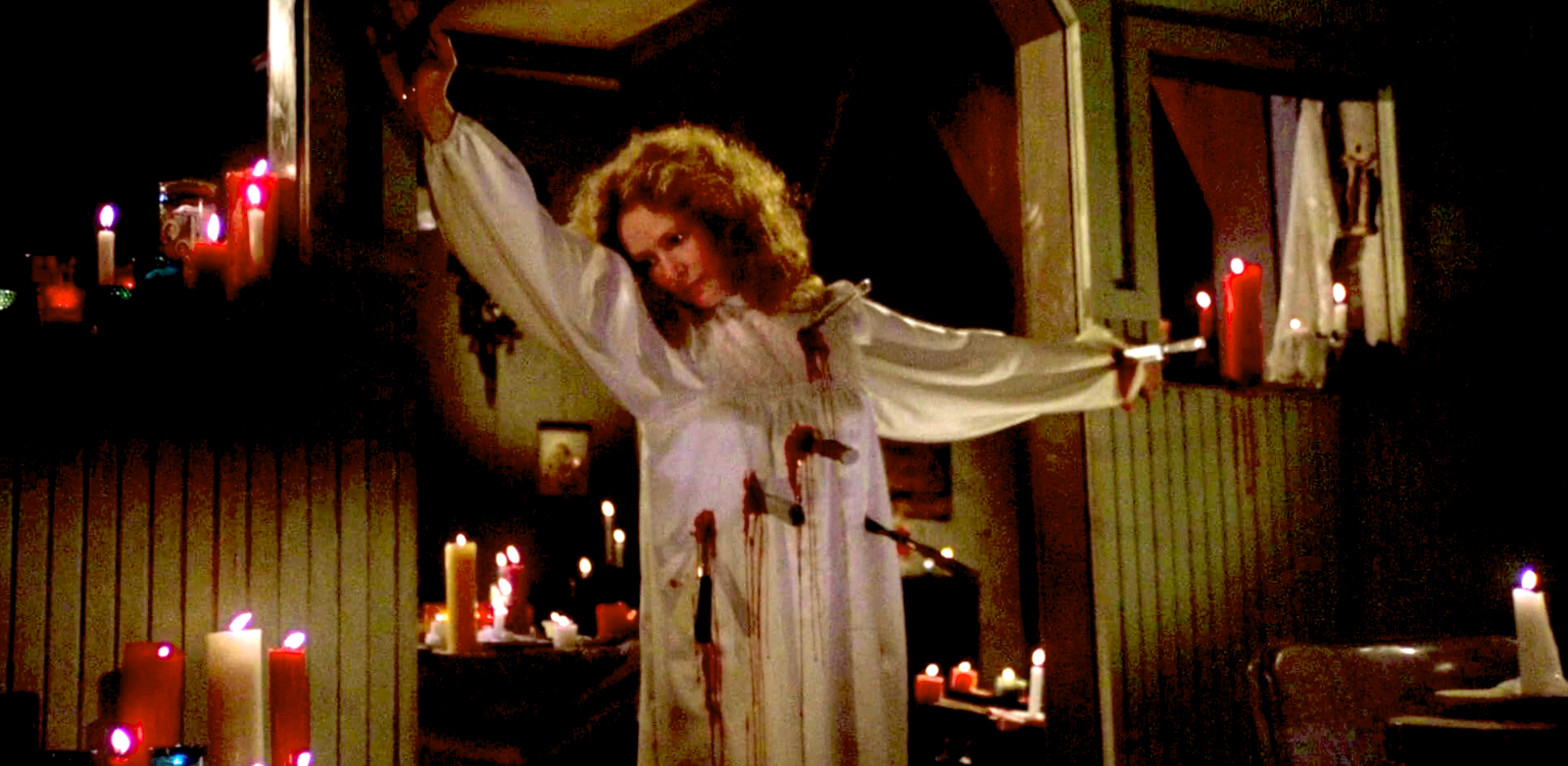
Laurie, who left a fifteen-year retirement to do this role, is a revelation as Margaret. Her performance is big, but it’s operatic in its achievement. She’s scary and tragic and funny all at once, the lighting often highlighting the edges of her frizzy hair like an unholy halo. Whether it’s her disturbing orgasmic moans of martyrdom at the film’s conclusion or her descending down the stairs making the sign of the cross with an upraised butcher knife, it’s a tour de force, a brave performance that pays off. Spacek and Laurie deserved their Oscar nominations.
There are abundant cast interviews on the second disc, from multiple time periods, and here are some of the more intriguing tidbits. De Palma told Buckley to actually slap Allen in one scene to get a surprised response, but both actor’s memory of how many takes De Palma asked for vary — Buckley says twelve and Allen says thirty. Ouch. Buckley also looped in the voice for the little boy on a bicycle who yells “Creepy Carrie!” The boy was De Palma’s nephew, Cameron.
P.J. Soles says the full stream from a firehose pointed at her head in the prom sequence burst one of her eardrums. Carrie and Star Wars were cast at the same time, leading to many actors auditioning for both films. Katt remembers doing a scene for Star Wars with Kurt Russell — imagine that combo of Luke and Han. Katt as Tommy also sports what is essentially the hairstyle featured on the ’70s album cover “Frampton Comes Alive!” Also, De Palma and Steven Spielberg both met their future wives from their involvement with Carrie.

Lawrence D. Cohen, who went on to adapt other Stephen King novels such as It and The Tommyknockers, produced a very tight script. He eliminated the epistolary nature of the novel and streamlined the story, keeping the plot relentlessly moving forward but retaining vibrant character detail. He points out in an interview that De Palma’s inspirations for Margaret’s memorable death scene (matching the St. Sebastian statue in Carrie’s closet) was Kurosawa’s Throne of Blood, and the final jump scare was the end of Deliverance. Cohen also talks about creating the musical of Carrie, which was an infamous Broadway flop but later found success in many high school and college productions.
De Palma proved to be an ingenious choice for directing Carrie, and his mastery of cinematic tools were put to superb use. His split diopter shots feel seamless, his camera moves are elegant, and his use of high and low angles support the emotional states of the characters. Editor Paul Hirsch comments that he found the split screen sequences difficult to edit, and even De Palma admits that the technique is too intellectual. To me, his shot of Carrie covered in blood on the prom stage as fire flows upwards to create a wall of flame behind her is the most stunning visual image in the movie, but as a piece of filmmaking, another scene is even more impressive.
The long one-shot sequence during the prom that begins with PJ Soles’ character collecting ballots and ends with an overhead shot of the bucket of blood poised above Carrie is not just worthy of admiration due to its difficulty. Its accomplishment is that it reveals the motivations of multiple characters entirely through visual language and no dialogue — the setup to the biggest moment in the movie is brilliantly done using the tools of silent film. It’s pure cinema.
Terry Morgan’s full series of Trailers From Hell articles are peruse-able at his TFH ‘Watching the Dark’ Archive.

Peter Travers’s review of the Melania Trump documentary said something like “I would rather attend Carrie’s prom than have to sit through Melania again!”
That sounds like a good call.