


Hollywood went political for a number of projects in the early 1970s, often due to contracts with European producers and directors like Costa-Gavras and Gillo Pontecorvo. Sometimes they ended up with movies that ‘needed adjustments’ for the American market, i.e., political censorship. Even Sergio Leone’s Duck You Sucker, when first shown by United Artists, was shorn of bits of dialogue linking American investors to revolution in Mexico.
Added to this list might be Oliver Stone’s much later JFK, which helped ignite the cultural notion that everything in history and on the news is a big conspiracy by a hidden deep state which sold us down the river so long ago that everything is hopeless. Despite howls of protest from an elected official or two Hollywood went nuts over JFK, because controvery sells tickets, and ticket sales rule.
A few years before, Universal saw Alex Cox as a potential winner due to his cult hits Repo Man and Sid and Nancy, and bankrolled his next picture, Walker. The studio supported Cox’s flagrant assault on the Reagan administration only until the hate mail started coming in. Filmed in Nicaragua during the Contra war in open support of the leftist Sandinista government, Walker had but a brief life on the big screen.

The argument that politics don’t make for good entertainment is usually reserved for films critical to the status quo. The audacious, often wickedly funny Walker looks at an early chapter in an ugly history of Yankee adventurism south of the border. Long before the U.S. Marines got involved, the freebooting soldier of fortune William Walker repeatedly invaded Central American countries, and in 1855 succeeded in making Nicaragua into his personal fiefdom. The word filibuster, from the Spanish filibustero, was originally a military term. Look up the word and you’ll see it immediately applied to, who else, William Walker.
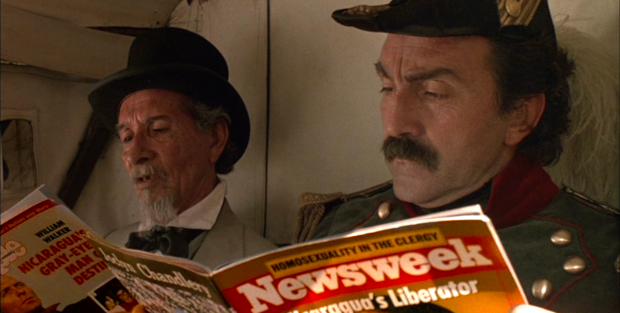
Fans of Sergio Leone movies may not know that there was a strong vein of ‘committed’ Italo westerns that dispensed anti-Capitalist and often Anti-American themes along with their double-crosses and bloody shootouts. Alex Cox’s bloody black comedy Walker channels motifs from these left-leaning spaghettis and imagery from Sam Peckinpah epics. The story is somewhat historically authentic until Cox leaps into New Wave Mode, introducing all manner of weird & funny anachronisms. Some of these sneak up on the viewer. When issues of People and Newsweek appear in 1856 with color pictures of William Walker smiling on the cover, it’s clear that Cox is really talking about the here and now. As portrayed by Ed Harris, the charismatic but rigid Walker lectures that it is America’s duty to use force to bring Democracy to barbaric lands, and then checks his digital watch to see what time it is. Manifest Destiny lives, and it isn’t pretty.
It’s 1853, well before America’s War Between the States. The would-be conqueror William Walker (Ed Harris) flees Mexico after a failed attempt to incite an armed insurrection. Due to popular support for his beliefs about spreading ‘Americanism’ to other countries, Walker is acquitted of legal wrongdoing. His plans to marry and publish a newspaper end when his sweetheart Ellen Martin (Marlee Matlin) dies of cholera. Walker then accepts an offer from millionaire Cornelius Vanderbilt (Peter Boyle). ‘Commodore’ Vanderbilt sends Walker with sixty mercenaries to overthrow Nicaragua, to secure for Vanderbilt an exclusive overland shipping route between the Atlantic and Pacific (there is as yet no Panama Canal). Walker’s ragtag brigade sails to Nicaragua and blunders its way into an armed conflict. His losses are so bad that he’s surprised when the battle is declared a victory in hindsight. When the capital falls Walker allows the president to stay in charge, but takes his mistress, Yrena (Blanca Guerra). Incompetent policies and widespread looting inspire a rebellion, so Walker orders the president shot and assumes his place. Becoming delusional about his role in history, Walker revokes Vanderbilt’s license to the overland trade route. Nicaragua and its neighbors unite to rid themselves of the unwelcome gringo dictator.

Alex Cox and screenwriter Rudy Wurlitzer’s Walker directly attacks U.S. policy through broad comedy and absurdist visuals, a cinematic combination that has always played to a select (read: splinter) audience. We’re told that audiences didn’t even notice many of Cox’s dozens of whimsical anachronisms (a favorite: a modern Zippo lighter). Some audiences were only mildly confused when a helicopter suddenly appears in the last scene.
A connoisseur of violent westerns, Cox has a field day with gory battles and slow motion blood spurts a la Sam Peckinpah, over-the-top gunplay that had long before lapsed into self-parody. The assassinations and executions eventually lead to authentic Nicaraguan news film of Contra victims being washed for burial. Walker dares to be unpopular and it doesn’t hold back. It sees the Nicaraguan war as a sick joke that Americans don’t want to hear.
Star Ed Harris was a sterling John Glenn in The Right Stuff, still his best-remembered role. He’s equally convincing as the psychotic William Walker, a Yankee Who Would Be King. Too obsessed with his destiny to formulate a strategy, Walker attacks blindly, drifting through his battles incapable of giving a coherent order. He spouts idealistic rhetoric while his men rape and pillage. He metes out draconian punishments like a good Puritan: “One must act with severity or perish.” But Walker is easily seduced by the beautiful Yrena, who insults him in tender Spanish and dominates him in bed. Living in a delusional state of mind, Walker betrays his corrupt American sponsor and decides to introduce slavery to Nicaragua. Although the real William Walker escaped to attempt yet another mercenary invasion, Alex Cox ends his tale of the mad conqueror with a stylized mini-apocalypse. Upset that his plans have gone astray, Walker burns his own capital city Granada, simply out of spite.

Cox and Wurlitzer populate their political farce with a gallery of oddball performances. William Walker’s mercenary ‘Immortals’ are given funny costumes and quirky personalities, as if the bounty hunters of The Wild Bunch were crossed with Captain Hook’s pirate crew. Joe Strummer of The Clash plays a small part in addition to composing the film’s score. Extras were recruited from pro-Sandinista Americans found in Managua, while key roles were filled by actors willing to work in a war zone. Rene Auberjonois is a goofy German sea captain: “I studied strategy under Lubitsch!” Peter Boyle and Richard Masur have only a couple of scenes each as the power-mad Vanderbilt and his key henchman. The under-used Marlee Matlin is Walker’s deaf-mute fiancée. Her scenes with Harris form a wonderful parody of movies about ‘Great Men’ dealing with petty domestic issues: Matlin’s Ellen gestures at the guns and gear strewn about her New Orleans house and tells her sweetheart to clear it all out, or else. Do all aspiring empire-builders suffer this lack of support at home?
Cornelius Vanderbilt offered free steamship passage for anyone seeking a future in the new Nicaragua, clearly wishing to transform the country into an American colony. Thus arrive Walker’s no-account brothers (Gerrit Graham and William O’Leary) looking for a free ride in the new tropical kingdom. One volunteers to head the treasury while the other imitates Walker’s dress and becomes his loyal bodyguard. The show has no lack of colorful characters — Vanderbilt’s minions, various Nicaraguan and Costa Rican friends and foes, and Walker’s own Immortals. At times the cutthroats in funny costumes are indulged a bit more than they should be, and some of their hijinks would fit better in a pirate movie. The build-up to ‘Walker’s Apocalypse’ is perhaps also a bit much, but it’s never dull.

Ed Harris cuts a fine figure, posing as if for his own stature. He strides through his own burning capital, leading little parades going nowhere. He’s a self-hypnotized ‘great man’ who thinks that if he takes himself seriously enough, others will.
The movie abounds with freaked-out details. One shot reveals Walker and his Immortals as the subjects of a parody of the painting The Last Supper. Serving as a surgeon, Walker pauses during an operation to laugh, and taste a piece of something he cuts out of his patient. Pitched battles are scored with Latin Jazz, and the Immortals perform Shakespeare on the steps of Walker’s half-built opera house. A surreal C.I.A. agent arrives to evacuate Walker’s men, but only accepts those with American passports.
Walker’s Gonzo approach found few friends among critics. The film was labeled as propaganda and largely ignored by an America satisfied with the vision of Central America presented on the network news. Seen in today’s political climate, William Walker’s rhetoric about America’s duty to spread Freedom through force sounds like contemporary speechmaking — an anachronism in reverse.

