
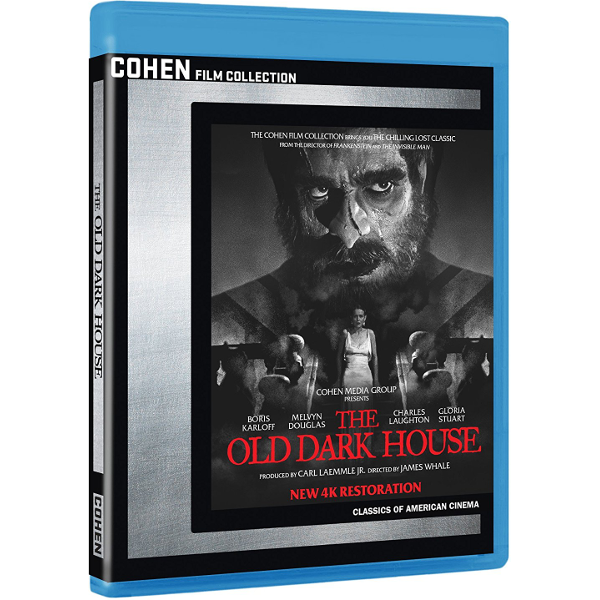

I suppose fans of horror films will forever hope that some pristine copy of the lost 1927 London After Midnight will someday appear. As unlikely as that seems, it’s not impossible considering the numerous remarkable cinematic finds made in just the last few years. We know the story of how James Whale fan and friend Curtis Harrington made a personal crusade out of preserving Whale’s original, mostly forgotten 1932 The Old Dark House. The movie had never been part of Universal’s Shock or Son of Shock TV syndication packages — the studio’s rights expired in 1957, years before Columbia’s comedy remake starring Tom Poston. As Universal could no longer market the picture, it might conceivably have been destroyed just to make space in a vault. Without an intervention the original film elements would have soon crumbled to dust.
Even though prints had been made for several archives, The Old Dark House couldn’t be reissued or licensed to Television. We read about it in early genre books by Carlos Clarens and Ivan Butler, and marveled at the still photos of the baleful makeup of Boris Karloff in Famous Monsters. The actor was already being billed on posters simply as ‘Karloff’. The stellar cast promised something different as well — Charles Laughton and Ernest Thesiger would surely be choice hams for James Whale’s crazy, pre- camp sense of humor.
When VHS and DVD tapes did show up, the quality was so poor that we had to strain to see facial expressions and to hear the dialogue. I watched a few minutes and gave up — one couldn’t tell whether things were supposed to be funny or serious.
The Cohen Group handles the Raymond Rohauer collection of films, which has come to encompass a number of great rarities. Cohen’s releases include sterling copies of the silent greats Intolerance and The Thief of Baghdad, as well as an uncut Hangmen Also Die! The disc lists a 1932 Universal Studios copyright. Cohen’s first press release said that Universal was working with them on the restoration, even though it would appear that their rights lapsed ages ago. We lucky folk marooned out here in 2017 don’t really care about the details, as the almost absurdly well-preserved version of The Old Dark House is a wonderful new horror discovery.

Haunted house movies of the 1920s were often spinoffs from Broadway mystery-comedies, the kind where relatives gather to hear the reading of a will. Almost always, a murderer is trying to make his killings look like a supernatural curse. J.B. Priestley’s original novel from 1929 pares away the theatrical hoo-haw to unearth the basic notion that Horror Is A Family. It’s an idea for misanthropes, that families are collections of incompatible people bound together by a ‘curse,’ mainly the fact that they’re related by unbreakable blood bonds. Add some money, class distinctions, resentments, and maybe a little madness, and some pretty screwy things are possible. It’s not a difficult stretch to see that the unpleasant Femm family isn’t all that far removed from the clan of unemployed butchers on that ugly property with the yard decorated with animal bones.
Thanks to the success of his Frankenstein James Whale had carte blanche to make Priestley’s book (original title Benighted) into a fright comedy in his eccentric personal style. Much of the humor that one thinks would be a James Whale touch is already in the book, although the movie is definitely lighter and more comic overall. Whale had a pre-Black Comedy attitude, a refined fussiness that some modern critics have codified as a gay sensibility. He was able to further refine this giddy weirdness in The Invisible Man and especially his masterpiece The Bride of Frankenstein. Whale did excellent work away from horror material. His masterful musical Show Boat was a giant hit, but the studio’s financing was in such bad shape that the Laemmle regime at Universal came to an abrupt end, and with it Whale’s artistic freedom.

The married Wavertons Philip and Margaret (Raymond Massey & Gloria Stuart) are pretty chipper considering that they are caught on a Welsh road on a dangerous ‘dark and stormy night. Their carefree friend Penderel (Melvyn Douglas) makes light of the mudslide that almost wipes them out, and they’re still cheerful when they seek shelter at the enormous stone house of the Femms. The baleful butler Morgan (Boris Karloff) can barely speak and has an enormous scar cleaving his face. The nasty Rebecca Femm (Eva Moore) is all but deaf, and keeps telling them that they can have no beds for the night. She demonstrates her distaste by pawing Margaret’s elegant silk dress and proclaiming that both it and the pretty girl inside will someday rot. Rebecca Femm’s brother Horace (Ernest Thesiger) is a prissy scarecrow with cheerfully condescending manners. The visitors take what comfort they can and are grateful for a meal. Also stranded on the road are the blustery industrialist Sir William Porterhouse (Charles Laughton) and his companion Gladys (Lilian Bond), a showgirl whose peppy manner really sets Rebecca Femm on edge. Things never get a chance to settle down. Morgan menaces Margaret at every opportunity. Penderel and Gladys exit to the barn to get to know one another better. The cowardly Horace retreats to his room, leaving Philip and Margaret to visit the ancient Sir Roderick Femm (billed as John Dudgeon but actually played by Elspeth Dudgeon, an actress). Morgan gets drunk in the kitchen and sets his mind on freeing Saul Femm (Brember Wills), an unpredictable maniac kept locked in an attic. We’re told that Saul has previously tried to burn the house down, and that only the brute Morgan can keep him under control.

The Old Dark House is eccentric and weird in a way that surely inspired the cartoonist Charles Addams — Karloff’s Morgan is undoubtedly an influence on Addams’ goonish butler, Lurch. Whale has absurd fun with every aspect of the spooky house genre, even as he refuses to fall into the usual dinner-theater traps. Despite production stills to the contrary, no spooky hands reach out to clutch the naked shoulders of lovely Gloria Stuart. Morgan’s interest in her ‘soft white flesh’ is much more direct.
The storm is nothing to sniff at, with the touring car sludging through a real muddy torrent. The subjective traveling shot entering the Femm compound is an impressive miniature. The wind howls and the rain blasts everyone. When Margaret gets out of her ‘wet things’ she puts on a sheer silk dress that wouldn’t keep anyone warm — is that supposed to in itself be a joke on the genre? Whale told Stuart that he wanted her to look like ‘a white flame’ when chased around. Just looking at Margaret gives us chills, even though the Femms have a roaring fire going.

The joy is in the ensemble acting and the rich characterizations. Margaret and Philip are the straight couple, but everybody else seems lost in eccentricity. The supposed hero Penderel is identified as a WW1 survivor whose refusal to take anything seriously may just be his bright personality, or an unhealthy reaction to combat. Charles Laughton is an animated presence, but he’s either not ready to steal attention, or Whale kept him in line; compared to his performances in The Devil and the Deep and Island of Lost Souls Laughton is almost subdued. Maybe that’s because the script doesn’t give him much do – we merely hear about his tragic marriage, and his use of Gladys as an asexual companion. Porterhouse’s situation is barely touched upon. We wonder if, with a bit more information, it might yield a gay subtext as well.
James Whale is clearly tickled by Ernest Thesiger’s perfectly modulated clowning, and missed no opportunity to help the actor develop nonsensical bits of business. Horace Femm is so solicitously creepy, he’s hilarious just standing with his hands folded. Melvyn Douglas’s Penderel has great reactions to Horace’s batty behavior, generating mirth even without obvious jokes or comedy business. It’s a cumulative effect. Just the way Horace sniffs a gin bottle causes giggles, and there’s of course the oft-quoted dialogue when a bowl of potatoes is handed around the table.

It’s hard to say that The Old Dark House goes anywhere in particular, but the getting there is highly entertaining. When Penderel and Gladys become cozy and start making plans, we wonder if Sir Porterhouse will object. Although Morgan serves a fine meal, he’s soon thrashing about as if he wants to tear the house down. But don’t expect a strong finish, or even a particularly violent one. The visits to the upstairs rooms raise shivers, although Sir Roderick’s bedroom seems downright pleasant compared to the rest of the house.
What really gets us is James Whale’s excellent direction. His camera angles and cutting always take us by surprise, showing things from unexpected directions and often cutting before we expect a cut. There are no stage waits or ‘dissolves to a little later.’ As in a stage play everything is happening Now and attention must be paid.
The visual highlights make a big impression. Rebecca Femm’s semi-religious rant to frighten Margaret is delivered in a series of strange matched cuts, which show the woman through distorting glass and warped mirrors. The jarring effect gets on Margaret’s nerves when she looks at herself in the same mirrors. Top-billed Boris Karloff is again at a loss, without an opportunity to use his vocal talents. Karloff underplays Morgan’s drunkeness, leaving his menace to be suggested by Whale’s alarming flash-cuts to disturbing details — the deep scar across his nose, the drooping eyelid, the permanent scowl. Whale pops three cuts together, less than a second each, and the effect is like a slap to our faces. A fight between Morgan and Penderel is a sloppy mess, and a chill sets in when the imprisoned Saul turns out to be a different kind of menace than we feared.
(The ever-informed Gary Teetzel reports that in Priestley’s book, Saul is an enormous brute that only Morgan can handle. As was his habit, Whale drops that idea for something unexpected.)
The Old Dark House is an odd duck in the classic Universal horrors of the early ’30s. There’s no supernatural element at work, and most of the creepiness erupts out of social awkwardness, or maybe the cumulative spell of less artful haunted house movies. Style, directorial skill and stellar performances make it a don’t-miss hybrid horror classic.
