


It’s been 25 years since the European film explosion that came with the advent of DVD; as the format surged in popularity, interest in entire decades of continental genre filmmaking went up as well. We were finally able to see uncut versions of Italian and French horror items that had been censored, poorly dubbed, or simply never made available at all. Blu-ray and now 4K have seen restorations of exotic horror that look just as good as what audiences in Rome and Paris saw when they were knew, great movies by Riccardo Freda, Mario Bava, Antonio Margheriti, Giorgio Ferroni, Victor Trivas.

Videodiscs have also popularized the films of more marginal directors like the Spaniard Jesús Franco and Frenchmen Alain Robbe-Grillet and Jean Rollin. An early issue of Cinefantastique had carried an article on the first three or four Rollin features, accompanied by stills showing Rollin’s nude vampire women posed in boudoirs and dungeons, soft-core material in line with the morbid-erotic imagery catalogued in Ornella Volta’s 1962 erotic art book Le vampire: La mort. Le sang. La peur. → Rollin hung bat emblems on his unclad vampire women and posed them on a misty beach, and offered little more in horror content or atmosphere. The combination of skin flick thrills and morbid themes was a hit in the out-of-the-way Parisian theaters that catered to horror.
Jean Rollin shot his films on a shoestring. He would later turn to directing porn under pseudonyms, with titles like Sexual Vibrations and Sweet Penetrations. Frustrated with the direction his initial erotic horrors were taking, in 1973 he tried a more poetic approach with The Iron Rose (La rose de fer), a micro-budgeted effort filmed almost entirely in an atmospheric graveyard. The film is special in Rollin’s work because it shows him pushing in a less exploitative direction. As Tim Lucas shows us in his commentary, Rollin was motivated by the morbid poetry of Tristan Corbière. This show aims at the confluence of love, sex and death. To star, he found Françoise Pascal, a noted young actress who took an interest in his erotic theme.

In a crumbling provincial town, a young would-be poet (Hugues Quester) and a mildly adventurous student (Françoise Pascal) meet at a wedding and arrange for a bicycle picnic the next day. They find themselves at the local cemetery, which would appear to have possibilities as a quiet place for making out. The two break into a crypt and make love on a pile of bones. They discover that night has fallen and cannot find their way back to the cemetery entrance. Stumbling lost among the spooky headstones, ‘The Girl’ first loses her nerve and then her grip on sanity. Feeling a kinship with the dead around her, she seizes upon the idea of joining them in eternal rest.
We’re young. We’re in love. Let’s die together.
Some Corbière is quoted in The Iron Rose, a picture that takes a direct route to its fantastic theme. Young lovers ‘discovering’ sex sometimes get the delirious romantic-morbid idea that the next logical step would be to consummate the act by dying. Rollin’s actors energize some of that weirdness up to a point. But he can’t resist introducing inane surreal clichés, as when a circus clown enters the cemetery in full costume, to lay flowers on a tomb. But the basic appeal of his premise is mostly uncluttered by extraneous content.
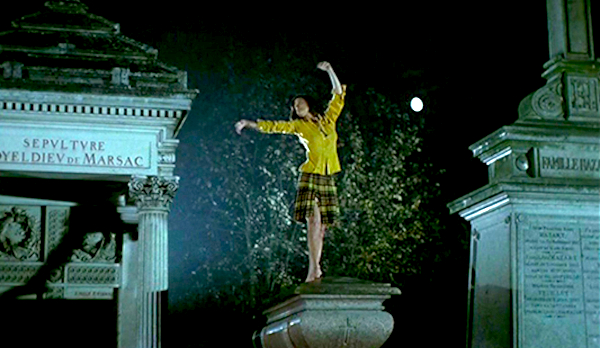
Rollin never demanded much from his actresses. They disrobe and take straight direction as to how to pose with blank expressions. Most scenes would work better as softcore erotic still photography. The Iron Rose’s model-actress Françoise Pascal clearly believes in her character. She does her best to express ‘The Girl’s’ shift from carefree abandon to claustrophobic panic, and eventually to a weird embrace of a morbid destiny. Ms. Pascal and Rollin aren’t always consistent with this — every once in a while an inappropriate ‘blank smile’ comes through. But we remain interested by The Girl’s ordeal. We know that she is a dancer, and she expresses herself with delirious dance moves among the tombstones. ↑
The movie doesn’t build on its situation, but it does offer an interesting statement when The Girl’s mortal terror morphs into commitment to an eerie doom. The young poet isn’t given much attention, and Rollin really has no cinematic plan to show The Girl taken over by an erotic death wish. He doesn’t stage-direct her transformation. But Françoise Pascal’s committed performance gets us more than halfway to that goal, which in a Jean Rollin film is a major achievement.
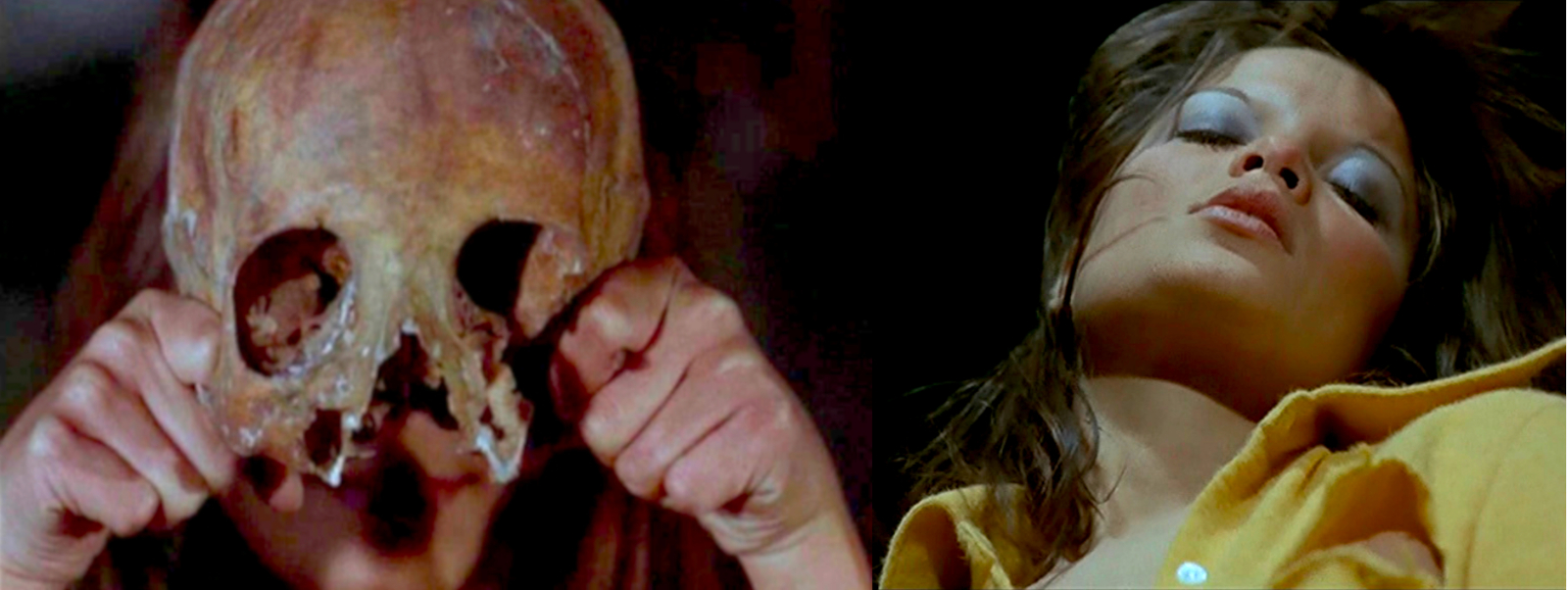
Perhaps The Iron Rose would have fared better as a short subject, like Robert Enrico’s adaptation of Ambrose Bierce’s An Occurrence a Owl Creek Bridge. We admire Rollin’s aims in this picture. Although his heart is in the right place, he doesn’t seem to be the man for the job.
Sustaining this sort of story takes more talent and resourcefulness than the norm, not less. The film deserves praise for being more than merely watchable. The Boy and The Girl are more generic types than specific people, a variation on kids in an exploitation movie looking for a place to share casual sex. Even with the poetic pretensions, Rollin has no tricks up his sleeve beyond contrasting the frightened and confused couple with their surroundings, cold tombs, grave markers and religious statues. Rollin doesn’t go for formal compositions, so his visuals don’t have the artful grace of Georges Franju … if he was after an improvisational, New Waveish looseness, he achieves it.
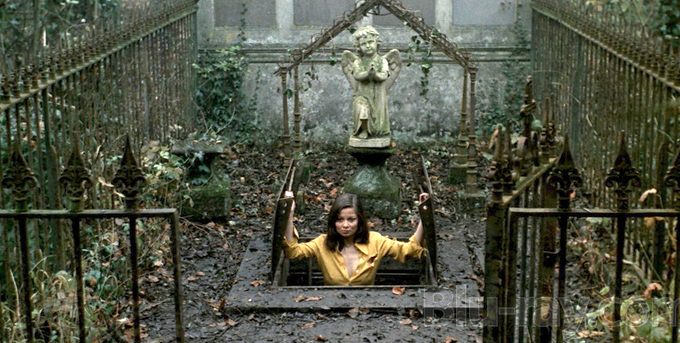
But many will find his visuals to be random, catch-as-catch-can. The main ‘crypt’ that the lovers invade is some kind of iron access door to who-knows-what, not anything that matches the graveyard around it. When The Girl closes its heavy cover, we’re not reminded of a portal to eternity, but the folding doors of a New York-style sidewalk freight elevator. ↓
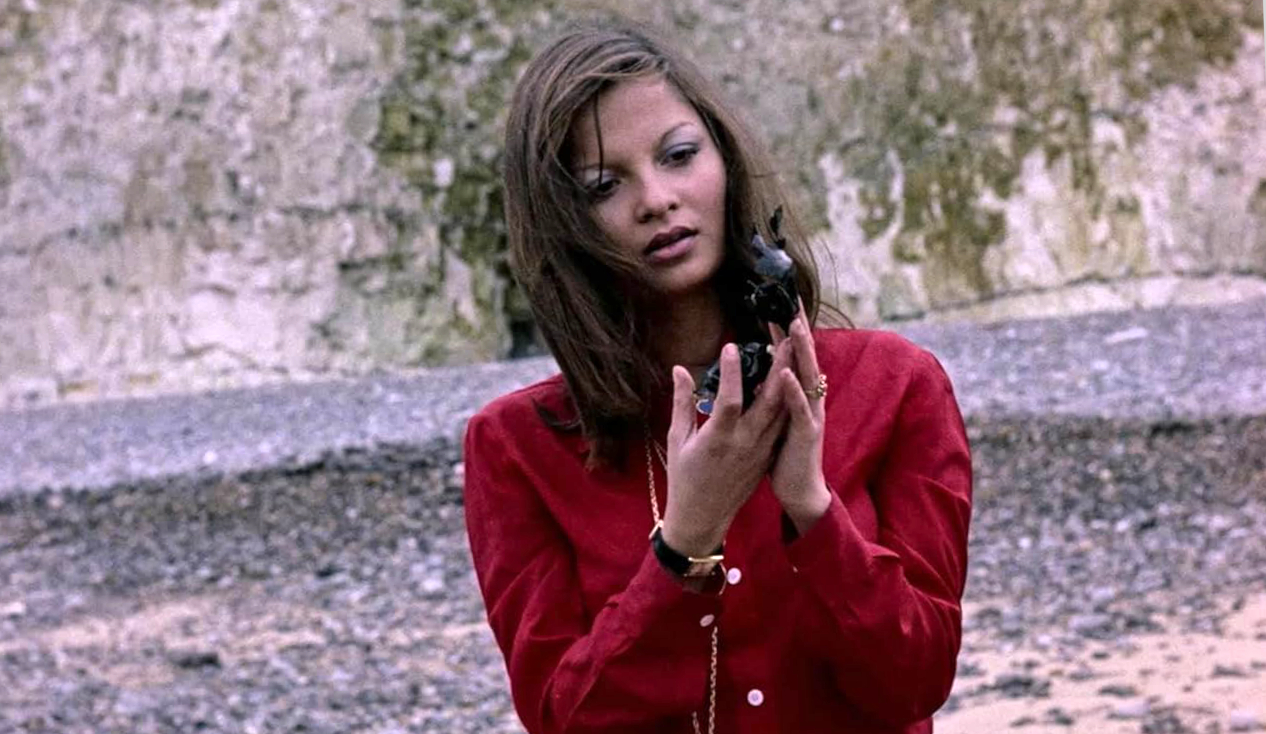
The Girl is possessed by a glass rose, which mirrors an iron rose decoration she found washed ashore on a beach in a prologue. It is of course the same beach that shows up in many of Rollin’s films, the one with a line of rotting pilings. The presence of the little iron sculpture would seem to trigger her delirium, although Rollin doesn’t push the point. Frankly, our thoughts run to wondering just how cold or warm that overcast beach could be — a prime qualification for a Rollin actress could well have been a knack for getting naked in chilly conditions. The nude Ms. Pascal drifts dreamily across the sand, without making ‘the shiver of the vampires’ a literal effect.
At about the one hour mark, The Girl finally loses her marbles and starts working against their escape from the cemetery. Ms. Pascal literally saves the movie by making this transition work, without much in the way of help from Rollin’s camera.
The Iron Rose is the one Jean Rollin feature that encouraged a second viewing. It wasn’t a box office success. As Tim Lucas says, its failure seems to have precipitated the director’s sideways shift into adult porn.

It must have been a warm night in the graveyard, for The Girl never seems chilled, even when her shirt is (strategically) torn. But the day looked cold and stripping for sex seems highly unlikely. Rollin laid tracks for trucking shots in the graveyard, shots that fail to convince us that the kids couldn’t find their way out. The Boy says he can’t find the pathways and chooses to cut through the crowded graves. But the marked paths are perfectly visible in many shots. Rollin’s choice of angles doesn’t help the graveyard feel more claustrophobic or threatening — older expressive means of racheting up the psychological tension are not employed. The Girl’s mental implosion comes off as spontaneous: ‘lock me up, and I go crazy.’ At one point The Boy can hear traffic on the road, but The Girl is already making plans to take up residence in the ice-cold tomb.
Rollin may have been consciously avoiding the trappings of old haunted graveyard movies, and there’s nothing wrong with trying an alternative to older gothic effects, as taken to the limit by directors like Abel Gance and Robert Wise. Isn’t an aim of genre to develop new approaches to subject matter? Just the same, our attention wanders to filmic predecessors that made us feel the chill of a haunted crypt. Fritz Lang’s Destiny contains an unforgettable tomb filled with hundreds of candles representing human lives. The building has no doorway until the Death figure opens it to admit a tearful woman. We also think of the creepy cemetery map in the near-miss horror picture I Bury the Living, with its delirious montages set to Gerald Fried’s pounding music score.
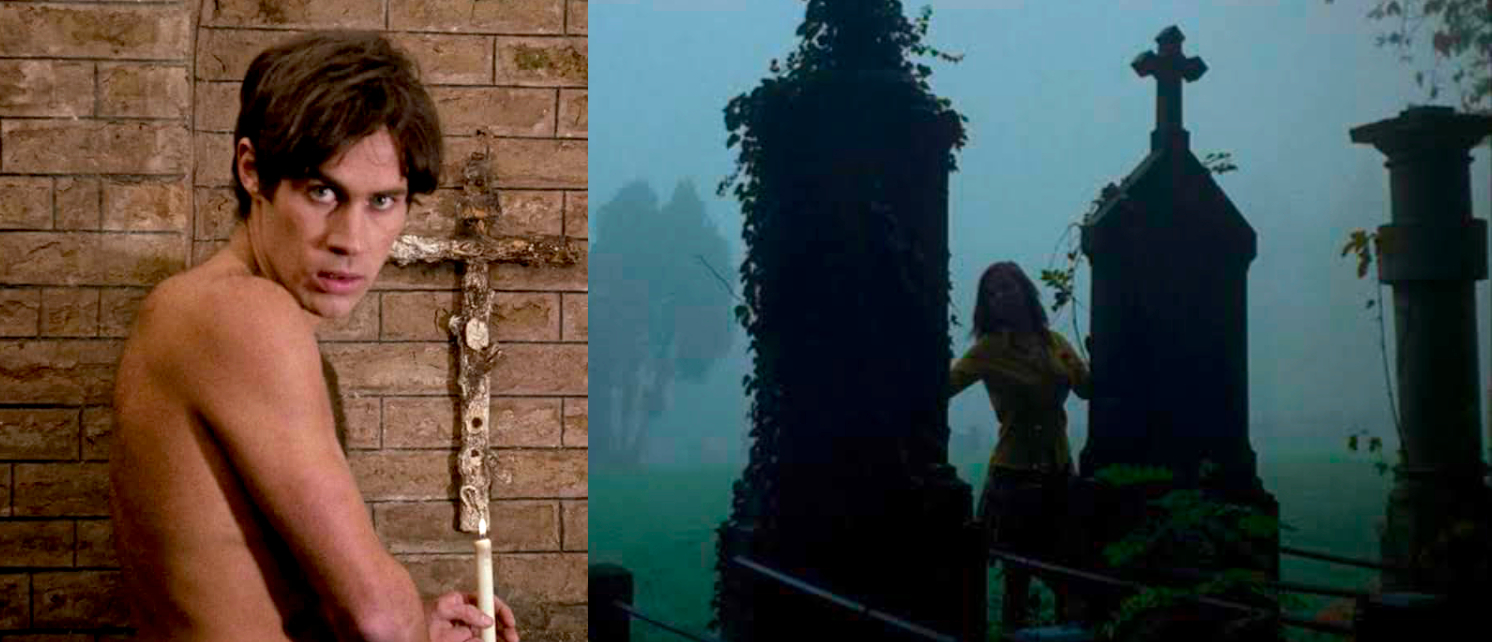
Morbid poetry? It just doesn’t sell.
A movie with New Wave DNA that has a somewhat similar theme is François Truffaut’s The Green Room, taken from a story by Henry James. A man becomes obsessed with a personalized tomb to his beloved dead; his fixation on the project negates a possible relationship with a woman who loves him. The Green Room didn’t find an audience anymore than did Jean Rollin’s The Iron Rose. His crowd wanted more nude vampires on Gothic stone stairways.
Made the same year, Mario Bava’s hypnotic Lisa and the Devil has no haunted graveyard, but it ‘goes all the way’ with the notion of a romantic death wish combined with necrophilia. Elke Sommer has a sexual rapture atop a pile of moldering bridal flowers … next to a rotting corpse. The magic is that Bava makes gives the spectacle an eerie beauty. His film was also commercially rejected, and later subjected to a re-edit that reshaped it into a crass Exorcist rip-off.
Rollin’s direction relies on proven erotic content. The Girl spends the entire day in a sheer blouse that attracts more attention than anything else that’s going on. The sex scene is restrained and not particularly exploitative. Yet, apparently concerned that his audience might become bored, Rollin has The Girl’s top get torn, so that her breast is visible in some scenes. As is so often the case with women in horror films, Ms. Pascal’s commitment to her role is what holds our interest. The rest is bare-bones symbolist filmmaking. As more poetic words are spoken, we cut to the beach again, where The Girl appears and overturns severak iron grave markers, perhaps to express the triumph of death over life. Or are we really still thinking along poetic lines?
Seen it. Neat one.
Having just recently watched “The Iron Rose”, I think it’s a valiant effort on Jean Rollin’s part that he was willing to make a feature that didn’t involve vampires, but I tend to agree the results fall short. The concept certainly would’ve worked better as a 30-minute student short film, as it’s certainly not enough to sustain 80 minutes or more. Part of the issue, for myself, is that the cemetery is supposed to be a “threat” towards the two main characters, but nothing is done visually to make it come off as a such: the night cinematography is well executed, but every shot feels languid and locked-down static framing. If any, Rollin should’ve taken a cue from George Romero and thrown in some zombies to give the main characters some menace (though, Rollin certainly must’ve kept Romero on his mind when he later made “The Grapes of Death” some years afterwards!). Rollin lucked out on having Françoise Pascal in this as she carries her role quite well, but Hugues Quester is a major weak-link: his lanky looks and somewhat disinterested performance makes him come off as being a stereotypical lazy French “poet” (bah!). The other issue is that “The Iron Rose” is still no different cinematically than any other movie from Rollin or any other French horror movie from that era: it all looks as if it were filmed by a bored observer, which is why the Italian gothics still have a much stronger fanbase as they are better shot and edited with far more zeal than what the French filmmakers were doing (excluding Georges Franju, of course; at least he put in the effort). Rollin certainly sticks to his guns on this one, but I cannot help but believe that by doing that he put himself into a tight spot with a movie that had no commercial purposes whatsoever, but then putting in such brief moments such as a sad clown visting a gravesite and a hunchbacked homeless man (played by Rollin himself, no less!) as if to say “I’m still the same guy that made ‘The Shiver of Vampires’ and ‘The Nude Vampires’: I HAVEN’T CHANGED!!!” Indeed, “The Iron Rose” is Jean Rollin’s folley, but its an interesting folly just the same.