
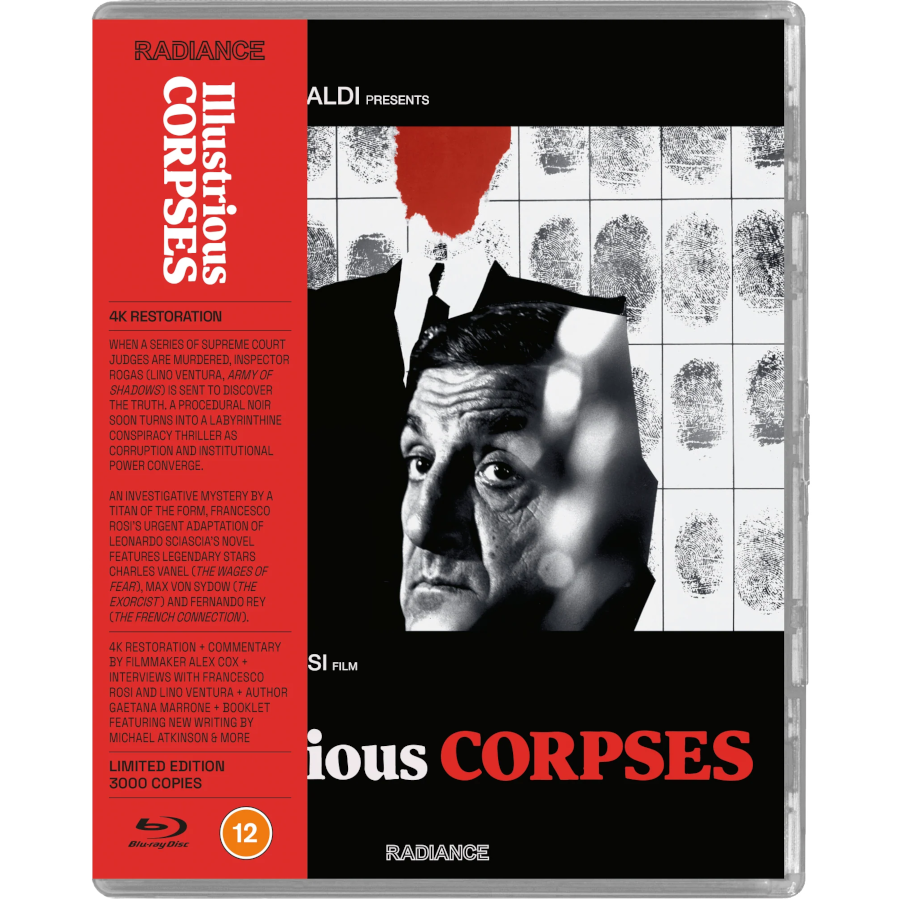

Radiance Films continues its steady flow of challenging European cinema. Director Francesco Rosi focused so tightly on the state of Italy past, present and future that only a few of his politically committed movies connected in the U.S.. His most notable success may have been the highly emotional Christ Stopped at Eboli. Years earlier, Rosi’s Salvatore Giuliano took a scathing look at the intersection of brigandry, liberation warfare and American betrayal in wartime Sicily. And the searing Hands over the City indicted all of Naples for normalizing corruption that prevented anything like decent public planning.

A masterpiece of social disfunction.
Rosi’s Illustrious Corpses would seem an Italian art-film extension of the 1970s spate of paranoid conspiracy thriller, as epitomized by Alan J. Pakula’s chilling The Parallax View. Sourced in the Kennedy assassinations and Watergate, the subgenre really began ten years earlier with John Frankenheimer’s The Manchurian Candidate and Seven Days in May.
In the middle ’70s the notion of a secret government conspiracy was still considered idle conjecture, grist for divisive rumor mills. Rosi’s fictitious thriller seems altogether credible, as Italy was then in the grip of outrageous political crimes of every stripe: kidnappings, murders, large-scale anarchist banditry. Much of it was committed by criminal opportunists making use of media headlines and TV coverage.

As pointed out by audio commentator Alex Cox, the film never verbally identifies the country on view, although what we see is obviously Italy. When ‘Rome’ is mentioned in the English subtitles, the actual Italian dialogue just says, ‘the big city.’ However, we note that a giant map of Sicily is prominently displayed in one scene.
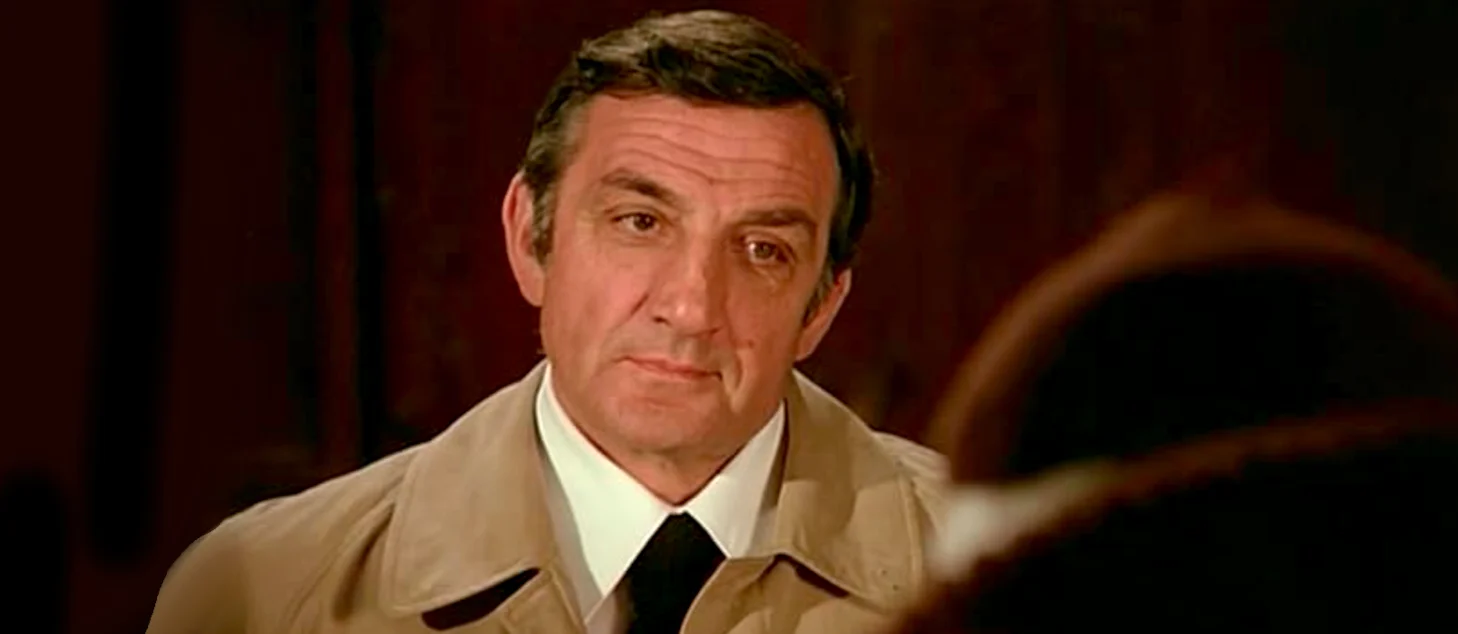
The pressure is on: Police Inspector Amerigo Rogas (Eurocrime star Lino Ventura) is tasked with solving the murder of an elderly magistrate, Procurator Varga (Charles Vanel of The Wages of Fear). When two more judges are shot dead in quick succession, the Security Minister (Fernando Rey of Belle de Jour) and the Chief of Police (Tino Carraro of Orgasmo) threaten Rogas’ job unless he gets results. They offer no support, just disapproval that Rogas won’t agree with them that ‘leftist radicals’ are responsible. Rogas looks for suspects that had a reason to hate the judges. He receives little or no cooperation from the public, which fears and distrusts all official authority. At Varga’s funeral, a blowhard orator (Corrado Gaipa) blames ‘the Mafia.’ In response, a crowd of students chants that he is the Mafia.

Rogas must take public transport to interview witnesses, while an elite group of government and military officials move around in chauffeured cars, on undisclosed business with some of the same people. A white car belonging to one of Rogas’ superiors is seen leaving the scene of a killing, but the testimony from a bystander and a prostitute (Tina Aumont) is contradictory. The police continue to round up random student demonstrators as suspects. Rogas predicts who the next two victims will be, but is told they are already ‘protected.’ He catches the Chief of Police lying about a visit to a person of interest in the case, but can do nothing.
Doctor Maxia (Paolo Bonacelli of Salo) shows Rogas the apartment of the missing suspect ‘Mr. Cres,’ and Rogas finds that all images of the man have been erased, even from Cres’s police fingerprint card. Hoping to locate this mystery man, Rogas slips into a party, where a well-known leftist celebrity accuses him of persecution. The Security Minister is hobnobbing with the well-to-do Communist elites. The inspector then realizes that his own phone is tapped. Meeting with his publisher friend Galano (Paolo Graziosi), Rogas finally admits that some kind of right-wing plot is afoot. The publisher sets up a secret meeting with the Secretary of the Communist Pary.

The beautifully directed Cadaveri eccellenti is a dark, brooding exercise in political fear. In this Italy/Not Italy, right-wingers and Communists exchange witty insults at swank parties. The one honest cop is met with hostility from all sides. Inspector Rogas is considereda respected professional yet his ordeal is not all that different from that of ‘K’ in Kafka’s The Trial. Ordinary people simply won’t talk, fearing the government as much as they do the Mafia. His two key suspects were once convicted by the judges in question. One threatens violence and the other (Marcel Bozzuffi) refuses to even look at Rogas.
Sort of a companion film to Elio Petri’s Investigation of a Citizen Above Suspicion, Illustrious Corpses paints a startling picture of Italian social dysfunction, where the law functions only for the convenience of a concentrated power elite. The top government men expect loyalty from Rogas but treat him like an annoyance — and perhaps a convenient patsy.

If they could speak, how many would scream, ‘I was murdered!’?
The elderly judges in question all exhibit eccentric, even alarming behaviors. Varga indulges the daily habit of ‘convening’ with mummies in the catacombs under a cathedral. An old priest insists that the rows of skull-faced corpses talk to Vargas. The grotesque mummies are definitely a thematic symbol. Rogas finally manages to interview two top judges, but neither take his warnings seriously. One (Alain Cuny) washes his hands obsessively, as if plagued with a Pontius Pilate complex. The other (Max von Sydow) is a closet fascist who publicly states that the government is failing. He also claims that judges are infallible, like the Pope …. he argues that a Judge’s ‘wrong’ decision is still ‘right,’ the same way that a corrupt Priest is above censure. The priest may be wicked, but the sacraments he dispenses remain pure, inviolable.
The few colleagues that help Rogas are too wary to get involved in ‘political’ issues. A police technician (Renato Salvatori) offers a snippet of audio that might hint of a conspiracy by the Chief, but like everything else, it’s not enough for Rogas to act upon. The authorities deny that any electronic surveillance takes place without a bench warrant, yet the police offices are packed with surveillance technology. Phones are monitored on a vast scale, not just suspects in cases but troublesome political rivals as well. The police chief excuses the practice by saying that the tapes are all destroyed later.
Rosi’s direction is rigorous, clear-headed. Scenes are often composed of two or three camera angles, but the setups are ideal. Long lenses isolate people in the frame and play games with perspective. These telephoto views become disturbing: any of them could suddenly represent a view through a sniper’s gunsight. The foreshortened compositions ‘visually restrict’ Rogas’s maneuverability. The case appears rigged to hide things from him. He’s unaware that other police units are conducting parallel investigations. When Rogas pokes his head into a random room at police headquarters, he interrupts a interrogator threatening a dozen imprisoned students. Either they confess, or they’ll never be released.

Some visual embellishments function almost like special effects. One of the dead judges may have murdered a youthful male companion (did we read that correctly?). When Rogas examines a B&W photo of the two together, we see a live-action version of it, in which the younger man looks very unhappy. After we hear the prostitute’s conflicting testimony about the street shooting, a ‘composite memory’ image of the killing appears, which has all the elements yet proves nothing. Rogas will have to proceed by experience and intuition alone.
In a nice detail, Rogas realizes his phone is bugged when its ringing causes static interference on a nearby portable radio. It is an update of the iconic ‘my phone is tapped’ moment in Abraham Polonsky’s 1948 Force of Evil. The most Kafka-esque visual effect occurs when Rogas thinks he spies the elusive Mr. Cres at a party: a zoom to a dark corner of the large room reveals a suspect face. But the eyes are blurred … Is the image a hallucination, or just a reflection in a flawed mirror?
Rosi makes good use of oppressive architecture. The police technician’s secret audio lab is a rented space in a vast underground bunker suitable for a science fiction setting. ↓ Building exteriors are giant blocks of uncaring glass and steel; some may be from the days of Mussolini. Even museums seem sinister when given this visual treatment. The hostile landscape is either faceless bureaucratic towers or ancient monuments that seem to say ‘nothing has changed in a thousand years.’

In the end the specifics of the conspiracy remain an enigma. Rogas has theorized that his superiors are blaming their all-out slaughter of judges on radical students. As in The Parallax View Rogas is a pawn in a bigger game, manipulated by powers that want no opposition. With their control over news announcements, it’s easy for those in authority to assign false motivations to the actions of men now dead.
Illustrious Corpses is not one of those frustrating excercises in nihilism, where the bad guys win and the truth never comes out. It paints a rich portrait of a society in serious disarray. The Italian-born Lino Ventura is ideal casting, as his established Cop persona is one of unassailable integrity. Rogas is the lone person willing to risk his neck to solve the crime, to find the truth.
That makes Francesco Rosi’s thriller somewhat comparable to Costa-Gavras’ “Z”, in which Jean-Louis Trintignant’s prosecutor has the same mission of chasing down ‘the truth’ for superiors determined to suppress it. Without getting into specific cases Cadaveri eccellenti is a powerful portrait of an Italy in political distress. Today, almost every Western democracy shares at least some of the frightening social-political discord seen in Italy, 1975. At this particular moment in the U.S., Rosi’s ‘fictional’ outrages no longer seem farfetched or fanciful.

Hi Glenn, it would have been nice to provide a visual comparison between the previous KL Blu-ray & the Radiance to note, if any, improvements. The KL is also from a 4K scan & is available inexpensively from Hamiltonbook. Cheers!
Great to have a Region B Blu-Ray of this wonderful film, but the Rosi film I’m really waiting for is The Mattei Affair (1972), restored by Martin Scorsese’s Film Foundation and the Cineteca di Bologna in 2012 but still unavailable as an official English subbed Blu-Ray anywhere due to long-standing rights issues. (I believe Radiance’s Francesco Simeoni has tried to clear the rights, but so far without success).
Alex Cox attempted to persuade the BBC to show The Mattei Affair as part of his Moviedrome TV series of screenings in the UK, and ended up leaving the BBC in 1994 partly as a result of his failure.
Cox’s theory about the rights issue is that Paramount, the film’s distributor, were “at that time, a branch of Gulf and Western, the oil company” and that they didn’t appreciate the film’s hint that the major US oil companies may have been mixed up in the real-life Mattei’s mysterious death in a plane crash.
Surely the malign oil execs wouldn’t have so a long memory (and lifespan) as to be still suppressing it though?
https://youtu.be/o4zu83yHQq8?si=pPCnxnk-TD7kD-cS
United Artists Classics did give the film a limited release in the U.S., beginning in San Francisco in February 1978. It also played Boston and Miami that year.