
Fires on the Plain — 4K
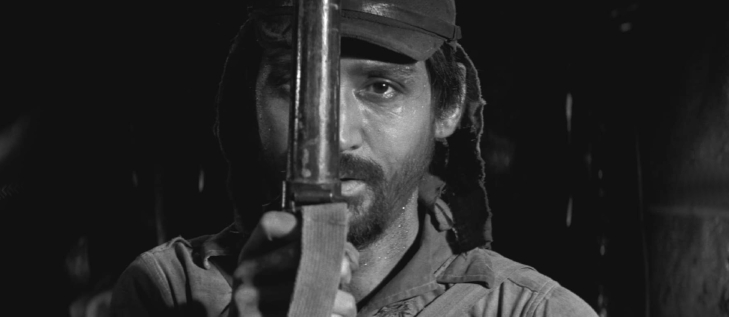
It’s a chronicle of defeat and doom, hopelessness and horror … yet director Kon Ichikawa turns it into an engrossing experience. Foot soldier Tamura is one of thousands of Japanese troops left behind after military defeats; surrender risks execution by partisan Philippinos, and the alternative is slow starvation in the hills. Desperation and madness take their toll, yet the show says a lot about the human spirit — we’re impressed, even if we’re not uplifted. The new restoration looks sensational in B&W Daieiscope by Eastman — it’s one of the most attractive B&W Japanese films we’ve seen. The extras include special input from the director.

Fires on the Plain
4K Ultra HD + Blu-ray
The Criterion Collection 378
1959 / B&W / 2:39 widescreen / 104 min. / available through The Criterion Collection / Street Date August 5, 2025 / 39.95
Starring: Eiji Funakoshi, Osamu Takizawa, Mickey Curtis, Hikaru Hoshi, Mantaro Ushio, Masaya Tsukida, Yasushi Sugita, Yoshihiro Hamaguchi, Tatsuya Ishiguro.
Cinematography: Setsuo Kogayashi
Production Designer: Atsuji Shibata
Film Editor: Tatsuji Nakashizu
Music Composer: Yasushi Akutagawa
Written by Natto Wada from a novel by Shohei Ooka
Produced by Hiroaki Fujii, Masaichi Nagata
Directed by Kon Ichikawa
 Kon Ichikawa has a solid reputation aligning him with an older group of Japanese filmakers — Kurosawa, Kinoshita — although he’s made a few rebellious shockers more in line with the later rebels, and even uses some of the same actors as the very socially critical Yasuzo Masumura. Several Ichikawa shows have crossed the Pacific for honors here, such as An Actor’s Revenge, Tokyo Olympiad and The Makioka Sisters. We’re told that his studio-era output covered many genres including his share of light family comedies.
Ichikawa has always been a respected film artist, but never more than with his two early films about the experience of ordinary soldiers in World War II. 1956’s The Burmese Harp is a contemplative tale of a soldier who refuses to return from Burma, but instead takes the identity of a Burmese monk and goes about his own private odyssey of atonement, burying the war dead left behind. Three years later, Ichikawa took on an even touchier project. Fires on the Plain is a raw first-person account of one of tens of thousands of Imperial troops cut off and abandoned when the Americans retook the Philippines. It’s a chronicle of a descent into oblivion, a wholly unsensational account of inhumane degradation.

It’s surely a tale that could fit many wars through the centuries; this time through it reminded us of the books of Cormac McCarthy, in particular Blood Meridian, a story of an armed incursion that becomes an uncontrolled bloodbath. The soldiers in Fires on the Plain are products of a stern, unforgiving military system that presumes from the start that their lives are forfeit to the Emperor’s will as administered by a draconian military system, some of which was based on values from the country’s feudal era.
Author Shohei Ooka was himself a soldier, a witness to this ordeal.

Just a couple of months into 1945, the Japanese military juggernaut has been defeated in the Philippines, with ships sunk and most of the air force shot down. Having been driven out of the cities, the troops on Leyte are stranded with little command structure and no supplies. The real fighting has moved on to Luzon and Manila. Private Tamura (Eiji Funakoshi) is one of many thousands of soldiers ‘left to their own devices.’ He’s got a tubercular condition but is turned away from the only medical unit he can find; he stops looking for official orders when an officer commands him to kill himself with a grenade. With and without his friends Yasuda and Nagamatsu (Osamu Takizawa & Mickey Curtis), Tamura forages for anything he can eat, like feral dogs. Starvation becomes a fever, and the behavior of some soldiers becomes animalistic.
Kon Ichikawa’s vision has a lyrical quality. Those landscape not littered with rotting corpses can be very beautiful. The soldiers are fearful of Philippine reprisals, and therefore try to avoid the giant bonfires they see on the horizon. One of the few possible symbols in the picture is an ant that Tamura watches at one point. It finally bites him, a basic statement of survival.

Survival isn’t really in the cards. Essayist Chuck Stephens says that Ichikawa and his wife-partner Natto Wada dropped author Ooka’s Christian theme, that gave Tamura an ‘out’ that included surviving. The last act instead touches on the historical reality of the abandoned army, scattered and left as individuals to figure out what to do. Sickness and starvation are constants; Stephens says that some of the actors ate little to help achieve a gaunt look, and that Eiji Funakoshi made himself sick that way. The stragglers face the hopelessness with stoicism, sometimes falling back on graveyard humor, or references to the utter absurdity of their situation. Tamura’s attempts to find a decent pair of boots, from what’s left of the corpses he finds, is particularly expressive.
The final reels delve into numbing horrors more ‘relatable’ than the fantastic grotesquery of 1960’s Jigoku — total degradation in what is found to eat. Tamura is intrigued to learn that some comrades have secured a supply of food, until he finds out what their ‘monkey meat’ really is.

Tamura kills in his struggle to find food. But groups of Japanese stragglers are also attacked by American units, mopping-up. In the end, desperate for food and water, Tamura’s former friends turn against each other.
Fires on the Plain isn’t a scream of protest, just an attempt to record a horrible chapter of Japanese history that was already fading from the public consciousness, 15 years after the fact. Japanese society of course had its protesters and historical lecturers, but the constructive cultural outlook had a tendency to screen out unpleasant memories. The movie addresses only the part of WW2 when the Imperial Army was already defeated, but there’s also an unseen element of unacknowledged guilt. History says that the Japanese Occupation of foreign territories was harsh, when the right term might be barbaric. They hadn’t signed the oft-referenced Geneva convention, which accounted for the inhumane treatement of prisoners of war. In the Philippines the general population was treated as slaves, and the cruelties dispensed in battle and in daily interactions with civilians would become the subject of many war crime trials.
Ordinary foot soldiers like Tamura had no choice in the matter, yet they knew what kinds of crimes their army had committed. That explains the terror of surrender — the Philippine partisan resistance would exact a bloody revenge. At one point Tamura tries to surrender to a Yankee, but stops when another straggler is shot down by a Philippine partisan in the American’s jeep.

1959 saw Japanese critics, and some Japanese filmmakers, protesting governmental policy for the Cold War, allied so closely to the United States. But even then, movies condemning the conduct of the war were not the norm.
Of the films we’ve seen that did, two by director Masaki Kobayashi have reached us in editions from Criterion. 1956’s The Thick-Walled Room charged that the War Crimes Trials had sentenced lower-rank soldiers to long prison terms and death, while higher officers that gave the criminal orders were allowed to return to civilian life untouched. The film was reportedly held up for three full years, which would mean that it was finally released the same year as Fires on the Plain.
Other films decried war in general, and placed Japanese conduct in WW2 within the context of a universal orgy of killing and atrocities. The most effective presentation is a followup Kobayashi epic The Human Condition. The six-film, nine-hour marathon of horror follows an idealist officer who thinks he can retain his humanitarian principles while serving in Occupied Manchuria.


The Criterion Collection’s 4K Ultra HD + Blu-ray of Fires on the Plain is an impressive digital restoration from 2022. A basic description makes one expect something ugly, but Ichikawa’s images reflect the contrast between the soldiers’ suffering and the natural context around them — rural Leyte is beautiful. As explained in the extras, the director began as an artist and cartoonist. The artful compositions seem to mock the abandoned troops. It’s a disturbingly poetic doom.
We learn that Ichikawa demanded Eastman film stock for his shoot, which gives the image more contrast and vitality than some other B&W Japanese movies. The show is at all times designed, composed and directed to a purpose.
The extras on the Blu-ray disc are really worthwhile. Expert Donald Richie’s introduction positions Kon Ichikawa in the context of studios and careers. Ichikawa passed away in 2008 but is present in an interview piece, talking candidly about his efforts and his collaboration with his wife Natto Wada.
Ichikawa explains one detail we can appreciate. His actors practiced and perfected many different ways to walk. Tamura almost never looks fully energized when he walks, but he’s never doing one of those aimless ‘lost in the desert’ stumble-walks from old movies. The need to conserve energy yet keep going and not fall gives Tamura and others some very strange gaits. Sometimes they come off as a March of the Dead more subtle than anything in a zombie movie.
Sharing the interview piece with the director is Mickey Curtis, an actor-musician with an English-Japanese background, whose biggest fame was as a Rock ‘n’ roll singer. That popularity plus being unusually thin helped him win the role of Nagamatsu. One can see a sample of his stage show (several years later) on YouTube: Mickey Curtis & The Samurais (1968)
Mickey confirms the stories about actor Eiji Funakoshi, who was so gung-ho about his starring role that he purposely starved himself. The movie had to be shut down after Funakoshi collapsed on location, and was hospitalized for several weeks.
Chuck Stephens’ essay in the folded insert distills a lot of good information and observation as well, especially as concerns the movie being about the end of the conflict, when many of Japan’s surviving soldiers perished ‘under non-combat circumstances.’ It’s good not to forget the earlier cruelties, when the conquering Japanese victimized millions.
Reviewed by Glenn Erickson

Fires on the Plain
4K Ultra HD + Blu-ray rates:
Movie: Excellent
Video: Excellent
Sound: Excellent
Supplements:
Introduction by Donald Richie
Interview program with Kon Ichikawa and actor Mickey Curtis
Insert folder with an essay by Chuck Stephens.
Deaf and Hearing-impaired Friendly? YES; Subtitles: English (feature only)
Packaging: One 4K Ultra HD + Blu-ray in Keep case
Reviewed: September 8, 2025
(7389fire)
Visit CineSavant’s Main Column Page
Glenn Erickson answers most reader mail: cinesavant@gmail.com

Text © Copyright 2025 Glenn Erickson
About Glenn Erickson

Glenn Erickson left a small town for UCLA film school, where his spooky student movie about a haunted window landed him a job on the CLOSE ENCOUNTERS effects crew. He’s a writer and a film editor experienced in features, TV commercials, Cannon movie trailers, special montages and disc docus. But he’s most proud of finding the lost ending for a famous film noir, that few people knew was missing. Glenn is grateful for Trailers From Hell’s generous offer of a guest reviewing haven for CineSavant.