


Now that almost all of Val Guest’s fantastic films are on Blu-ray, it’s a great time for sci-fi adepts to discover his impressive The Abominable Snowman (of the Himalayas), which Hammer Films produced and released in the same year as Guest’s phenomenal space invasion classic Quatermass 2. Guest had re-written Nigel Kneale’s teleplays for the first two Quatermass films, but for Snowman Kneale adapted his own 1955 teleplay The Creature, a 90-minute BBC Sunday-Night Theatre broadcast. Kneale would also adapt and script his third Quatermass TV show, filmed ten years later.
We can only imagine how claustrophobic the original live TV presentation of The Creature must have been . . . depicting the Himalayas on tiny BBC sets. Hammer’s production opens up the drama without dissipating its close-in debate about scientific ethics. A scientist is tricked into accompanying what is actually a commercial, exploitative venture. On a higher level, Kneale’s drama explores an ambiguous spiritual theme, with a Tibetan Lhama whose motives are difficult to read. Are the Lhama’s telepathic abilities the result of a spiritual awakening? Or were they gifted him by the secretive super-human Yeti, who might be extraterrestrials as well? Marketed as a monster thriller amid the snows of the world’s highest mountains, The Abominable Snowman aims far higher than typical matinee material of its time.

Reviewers of 1957 had little to say about this remarkable English production. Daily Variety called it a well-made ‘handy exploitation entry’ but not much else. It was more or less off the radar until the 1990s, in full view but seldom examined in detail. Old-school monster fans were perhaps not charmed by its reluctance to show its title characters. Hammer aficionados were more interested in the company’s Technicolored horrors. But the status of this Nigel Kneale adaptation has definitely been elevated by reappraisals of Hammer’s output. It’s a superior sci-fier of considerable sophistication and power.
In a remote monastery, botanists John Rollason (Peter Cushing) and Peter Fox (Richard Wattis) are the guests of the kindly but mysterious Lhama (Arnold Marle), who appears to have extra-sensory perception. The Lhama chides the scientists about their Western ways. He also meddles in John’s relationship with his wife Helen (Maureen Connell) when she objects to an unplanned detour in John’s research. Blustering American explorer / promoter Tom Friend (Forrest Tucker) shows up to propose a daring winter climb to a mountaintop valley where it might be possible to observe a real Yeti, the purported Abominable Snowman.

Over Helen’s suspicions and the not-so subtle warnings of the Lhama, John joins the Friend expedition. Once out in the deep snow, he discovers that much of what Friend has advanced is false: the expedition has brought traps and nets to capture a Yeti, and if that doesn’t work, guns to kill one. Friend has already promoted a phony wolf-child in India.
When no Yeti turns up Friend decides to pass off a snow monkey as an exhibit debunking the Yeti myth. Then real snowmen abruptly appear. A trap set by the reckless Ed Shelley (Robert Brown) breaks the ankle of team member McNee (Michael Brill), who goes quietly insane watching a gigantic Yeti hand reach into his tent. Shelley succeeds in shooting one of the ten-foot beasts, yielding a dead specimen to haul back to the monastery. But the situation quickly deteriorates thanks to Tom Friend’s willingness to expose his comrades to danger. John Rollason becomes convinced that the Yeti are actually ultra-intelligent, and realizes too late that they are using telepathic powers to manipulate the minds of the surviving expedition members.
Shangri-La meets Wooly Bully.
Let’s get straight to the fun big-idea theorizin’. I humbly propose that author Nigel Kneale’s The Abominable Snowman neatly revisits the setup of Frank Capra’s 1936 fantasy Lost Horizon. The teleplay about mysterious Yetis is very similar to the James Hilton book and movie about a hidden Utopia, whose function is to wait patiently for civilization to destroy itself. Snowman’s Lhama carefully manipulates John Rollason much the same way that Shangri-La’s Chang snookers Ronald Colman in the Hilton/Capra film. Instead of divulging secrets to an outsider Englishman, this guru keeps Cushing’s scientist almost completely in the dark. Both Hilton’s High Lama and Kneale’s Lhama offer portentous speeches claiming that humanity’s days are numbered, that our civilization is in full self-destruct mode. For this science fiction update, Kneale pushes the idea one step further to suggest an ambivalent human-alien relationship. The wise (or deceitful?) Lhama tells Rollason that a ‘better mankind’ will emerge, but one that isn’t strictly human. An evolutionary fork apart from men and apes, the Yeti have lived in secret, waiting for the coming apocalypse that will allow them to inherit the earth from unworthy humanity. Nigel Kneale would further develop the theme of alien influence in his subsequent conceptual masterwork Quatermass and the Pit.
Kneale’s Lhama is suspiciously selective when dispensing his sage wisdom. His main talent is for artfully dodging John Rollason’s innocent, curious questions. The Lhama speaks slowly but has mastered the art of changing subjects, ‘controlling the narrative.’ He pretends to be a passive participant in Rollason’s business, but his backhanded advice is what motivates the doctor to join the Friend expedition. Even more importantly, we can only speculate about the Lhama’s relationship to the Yeti, with whom he shares the power of telepathic communication. Is the Lhama voluntarily shielding and protecting the Yeti, or does the alien race control him, as he seems to control others?
There’s no doubting that telepathy is taking place: between the Lhama and the Yeti, between the Yeti and the expedition, and between the Lhama and Helen when she launches her ‘intuitive’ rescue mission. The Lhama takes steps to see that John Rollason comes out alive. But why, exactly? Does he recognize in Rollason a Ronald Colman-like kindred spirit, or is he callously using the scientist to quash curiosity about the Yeti?

Kneale never divulges the exact nature of the telepathic meddling that we witness. Are the Yeti an indigenous race destined to inherit the Earth, as in Planet of the Apes? Or are they invaders from outer space, making the Lhama their puppet? Are they just more subtle than the Venusian creature in Roger Corman’s It Conquered the World?
The tease ending of The Abominable Snowman is endlessly intriguing, even as it wraps up the show far too quickly. The continuity jumps from John’s rescue direct to a brief coda with the Lhama. We are not given a chance to ponder the significance of what has happened, and we don’t know what has transpired between John, Helen and Peter Fox. Has the rescued Doctor told them the full truth about what happened to his climbing party, or have the Yeti ‘done things’ to his mind, to maintain their secrecy? The rescued John Rollason meekly endorses the Lhama’s false assertion that, “There is no Yeti.” The first angle on Cushing gives the impression that John is in control, and voluntarily lying. Perhaps he’s been morally converted to the Lhama’s position, just as Lost Horizon’s Ronald Colman bought into the big Shangri-La cover-up. But in his final close-up, Cushing’s pale, staring face conveys an impression of involuntary brainwashing.
When Savant first saw The Abominable Snowman as a child, this ending seemed merely abrupt: what, no more monsters? The show now plays as a mature eco-fable: if we humans can’t take better care of our Earth, we’ll lose it to beings that will. The Abominable Snowman belongs on a spiritual double bill with John Huston’s magisterial The Roots of Heaven, one of the few other commercial films to take our ‘species arrogance’ as its subject.
The Abominable Snowman is a bit talky … there’s a too much of the radio-show overwriting from which a lot of early TV drama suffered. You’re all adults, so adjust. Kneale respects his characters. Cushing’s Rollason is a warm and likeable scientist; perhaps this is what Hammer’s Bernard Quatermass would be like had he played him instead of Brian Donlevy. Maureen Connell’s scientist- wife is not just there to complain or to pour coffee — she has a genuine stake in the outcome and is the heroine of the film’s final act. Richard Wattis normally plays a silly-ass twit (his general in Casino Royale ‘67, for one). His stock supporting role here is given careful depth. Peter Fox is a tad fussy and critical of Tibetan cooking, yet is a solid professional partner for Dr. Rollason.

Instead of the cardboard villains seen in most ecologically themed dramas, the enterprising Tom Friend and his cohort Ed Shelley simply have materialistic aims — they’re adventurer-pirates with little commitment to the truth. Friend wishes no one harm, and Shelley is a hearty team player. But they’re disinclined toward selflessness or enlightenment, and Kneale doesn’t suggest that a better set of priorities would redeem either of them.
Viewers can easily assign Tom Friend’s self-dealing pragmatism to ‘Ugly American’ stereotyping. By now most sci-fi fans know of Nigel Kneale’s distaste for Brian Donlevy’s interpretation of his beloved Bernard Quatermass character. Friend would seem to represent everything that Kneale hated about Donlevy’s Quatermass, purposely contrasted with the benign and unselfish Dr. Rollason. Had Cushing been Hammer’s choice to play Quatermass, perhaps history would have seen a series of Technicolor Hammer Science Fiction films.

1957 saw Hammer’s initial Technicolor gothic horror movie and also this first anamorphic ‘Hammerscope’ release. The format jump may have been influenced by Hammer’s U.S. associate Robert Lippert, whose company ‘Regal Pictures’ switched over to ‘Regalscope’ in the same year; the poster of Fox’s release calls out Snowman as a Regalscope release. Hammer’s B&W Hammerscope productions stand out from their color counterparts by virtue of their enhanced visual flexibility (more camera angles, more cuts) and overall scale of production. The time and money to light for Eastmancolor seemingly limited the early, popular gothic features to the same familiar exteriors and redressed sets. Snowman makes effective use of a well-designed monastery set, and its studio snowscapes are excellent (and aided by creative lighting). Hammer sent a film crew to the French Pyrénées to capture the impressive snowy mountain trek scenes. The matching with the studio-shot material is excellent, as one would expect from director Val Guest and his favored editor Bill Lenny (16 collaborations!).
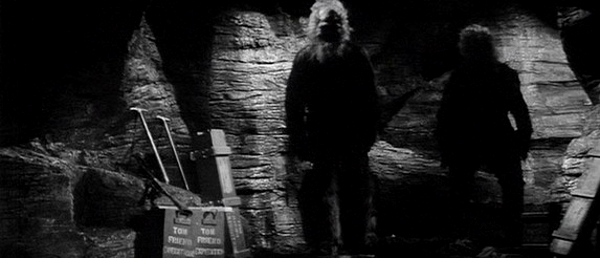
Minor notes. An oft-printed still photo showing the entire body of the felled snowman ( ↓ ) prompts us to expect a corresponding scene in the movie. No such camera angle exists, not even in the longer cut. Also, we’re tempted to look for similarities among the other Brit Sci-Fi releases of the late 1950s. If writer Jimmy Sangster’s X The Unknown can be taken as an in-house knock-off of Kneale’s Quatermass series, what about Kneale’s BBC show The Creature and the subsequent ATV TV series The Trollenberg Terror? The shows share climbing treks in snowy mountains, and telepathic communication with aliens is interpreted as supernatural/psychic in origin. Although written for TV by Peter Key, Trollenberg was adapted into a feature by Hammer’s Jimmy Sangster, adding the American actor Forrest Tucker along the way.
Here’s Joe Dante on the Kneale classic:

