


From out of left field comes this Covid lockdown production, a found-footage creation that overachieves beyond all expectations. It’s a science-fiction tale taking place in WW2, told in fractured manner — yet an imaginative idea, good performances and some delightful surprises keep us in the throes of suspense. Two women in wartime England operate a radio-television capable of receiving transmissions from the future, and use it to help win the war … but discover that they’ve altered much more of the future than they intended to, in a very negative way.
You Really Got Me.
Andrew Legge uses the found-footage filmmaking style for LOLA, and instead of insulting our intelligence, the style’s splintered-reality effect brings us closer to his characters, and to a story that might seem trite if told straight. It certainly would have been out of Legge’s budget price range if he shot it straight. The show begins as a no-budget affair until Legge’s digital effects deliver sequences made of altered vintage newsreel footage, intercut with extremely well-done new scenes.
LOLA is a close relation to the fantasies that alter wartime history to make a point, like Philip K. Dick’s phenomenal book The Man in the High Castle. These stories can end up as exercises with little point beyond surface thrills (The Eagle Has Landed, The Final Countdown) or they can be as brilliant as Kevin Brownlow’s ‘amateur’ masterpiece It Happened Here, a movie initially filmed by schoolboys on weekends, motivated by access to a collectors’ bounty of authentic weapons, costumes and vehicles.
Andrew Legge has a different set of fringe-production puzzle pieces to work with, but comes through with a compelling sci-fi story that won top Festival prizes at Trieste and Sitges. The opening conceit is that a lost ‘history’ of WW2 has been pieced together through 16mm film recordings made by a pair of inventors in Sussex, starting in 1938.

The Angel of Portobello.
Thomasina ‘Thom’ Hanbury (Emma Appleton) is a brilliant original theorist. She has combined a hyper-sensitive broadcast receiver with ‘quantum physics’ to create a device she’s named LOLA, after her mother. Thom’s sister Martha ‘Mars’ (Stefanie Martini) is her inseparable partner; they marvel at their newfound ability to hear and watch broadcasts from just a few hours ahead — or ten and twenty years in the future. At first Mars simply wonders at the developments of the future, and indulges a taste for folk music and rock of the 1960s and 70s, her favorite being David Bowie. But when England is attacked by Germany, they use a clever hard-to-detect broadcast signal to warn English towns of impending air raids. They become known as ‘The Angel of Portobello.’ The women are finally tracked down by Lt. Sebastian Holloway (Rory Fleck Byrne), who accepts the possibilities of using LOLA against the Nazis. Becoming officially involved is complicated. They can’t afford to tip off the Germans that LOLA exists, and Holloway’s own superior Major Hobcroft (Aaron Monaghan) is a glory-hungry careerist.
Anticipating German battle plans turns the tide for England right away. Hobcroft accepts awards while the women work hard, and Mars and Lt. Holloway become lovers. But then things take a terrible turn for worse. They accept a message planted by the Nazis and an American ship is sunk with over 2,000 passengers. The news turns U.S. sympathy away from Britain — America won’t enter the war. Another bad message enables the Germans to successfully cross the channel and gain a foothold … and England looks set to fall. When Mars now ‘tunes in’ to her 1973 broadcast, David Bowie has been replaced by songs glorifying Fascist power…

What Would Kevin Brownlow Say?
The Found Footage format is occasionally a little frustrating — Thom has also managed to perfect sync sound 16mm filmmaking 20 years before Maysles and Company. We also wonder where they get all the film stock, during wartime, but that’s a minor issue. Naturally, Lt. Holloway also has a signal corpsman with him, filming as well … it’s like our cell phone video era, half a century too early. The blips and snippets of grainy 16mm do give us a quick intimacy with the Hanbury women, creative eccentrics that live in an isolated country house and always seem to be drinking champagne.
Director Legge home-developed his 16mm film, and used a vintage camera to shoot his imitations of 1940s newsreel footage. As this is found footage, we see plenty of leader, raw splices and light leaks on the film, reminding us that we’re watching a compilation assembled by Mars at a later date. It works well enough until the final act, when there’s no way that our lovers, now fugitives, could possibly be accompanied by any kind of camera, let alone one recording crucial moments. But …. by that time we’re hooked on the story, cheated-footage vérité or not.
The movie’s smart, insightful play with time collisions is wonderful, with bits of the 1941 period clashing with bits of the future. Lt. Holloway is surprised when Mars uses words like ‘cool’ and ‘groovy.’ At a party celebrating another success against the Nazis, Mars prompts the band for a swing version of The Kinks’ “You Really Got Me.” In Back to the Future, the teens of 1955 couldn’t relate to music from 1985, but the 1941 jitterbugs go crazy for the Kinks song. With some deftly-organized CGI work, we see the song’s title converted into a patriotic slogan, and plastered on posters everywhere.
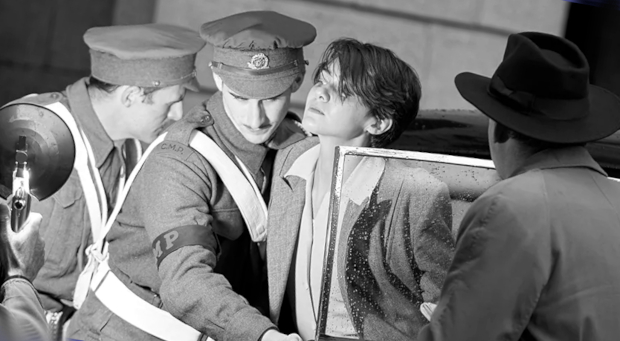
There isn’t a great deal of spectacle in the show, but a few shots of London being bombed and Big Ben engulfed in smoke look exactly like vintage newsreel footage. The same goes for scenes of Thom and Mars scapegoated as traitors, and sentenced to death.
Things becomes more complicated as the storyline bends more toward It Happened Here, with the historical U.K. Fascist Oswald Mosley imposed as the leader of a fallen England. The movie takes in a few too many new ideas at the end, but it does so in the right spirit.

Remember Tomorrow.
We’re delighted at how well LOLA plays — the parts that contemplate the collision of cultures between decades is fascinating. The technical stretches don’t offend because the actors make a solid emotional impression. The fact that the time-warp element is limited to broadcast signals really helps — hearing radio or seeing TV from the future feels more plausible than projecting a physical object through time, as with H.G. Wells or the imaginative but clumsy science fiction effort Terror from the Year 5000.
LOLA may be a small found-footage show, but its ambition and storytelling skill are big, and it pays off with an audience identification seldom found in this area of filmmaking. The snippets of invasion action — London falling — are more convincing than epic-scale CGI might be, and the enthusiasm of the Hanbury sisters for ‘future’ pop stars is infectious, especially Mars’s debut of a song 23 years before its time. But even then we’re wary of the Butterfly Effect … if Mars spreads “You Really Got Me” far and wide, what will The Kinks do for a #1 hit?

I saw this streaming on Peacock. It’s a cool concept but the flash cutting (editing?) early on does get annoying & in the way of the story telling. A diet of cigarettes & wine is over used too. Later it settles down as the subject matter becomes more serious, a good thing. Enjoy!