
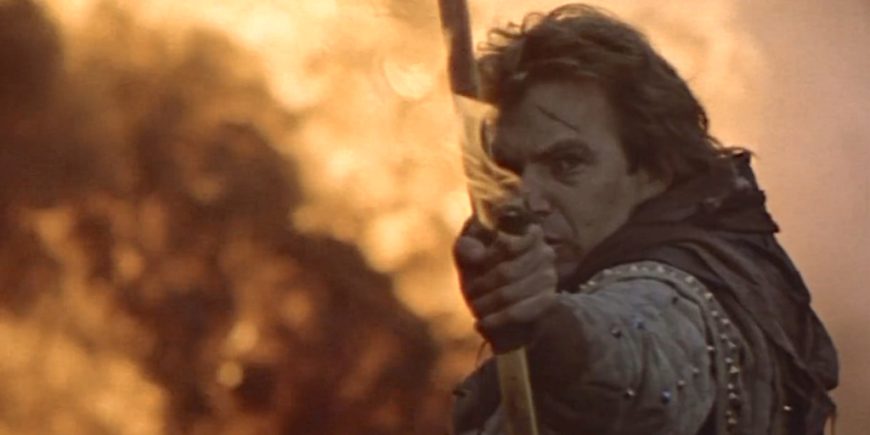
As we gear up for not one, but two new Robin Hood adaptations this year (Michael Sarnoski’s reactionary The Death of Robin Hood, starring Hugh Jackman, and Paul Greengrass’ The Uprising, starring Andrew Garfield), Trailers From Hell decided it was time to celebrate the still-unmatched contemporary interpretation of the fabled English hero. That’d be 1991’s Robin Hood: Prince of Thieves.
Trailers From Hell recently had the privilege of unpacking all things Robin Hood: Prince of Thieves with the film’s co-writer/co-producer, Pen Densham!
The film, unveiled at the height of Kevin Costner’s mega-stardom 35 years ago today, offers us a new-fangled hero. The Costner iteration of Robin Hood has a massive arc, transitioning from a petulant rich kid with a penchant for mischief into a chastened hero and leader of men — someone who appreciates collaboration in the face of conflict.
Densham wrote the original 92-page treatment for Robin Hood: Prince of Thieves, and subsequently co-wrote the script on spec with John Watson. The original kernel of their approach was essentially Robin Hood via Raiders of the Lost Ark, an adventurer who thrives under a concerted team effort, with a mystical element thrown in for good adversarial measure.
The Densham-ified Robin Hood was expressly designed to be a counter to the steroid-abetted bloodshed that was in vogue at the time.
“Robin Hood started because I had the privilege of having a son with my wife. And I looked at the movies that were around at that time, and we were trying all the time to figure out how to keep our lives going in Hollywood. We had a small company. We were sort of doing okay. Watching Stallone and Schwarzenegger make movies like Commando, where shooting people and killing them was celebrated, I looked at how much effort it took to raise a kid,” Densham tells Trailers From Hell.
“I had tremendous affinity for the Errol Flynn Robin Hood and grew up with the Richard Greene one in England as a kid, jumping off rocks in my backyard with a stick in my hand and that kind of adventure, and wondered if I could actually make a movie that would talk to the world that my kid would grow up in — where celebrating altruism, as opposed to killing, was considered to be healthy,” Densham adds.
“The movie I saw as being this man learning from his peasants, from Maid Marian, from others, to end up where he would take this wealthy, arrogant perspective of life off and become a person who’s willing to die for the future of his children.”
Cooking up this take on the man who robbed the rich to give to the poor inspired Densham, then fresh off writing, producing, and directing the underappreciated supernatural 1988 chiller The Kiss, to shop the idea around town.
He was initially confronted with an icy reception in the age of the Governator and Rambo.
“So I came up with a rough framework. I went out and pitched Tri-Star, Geffen, and Disney, and thought, ‘Well, it’d be nice to get paid to do this.’ Each of them said, ‘No, that’s not gonna work. That’s a really crazy idea. No one wants to see people with swords anymore; they want to see men with guns.’ They all told me, essentially, ‘Go away.’ I came back. There wasn’t even necessarily a whole lot of support at our company, right at the very beginning. Our assistant, who was our typist and our kind of helper, said, ‘You know, I think it’s a really cool story. If you want to start trying to write it, I’ll do my best to support you.’ It was literally that ephemeral.”
John Watson, who had also collaborated with Densham on scripts for The Zoo Gang and A Gnome Named Gnorm, was brought aboard to transfer Densham’s treatment into a screenplay draft.
“Then at that time we needed money to keep our company together, so I went off to write a horror movie and gave the [treatment] to John. And John, being English and being raised in the mists of England, also put his own stamp on what I had written,” Densham says. “I did a polish on his polish. Suddenly, we find that people are reading our version of it inside our friend group, and they’re raving about it! We go, ‘Wow, that’s kind of weird.’ So we put it out to the community, and we were suddenly in a bidding war with Warner Bros., Morgan Creek, and Fox being some of the key players.”
“So we hear through the grapevine that Warner Bros. is offering us the most money, and the backdoor is open for us. They’re going to take the project away from us as producers and give it to Joel Silver. So if we sell it, we’ll make a lot of money, but we’ll be gone. We hear through the grapevine that Joe Roth is going to buy it and kill it, so that his [competing version of] Robin Hood can go forward at Fox. Which left Morgan Creek. They wanted to buy it because Joe had run Morgan Creek and had left to go to Fox. Jim Robinson, whose company it was, wanted to show that he could make a movie without Joe Roth that was of quality. So he became the buyer that we elected to go for, which was less money, but we actually were attached to the movie. They were very open and accessible. They let my partner John literally move into their offices. Suddenly, from nobody wanting it, there were four Robin Hoods. There were another two that popped up, which was amazing! We were in a horse race, and the question was: Who could get a star that could get a movie made? And that opened up those other doors.”
Costner, at the time red-hot following his baseball hits Bull Durham and Field of Dreams, saved the day. All four Robin Hood projects wanted him as the titular star, but he preferred Densham’s take on the material.
“We were very lucky,” Densham reflects now. “I know at Fox they apparently made posters of him dressed as Robin Hood to show him, to try to talk him into their Robin Hood. He preferred our script by far to anything else that was out there. It touched him.”
With Costner’s Fandango director Kevin Reynolds on board, Robin Hood: Prince of Thieves was greenlit. But Costner was juggling the productions of Dances with Wolves (which Costner was also directing) and JFK, leaving the team with a finite window to shoot in 1990.
Cameras were rolling pretty much simultaneously, also in England, on the 20th Century Fox iteration of Robin Hood, produced by John McTiernan. Patrick Bergin starred as Robin Hood and a young Uma Thurman played Maid Marian. The film was released theatrically overseas, but was a TV special stateside.
“I think Joe Roth’s a good guy and he’s a character, and I think he’s doing what he would do to protect his own company and his investment. Ended up releasing it as an MOW, in a kind of pouty way of saying, ‘Well, you don’t have to go and see their Robin Hood, I’ll give you another one.’ We’ve never actually chatted about it.”
This iteration of Robin Hood is forged in fire.
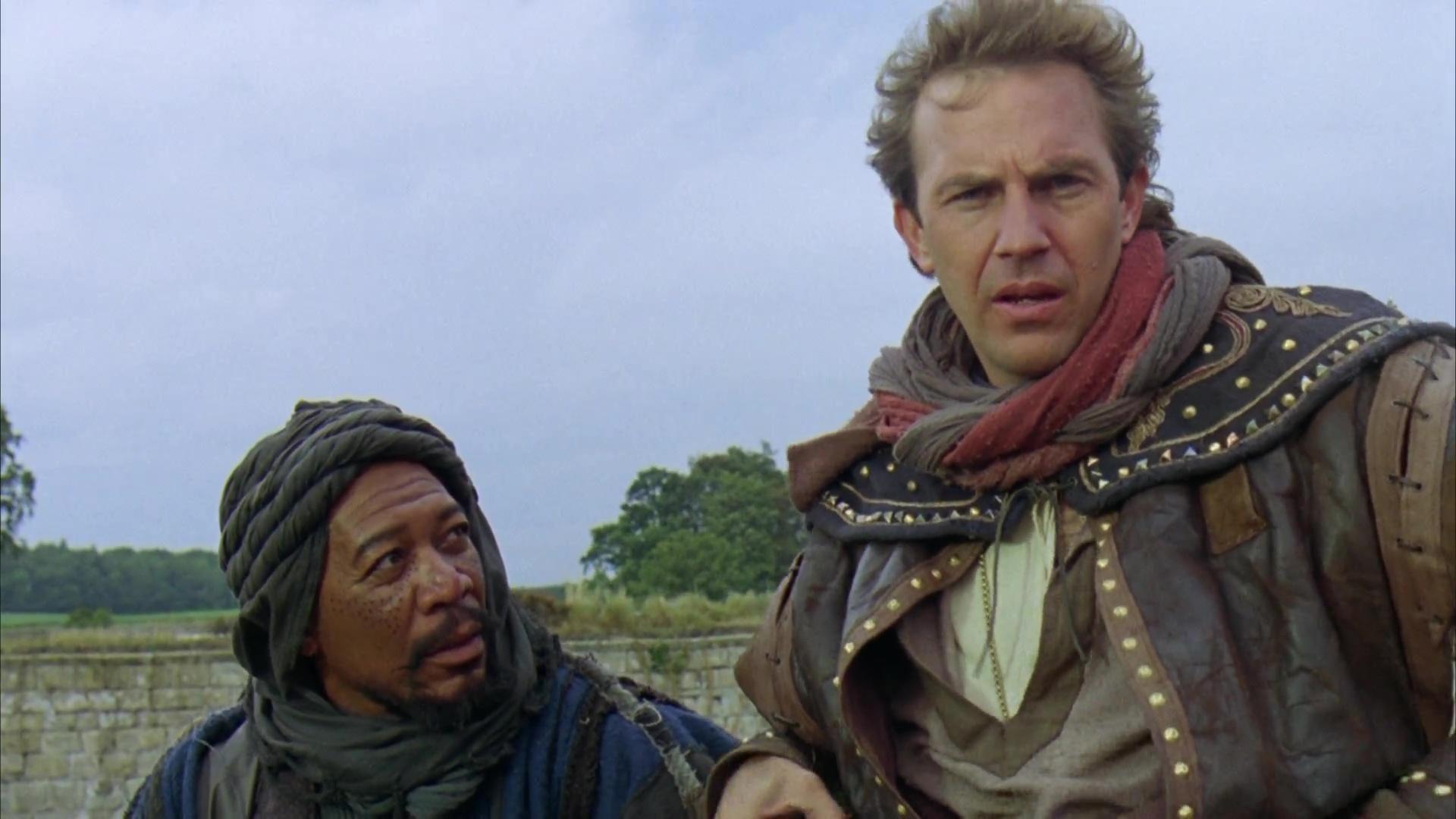
As the film opens, Robin of Locksley is a five-year prisoner of war in Jerusalem circa 1194, having served as a warrior during the Third Crusade for King Richard the Lionheart. He narrowly escapes execution along with the intrepid Azeem (Morgan Freeman) — a new character created by Densham.
“…I had this epiphany: what if you put a Muslim next to a Christian, side-by-side, and they learn from each other as opposed to wanting to take each other down?” Densham notes. “The idea for creating a Moor who would have a perspective on life that would be valuable to Robin was a combination of two things. One was very much Queequeg, from Moby Dick… A Maori of great dignity and entirely different character than the rest of the people around him, but who also was very distinguished-looking, had a very spiritual perspective on life. Prayed over his own coffin. And also I was influenced by Aslan, the lion in The Lion, the Witch and the Wardrobe, and wanted to infuse some of that majesty into my Arab character so that we as a Western audience could see things in that persona, that we would immediately relate to and see as being dignified and valuable.”
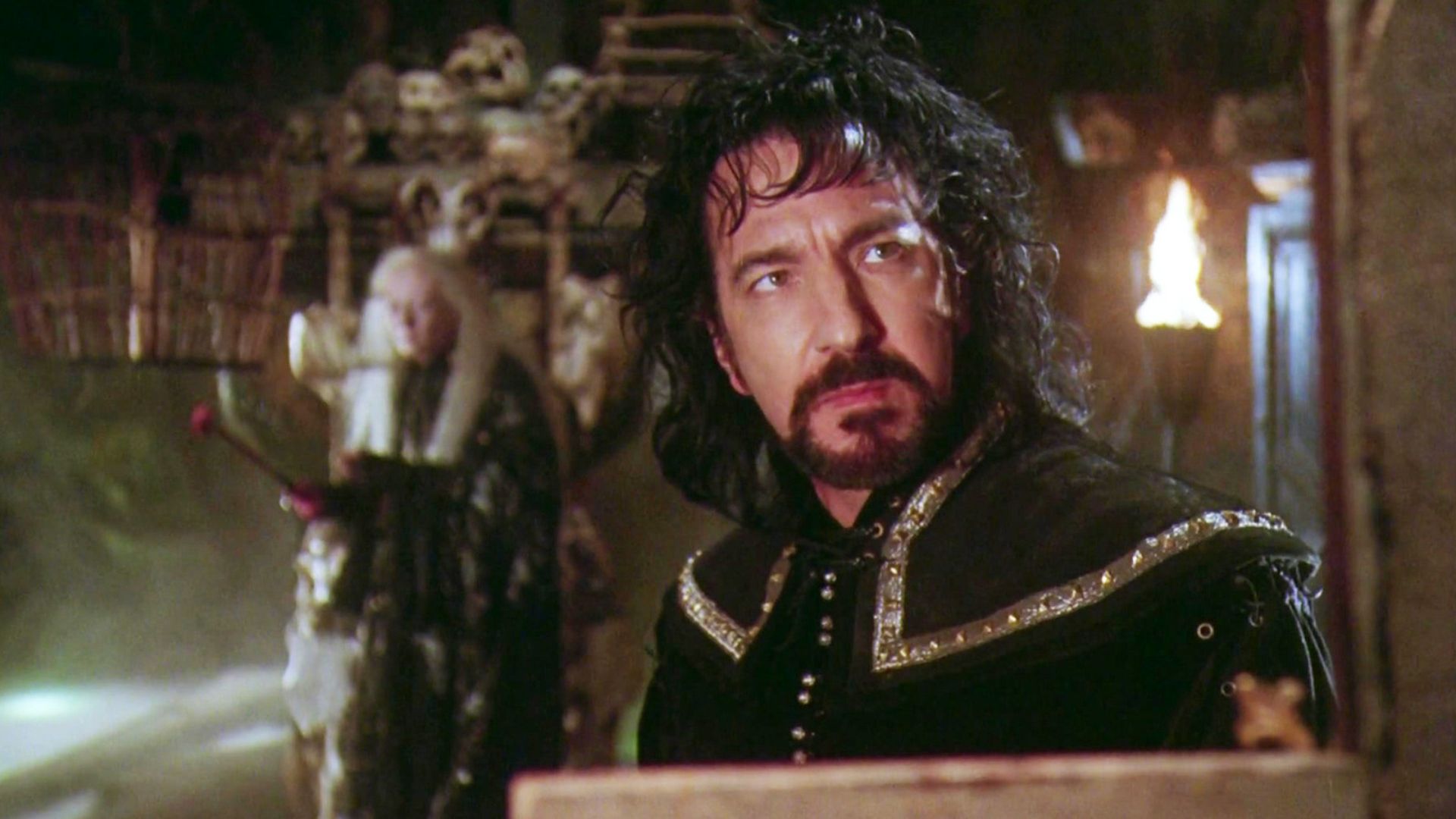
Robin and Azeem make their way back to the former’s family estate in England, only to discover that his father, Lord Locksley (Brian Blessed), has been murdered, his land ransacked, and his loyal house manager Duncan (Walter Sparrow) blinded. The culprit? The wicked Sheriff of Nottingham (Alan Rickman), who demanded Locksley’s loyalty to him over King Richard (an awesome cameo I won’t spoil here if you don’t know) and made him pay dearly upon being rejected.
With Azeem and Duncan in tow, Robin reconnects with his childhood frenemy Maid Marian, who has grown up to look like Mary Elizabeth Mastrantonio. The reunion is short-lived, and the Sheriff’s guard arrives to chase the trio into Sherwood Forest.
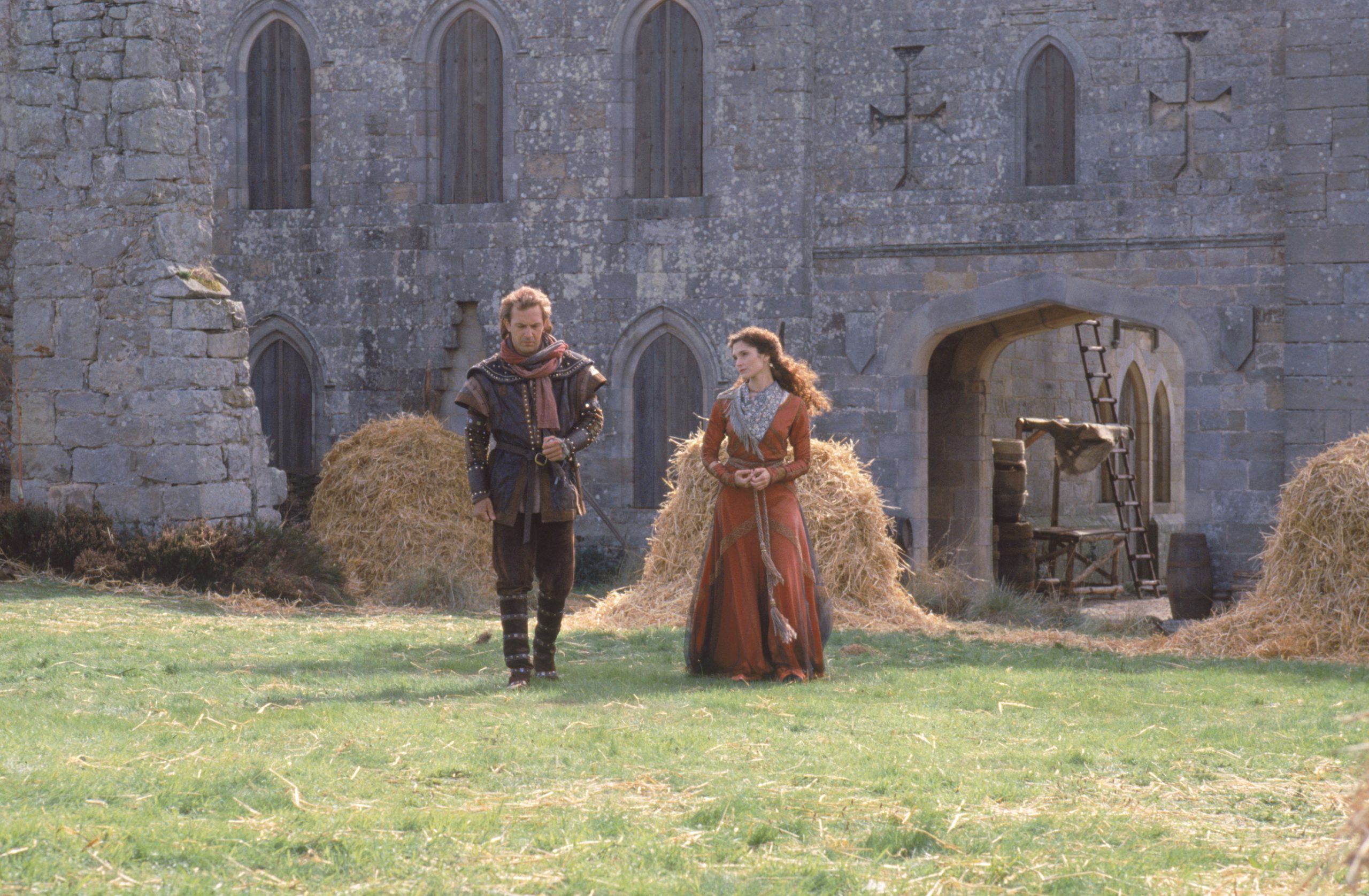
There, the trio joins forces with a band of outlaws, and Robin embraces his “Robin of the Hood” persona — they rob the rich proletariat who seek passage in the woods, much to the Sheriff’s growing chagrin.
The power-mad Sheriff of Nottingham is quite the twisted character. Advised by the demented witch Mortianna (Geraldine McEwan) and the crooked Bishop of Hereford (Harold Innocent), he is happy to cut down allies and family if they somehow disappoint him in his unending quest for control.
When he abducts Marian, a cousin to King Richard, in an effort to marry her, usurp the king’s rule, and stake his own claim to England itself, the newly dubbed “Robin of the Hood” and his merry band of thieves mount a heroic siege on the Sheriff’s castle.
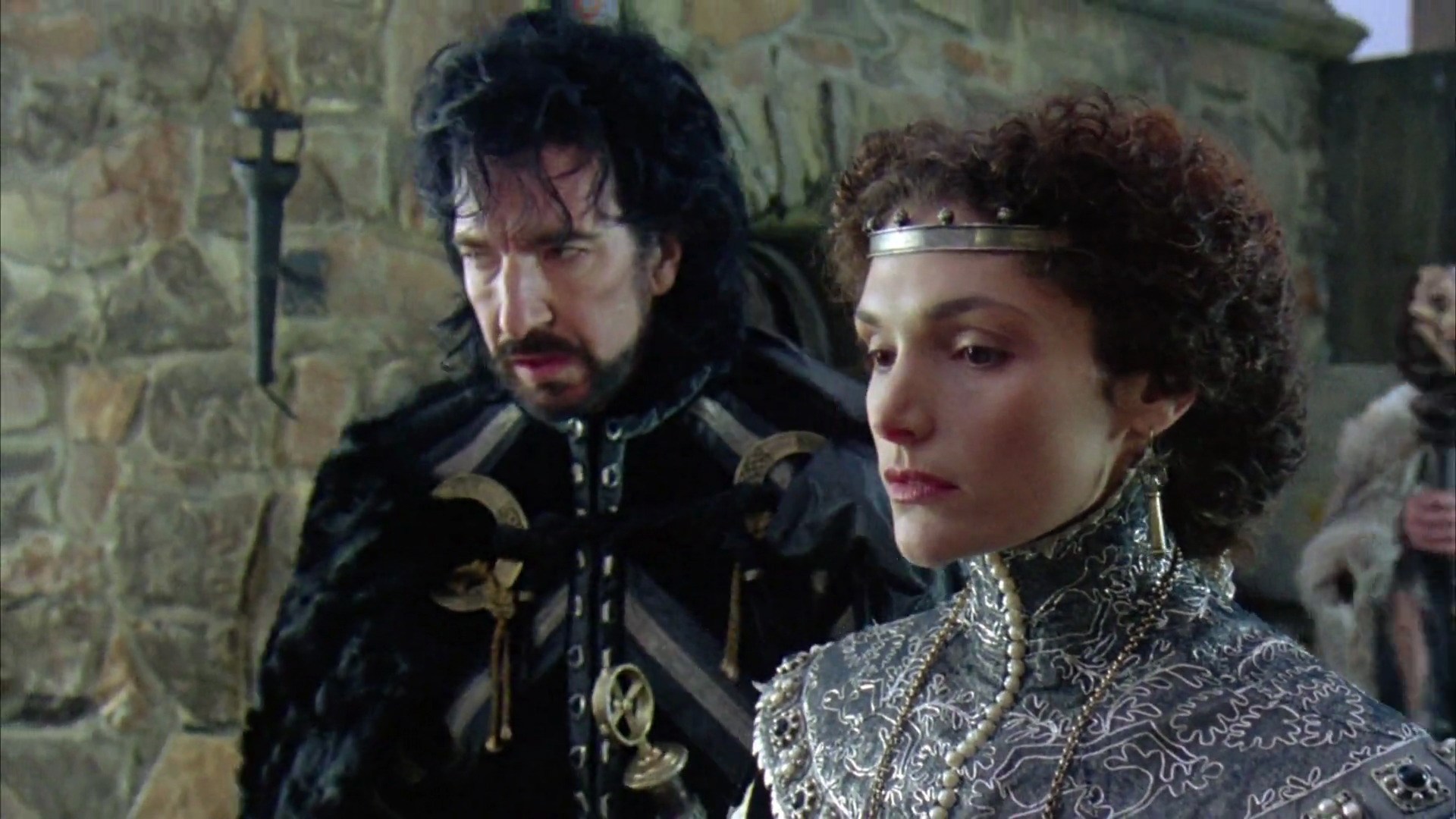
Having instantly made a name for himself as all-time baddie Hans Gruber in the original Die Hard, Rickman was Densham’s first choice for the Sheriff role, but he rejected the gig twice. While Costner makes for a strong Robin Hood, shaky accent and all (more on that in a bit), Rickman covertly steals the show.
Rickman’s Sheriff of Nottingham is a totally bizarre, scenery-chewing maniac. As he did with Hans Gruber, Rickman somehow manages to balance making a psycho funny without losing his baseline creepiness.
How did they ultimately lure one of the most in-demand character actors of the era into signing on, especially so soon after probably his career-defining heel turn?
“I wasn’t necessarily totally involved in all the elements of this, ’cause John Watson had moved to England to start putting the project together. So there’s elements where I’m doing script work, there’s elements where I’m fighting our own battles to keep things the way we wanted them out on the Hollywood side of things,” Densham concedes. “But as I understand it, what Alan was avoiding was trying to be typecast as a villain. He really felt that that was limiting his creative energies, and I believe the perspective for him was, if he could make that Sheriff as interesting and exotic as possible, then that would tempt him to come in. The perspective that we had was that, if you could add dynamics but not lose threat, then that’s really cool.
“Alan Rickman’s inventiveness, some of it was our screenplay, some of it was, he hired a lady comedy writer to give him some punch-up jokes, and there were elements of all of that. Kevin Reynolds encouraged him to fully evolve all his behaviors, to really follow his instincts and make this character as visually rich and as wildly inventive as he could. It proved to be fascinating because his gift to the movie was that he was always a threat, but he was wildly funny at times and very human in doing that. The rules of screenwriting are that villains are always heroes in their own lives… It took us away from this wooden, stentorian baron figure into somebody that was a total foil for Robin Hood — a total Machiavellian evil that deserved to be taken down.”
Costner only had a few days between the productions of Dances with Wolves, Robin Hood and JFK. Densham, Reynolds, and co. were also competing against the weather. Kevin Reynolds thus only had 10 weeks of prep time. The schedules of these three Costner productions were so condensed that, while Robin Hood did have a Hollywood premiere, the crew also hosted a press junket in New Orleans to accommodate Costner’s obligations to the JFK shoot.
The movie opened to a mixed reception from critics, who praised Rickman while often cutting down Costner’s inconsistent British/American accent.
“We were receiving critical analysis of his accent a lot. The press seems to like to inflate somebody to hero status and then pop them,” Densham notes. “Of course, anybody that knew anything about history knew that anybody that was a baron in that time period was speaking French!”
Despite the hurried production and unappreciative reviews, Robin Hood: Prince of Thieves was an instant blockbuster. The film’s $390.5 million gross made it the second-biggest worldwide hit of 1991, trailing only Terminator 2: Judgment Day.
Lately, Densham has been delving deep into impressionistic nature photography. The work has been showcased in galleries ranging from Here Is Elsewhere, Loisir Gallery, and Posner Fine Art. He has a new book out now, Qualia, that takes stock of some of his most arresting visuals.
“Photography can be more than a window — it can be a mirror for emotion,” Densham said in a 2025 press release. “When people look at these images, I want them to sense the world’s organic pulse, the same one that’s inside us all.”