
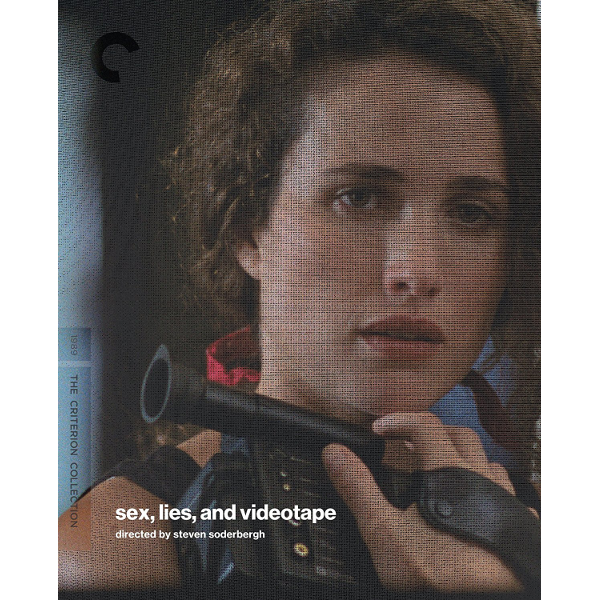

Director Steve Soderbergh has been making features for almost thirty years, as one of the few filmmakers to find something resembling working freedom in Hollywood’s unforgiving power structure. He’s taken on everything from expensive mainstream thrillers to science fiction remakes to personal movie experiments filmed on video. He’s also served as the director of photography on a number of his films. Soderbergh’s not the kind of director to sign up to do a Bond epic, but making films with the likes of George Clooney, et. al., has won him added wiggleroom in a confining industry. He’s quit once or twice, moved on to success on cable TV, and made entire features on an iPhone.
Back in 1989 Soderbergh arrived as a key figure in the newly emerging Independent Film scene. After directing a movie about the music group Yes, he put this show together by writing a script that attracted actors in need of breakout roles. James Spader was stuck playing snide collegiate-age villains. Ex-model Andie MacDowell was considered an acting washout after the producers of Greystoke: The Legend of Tarzan, Lord of the Apes decided to re-dub her entire performance with the voice of Glenn Close. Soderbergh’s tiny movie project didn’t amuse his actors’ money-minded Hollywood agents. Newcomer Laura San Giacomo had to threaten to change representation to get her agency to cooperate.

Filmed in Baton Rouge, Louisiana, sex, lies, and videotape is a intimate relationship movie that makes an asset of modest resources. The story stays focused on four main characters in a handful of principal settings. The camerawork is attractive but un-showy and no fancy editing or effects tricks are utilized. It’s all about the four leads, each of whom gets plenty of face time to fully express Soderbergh’s excellent dialogue.
The movie is about sexual-social dysfunction among adults in the new age of sexual candor. Married housewife Ann Mullaney (Andie MacDowell) is uncomfortable with sex and must be coaxed by her analyst (Ron Vawter) to talk about it. She feels something is not right with her husband John (Peter Gallagher), but fears that it might be her imagination. As it turns out, John is callously unfaithful to Ann. Smugly confident that she will not find out, he tomcats away from his duties as an attorney to spend time with Ann’s own sister, the uninhibited Cynthia (Laura San Giacomo).

The situational dynamic is complicated, to say the least, but Soderbergh allows each character to express a full inner life. Ann and Cynthia don’t get along, as Ann disapproves of Cynthia’s blunt talk about sexuality and lax commitment to their mother. Cynthia has pegged her sister as an uptight bore. Although she bears no intentional malice, Cynthia is clearly getting back at her sister on some level, while satisfying her own urges.
The catalyst that interrupts this triangle comes straight from the Acme school of cinematic contrivances, yet works within the context of the story. Ann is upset that John has invited an old college friend to stay with them while he searches for an apartment of his own. Graham Dalton (James Spader) turns out to be not another annoying ex- frat boy like John, but a sensitive and somewhat enigmatic loner, a drifter who deflects direct questions about himself. Graham shows no interest in reconnecting with his old local girlfriend, and spends a lot of time alone in his new apartment. Ann is intrigued, while Cynthia sees him as a potential new conquest. John thinks Graham is just weird.

John’s right, but Graham’s weirdness is made for the movies, as it were. He harbors a Peeping Tom– like obsession that both Ann and Cynthia, in their independent contact with him, find fascinating. Graham has been videotaping women he meets answering intimate questions about their sexuality and what turns them on. It’s his substitute for a conventional sex life — he tells Ann that he’s impotent, but only around other people. Graham’s gentle and benign manner impresses both women — the reckless Cynthia soon volunteers to become one of Graham’s videotape love objects, while Ann’s initial reaction is fear and revulsion. But Ann and Graham also sense that they have a strong mutual attraction.
Soderbergh’s film would at first seem to place the multi-sided love triangle in simple soap opera terms: John is a despicable cad, Cynthia is a reckless menace and Ann is a faultless old-fashioned lady experiencing difficulties in liberated times. Oddball freak Graham upsets the kettle — he’s sexually dysfunctional and engaged in a daring audiovisual sex world of his own invention. Graham now seems an early example of a J.G. Ballard- like case of humans melding with their technology. His unorthodox ‘sexual orientation’ is effected through 1988 electronics — a Hi-8mm video camera that uses little videotape cartridges. (Tell me about it, I have a drawer full of them, with important video of my children, that I now cannot play.)

It’s not often that we meet ‘characters’ this multi-dimensional; they’re like real people in that we mainly discover that there’s a lot more to learn about them. The story’s promised sex adventures turn out to be an exercise in sex therapy. A liberal interpretation of the romantic outcomes would forgive all the characters with the excuse that sexuality has no logic and stable relationships need a deeper foundation based on trust. Thus the clueless but honest Ann gravitates toward the ‘dangerously candid’ Graham, while Cynthia learns her lesson and expresses a sincere desire to atone for her disloyalty. John’s excuse for adultery, that Ann is frigid, is completely undercut. He is chastened by a video confrontation with his spouse, whom he discovers has sensual dimensions he never bothered to investigate.
A popular hit and a hot discussion topic in 1989, sex, lies, and videotape is fairly conventional in moral terms. We’re encouraged to thrill at John and Cynthia’s risky shenanigans, within reason: “Well, get your balls in the air and get your butt over here.” Ill-chosen actions have consequences, although nothing drastic happens, as would occur in a soap from an earlier decade. John is a big loser at home and at work, and forfeits his playmate as well. Cynthia (rather inconsistently but charmingly) matures in her appreciation of interpersonal responsibilities. Graham and Ann finish in sort of a trendy limbo, sitting cool and comfortable on a porch step, each a mellow individual yet comfortable as a potential couple. Undefined and amorphous relationships with no discernable future always look good in the movies. I almost want Graham to turn to Ann and say, “You know, I’ve got a lot more kinky ideas I haven’t told you yet …” For all she knows, he’s been crisscrossing the country in his convertible because he’s on the run from the law. I mean, he’s a guy obsessed with not having too many keys to worry about.

To return to the #MeToo debate, in this viewing James Spader’s Graham seems all right. He’s not aggressive with the females he meets, and he spells out exactly what he wants up front: if his modus operandi is too freaky they are perfectly free to bolt. Of course, Graham is a lot more attractive than the average guy who needs to ‘explain’ his personal preferences to a prospective lover, before things go too far. I doubt that many people like him exist; I would think that the average weird guy who brings a video recorder to a date has more intrusive and privacy-threatening ideas in mind.
Frankly, I think Graham’s magic key to putting women at ease should be obvious: he listens to them. Meaningful intimate communication is likely a lot more important to successful human relationships than sex. For a standoffish social misfit who sublimates his sex drive into ‘interesting’ behaviors, he’s nevertheless compatible with the needs of a lot of women — that’s a pretty full box of videotapes.
I liked the reaction my fellow Cannon Group employees had to the film — all of a sudden some of them, even the women, were talking about the picture and sex like adults. Everybody’s going to relate to Soderbergh’s film differently; for me the point of the picture is that all interpersonal relationships are risky, and that no set rules can be laid down. At the finish we don’t know if Ann will coax Graham toward a more conventional relationship, or if he’ll continue as he has before. As long as what works isn’t exploitative, most anything goes.
sex, lies, and videotape really hit the spot in 1989, winning major awards at Cannes and rushing Soderbergh into the industry spotlight. Besides a Palm D’Or win for Soderbergh, James Spader won as best actor. He, Andie MacDowell and Laura San Giacomo would each be rewarded with a major career boost.

