
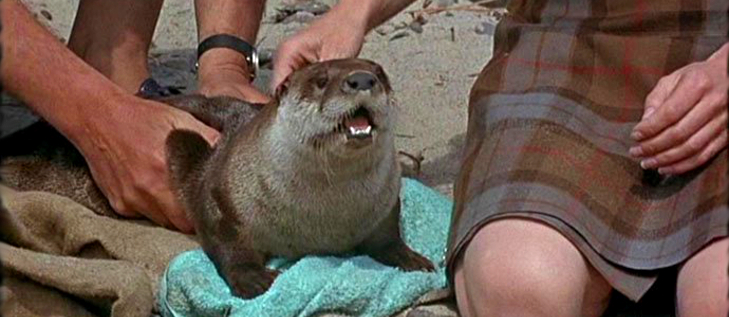


Remember the movies about cute animals that we once labeled as children’s entertainment? A Disney movie, like Sammy, the Way-Out Seal. The norm was light fare that usually had nothing to do with the real nature of animals themselves. Lassie the book was probably different, but the dog in the Elizabeth Taylor movie, influenced by the Douglas Fairbanks-inflected Rin-Tin-Tin, was some kind of mythical creature, as Mad magazine once said, with a college professor trapped inside. As a kid I expected dogs to read my mind, and to play intelligently with me as they did on TV. No wonder I’ve never gotten into pets. Dealing with humans is task enough, and the responsibility of taking care of a pet was a weight I was never ready for, even as I helped raise children.

Once upon a time, every darn creature Ivan Tors could think of became a cuddly pet: Flipper, Gentle Ben, etc.). Cornering the TV animal racket made producer Tors a millionaire. Savant once had to cut a promo for a gawdawful thing called Zebra in the Kitchen, which had a title tune by, I believe, The Beach Boys. Mr. Tors had begun in the ‘fifties with imaginative Science Fiction movies (The Magnetic Monster, GOG, Riders to the Stars), so it’s ironic that the ‘magic animal’ subgenre was much later subsumed back into Sci-fi in Steven Spielberg’s beloved but retrogressive E.T., the Extra-Terrestrial. That celebrated movie is Lassie Come Home all over again, but with the psychic communication between boy and ‘other’ being literal.
This brings us roundabout to Ring of Bright Water, the prime exponent of a handful of animal movies that don’t rely on Hollywood schmaltz and John Williams music to soften our brains as well as our hearts. Virginia McKenna and her husband Bill Travers were pioneering animal rights activists before the term was invented. Both were already reasonably big names in English films (he: Wee Geordie; she: Carve Her Name With Pride) when they struck pay dirt with an only slightly treacly animal epic that became a sensation: 1965’s Born Free. A spirited plea to respect nature and save the animals of the African veldt, the story of Elsa the lioness was propelled to the big time via a hit song by John Barry, sung by Matt M0nro.

Being sensible realists, Travers and McKenna did not imagine that they had reinvented cinema with Born Free. What people really remembered from that film was the song, and the cutesy scenes of the little lion cubs playing, which thereby taught us that cute and cuddly animals need protection the most. Four years later, they took the nonfiction book by best-selling naturalist author Gavin Maxwell, and with the interesting producer Joseph Strick (Ulysses, Tropic of Cancer, Never Cry Wolf) produced an extremely charming, low-key movie about a man and his otter that, well, made a big splash in 1969. In our town, Star! came and went in five days; Ring of Bright Water lasted four weeks.
It’s a good thing, whenever a dissatisfied city man develops a Thoreau itch. Graham Merrill (Bill Travers) is a writer unhappy with his day job in London. Graham becomes interested in an otter he espies one day in a pet store. Naming the otter Mij, Graham tries to keep it in his apartment, a hopeless ambition considering the otter’s restless, destructive habits. A low blood-pressure kind of guy who smiles indulgently when Mij destroys his furniture and eats his tropical fish, Graham takes another bold move and rents a seaside wreck of a cottage in a remote corner of Scotland. Otter in tow, he meets local doctor Mary McKenzie (Virginia McKenna) and her dog, both of whom take a liking to the extremely gentle Graham, and the rambunctious Mij. The problem of feeding the otter when the local eel population is depleted leads to an unlikely expedition to harpoon a giant basking shark for a food supply. Then Mij is seduced by a wild she-otter and Graham must row for miles to bring him back. Graham’s year in Scotland was a needed break from the grind in London, but his attachment to his pet is preventing him from getting on with his writing. When is enough, enough?

Telling people “Hey, it’s a kid’s movie, but for adults too!” was in my time a guaranteed recipe for box office doom. The truth is that Ring of Bright Water is too good for kids. A respite from frantic, agitated movies, it’s possibly too slowly paced for many, especially the first fifteen minutes or so. It’s a straight realistic narrative devoid of mechanical crises and manipulated trauma. Those pesky hunters of The Bear are mostly absent, and no coyotes or sharks or dingoes are waiting to rip Mij to pieces. Instead, we simply observe the naturally interesting Mij, and watch Travers deal with the problems of living with such a creature. The kinds of antics that pad out Disney movies are there to some degree, but Mij is never an anthropomorphosed ‘delinquent’ getting into mischief. He’s just an animal with some dignity, and that’s enough.
The lesson here is that, although Mij is an animal, he knows how to live and love and play in a simple way that Graham Merrill thinks humanity living in cities ought to envy. The idea that animals are precious and not to be killed for frivolous purposes is also excellently communicated, without a hectoring speech or scenes of slaughter. On a trip to London, Graham simply stops in front of a store selling an otter coat, and stares at it for a beat.

The filmmakers have applied a gentle, low-key approach that brings out the charm in both the players and the beautiful Scottish coast. We see many pleasant faces of kids and adults charmed by Mij, of town gossips and canny fish-peddlers. Ring of Bright Water neither judges them nor gives them ‘quaint’ roles to play, and there I noticed no exaggerated Scots accents. An obvious romance exists between Travers and McKenna, an affection that also arises naturally, but they are first and foremost simply friends. Cameraman Wolfgang Suschitsky (Get Carter) has filmed some amazingly candid otter footage, a lot of which looks looks as though it was very difficult to capture. The show never degenerates into ‘home movie’ grab-shots of the fast-moving, unpredictable animal. The director in fact comes up with a number of subtle touches, such as showing a large spider’s web, just as we’re concerned about Mij being caught elsewhere in a fisherman’s net.
Ring of Bright Water presents a reasonably realistic world neither too violent (Namu, the Killer Whale) nor too sweet for credibility. Mij doesn’t rescue any lost children or have any secret powers of understanding. He gets hungry. He’s too domesticated to survive on his own when an oily femme otter seduces him away from his cozy home. Actually, since all otters are substantially oily, that last remark is biased and reprehensible, and Savant regrets it. Mij’s survival skills don’t include the knowledge that an ordinary human stranger might consider him vermin to be exterminated. When accidents do happen, they have to be accepted as part of living … this Mij can’t ‘phone home’ and dodge the consequences of reality, as seems to be the real message of so much of Children’s Entertainment.
In other words, see the ending of the show before you present it to impressionable children. Today’s PC-warped audiences will accept untold horrors inflicted humans innocent or guilty, but woe to the unwary filmmaker that allows a cute animal to be seriously injured in a movie. That never happens in real life.
—A corrective note from correspondent ‘Bee,’ 5.25.19:
“Unusually for Savant, you never mention outside of your credit block Jack Couffer, the guy who directed Ring of Bright Water and co-authored its screenplay. Ring does reflect — sort of — the kind of observational sensibility of The Savage Eye, the famous docu that producer Joseph Strick made with Ben Maddow, Irving Lerner and Sidney Meyers. But much of the success of Ring is attributable to the skill and patience of Couffer, a veteran wildlife cinematographer who had worked on Savage Eye, and had worked for Disney for some years in the early ’60s, photographing and sometimes directing a few of the studio’s ‘True-Life Adventures.’ Couffer knew his stuff. He later directed Living Free, the uneven sequel to Born Freee,, and photographed Jonathan Livingston Seagull for Hall Bartlett. In the early ’80s Couffer, Strick and Lewis Allen brought the idea of making Farley Mowat’s memoir Never Cry Wolf to Disney; they jointly produced the excellent 1983 Carroll Ballard movie for the studio.”
