
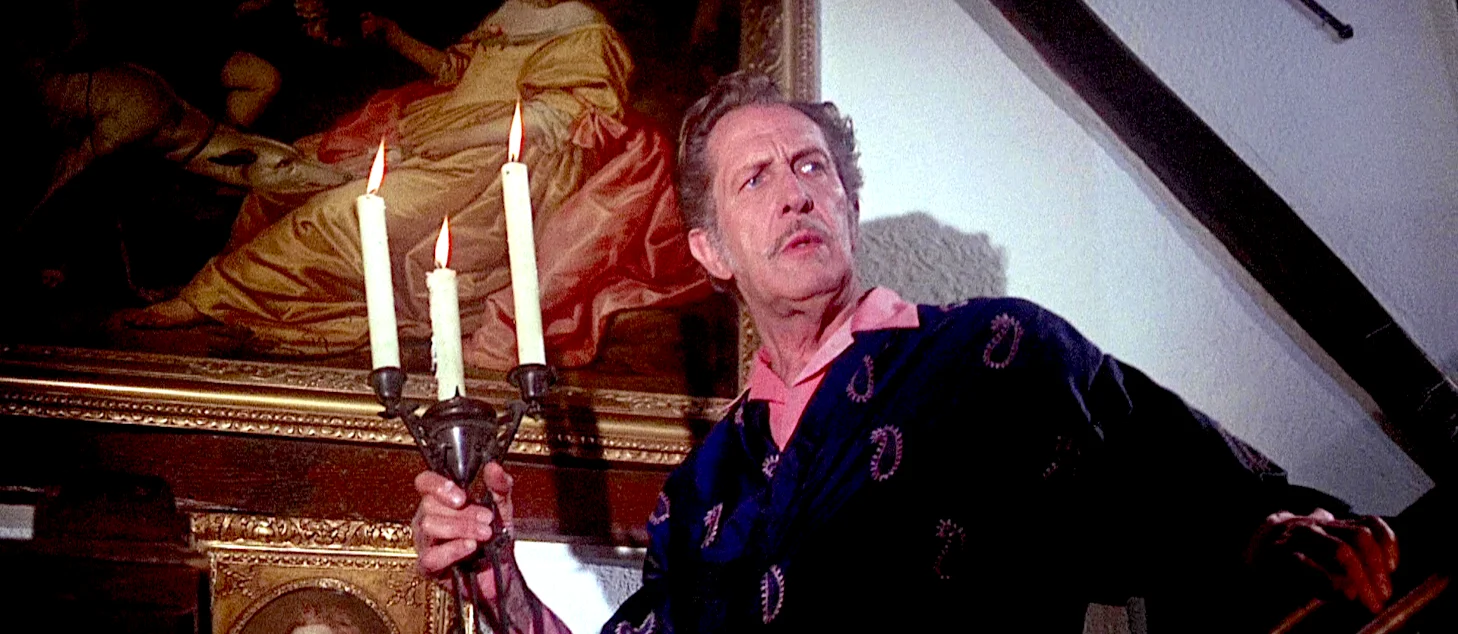

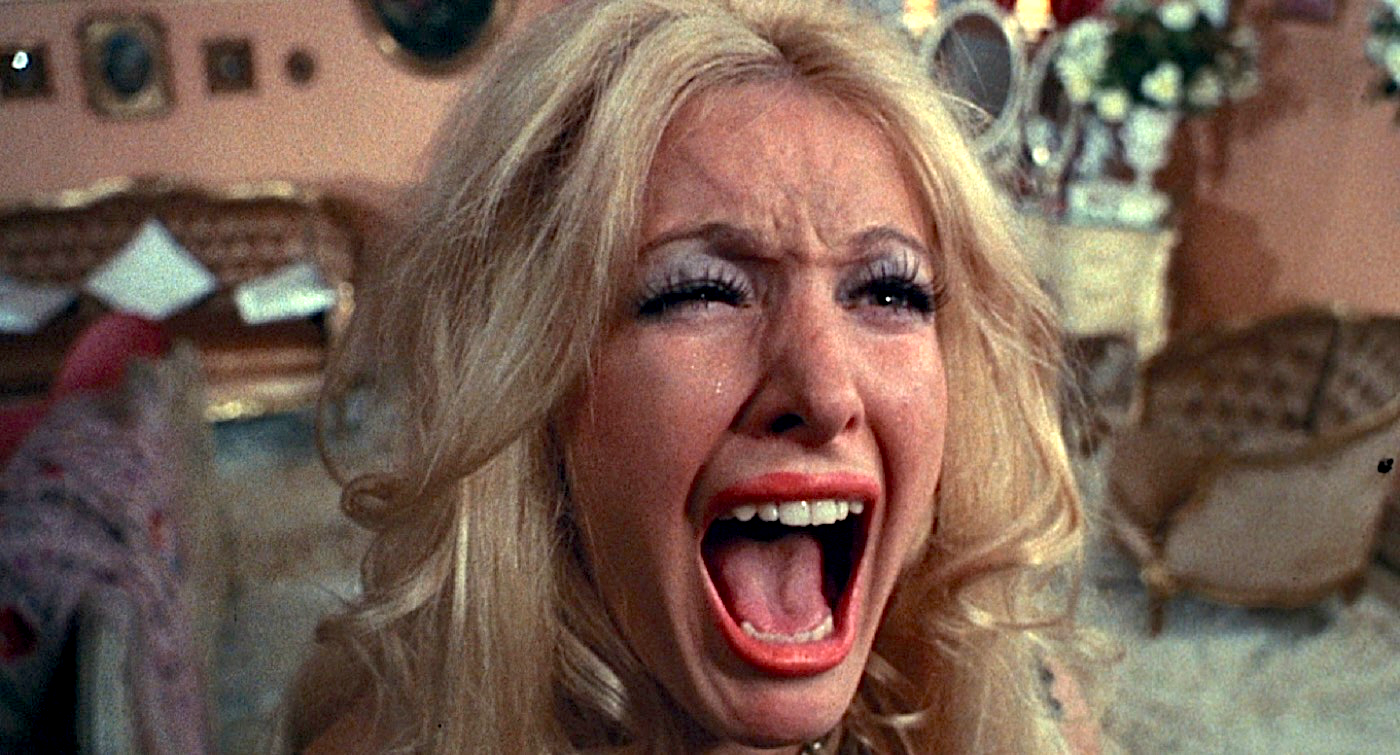
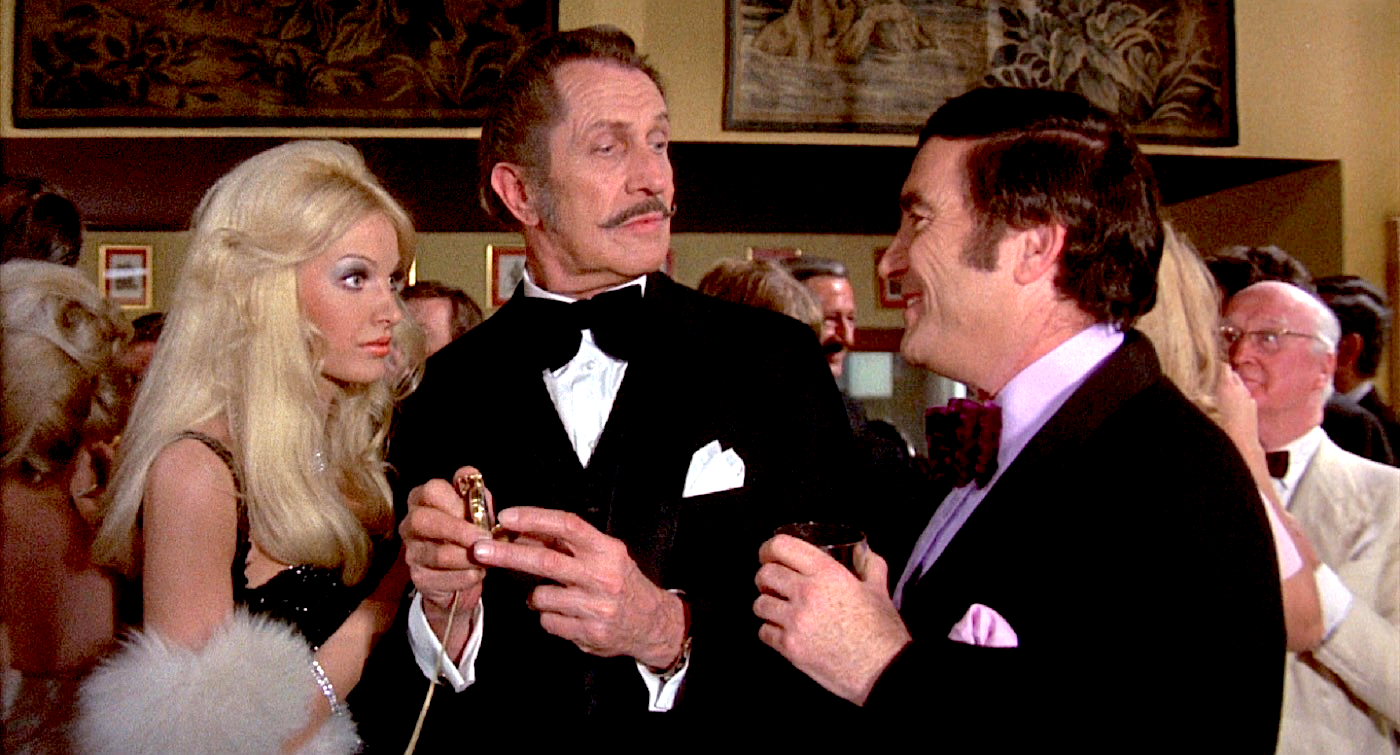
Hollywood, some years ago … horror film star Paul Toombes (Vincent Price) is hosting a swanky New Year’s Eve party and screening one of his signature “Dr. Death” movies when a spiteful producer, Oliver Quale (Robert Quarry), reveals that the actor’s young fiancée Ellen Mason (Julie Crosthwaite) got her start in Tinseltown by starring in his adult films. After withdrawing to her bedroom, Ellen is decapitated by somebody dressed as Dr. Death. Toombes awakens from a nap, finds Dr. Death’s leather gloves on his bed and subsequently suffers a complete mental breakdown when he discovers Ellen’s body.
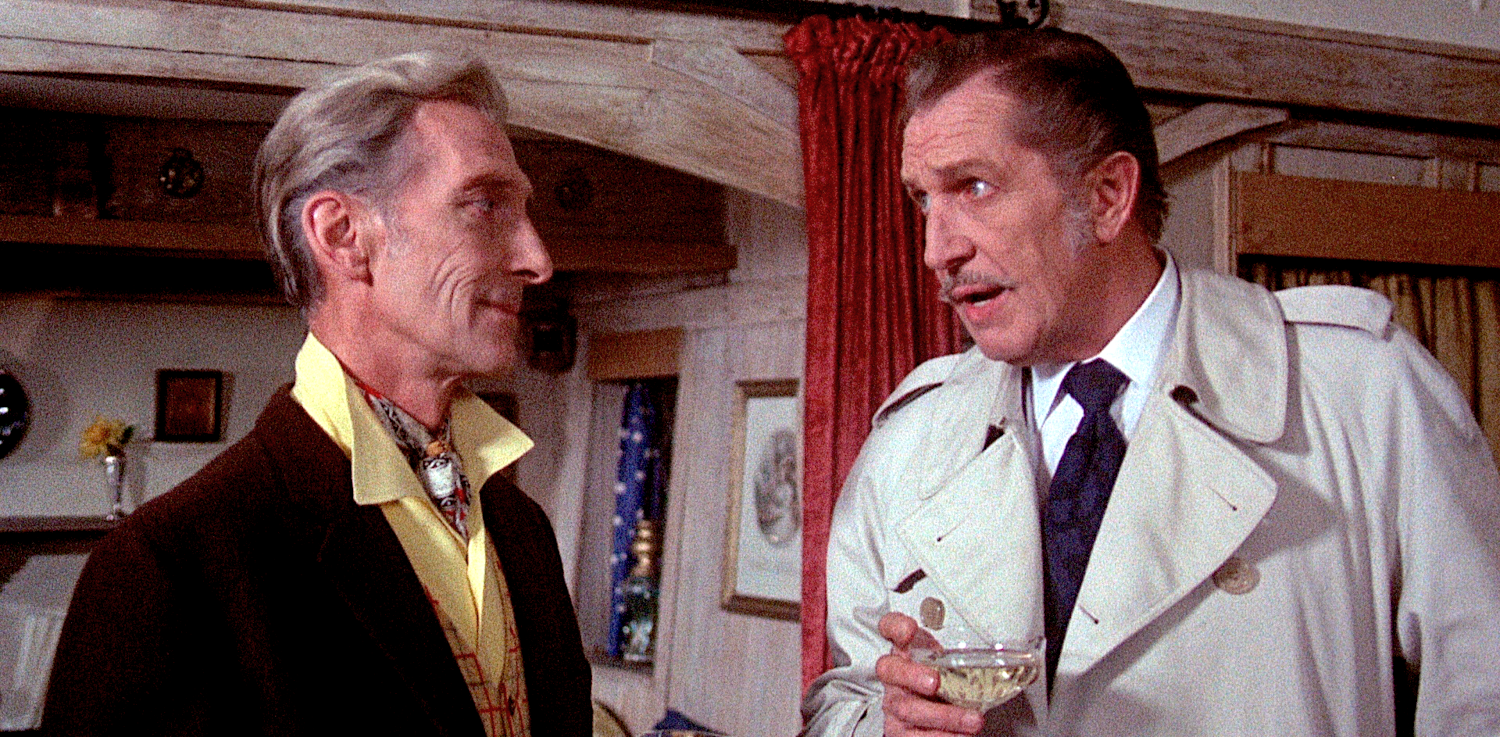
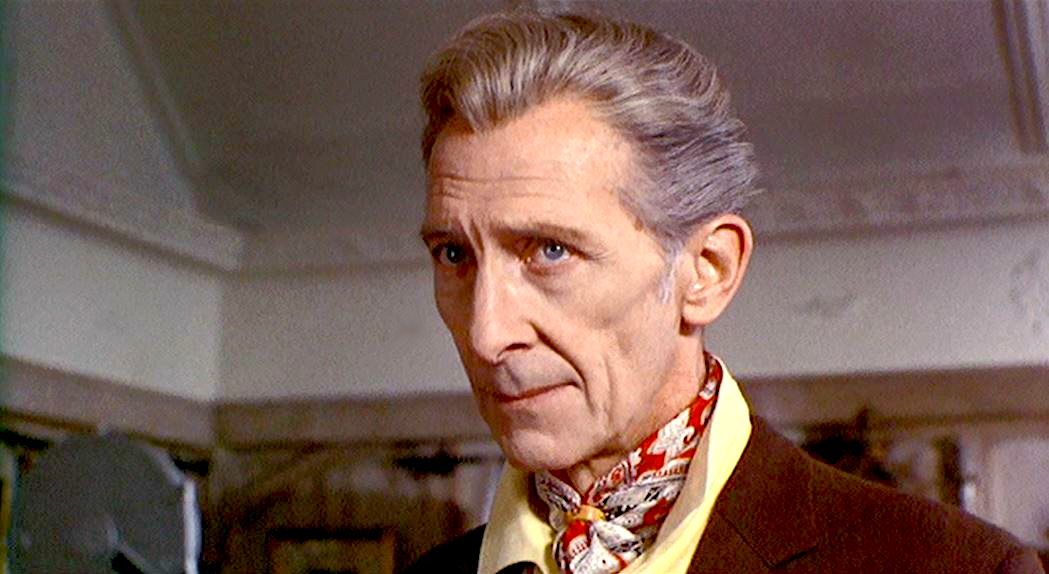
London, today … at the request of his old writer friend, Herbert Flay (Peter Cushing), a reasonably restored Toombes has come out of retirement to appear in a new Dr. Death television series. The actor is disturbed to discover that Quale is producing the show, but his fragile psyche is soon pushed to the brink when those around him start falling victim to somebody posing as the murderous Dr. Death.
Writing on Jim Clark’s Madhouse has often focused on what was going on in relation to the film’s troubled production as much as on the film itself. It was known that this would be Vincent Price’s final film for American International Pictures and that his contract with them was to be allowed to lapse without renewal by mutual consent. At the same time, old school horror films of the type that A.I.P. had specialised in were suddenly struggling to find an audience and the company had entered into a co-production deal with Amicus Productions in order to spread production costs.
That might have made sense financially but both companies’ executives had conflicting ideas about how the film should be developed. A.I.P. originally had Robert Fuest, the director of Price’s fantabulous The Abominable Dr. Phibes (1971), lined up to direct Madhouse but he had moved on by the time the film finally went into production. To make matters worse, Madhouse’s initial script required a series of hasty rewrites, with some still being done during filming. To top things off, Clark (who went on to become an award-winning editor) had his original cut of the film rejected. Madhouse was re-edited by Amicus’s Milton Subotsky and Clive Smith and then further re-edited by A.I.P. before its release.
Given the above context, it’s little wonder that Madhouse has tended to be overlooked when Vincent Price’s films / 1970s’ British horror movies in general are being critically discussed. I first saw the film when it debuted on TV sometime in the late 1970s / early 1980s. Madhouse was broadcast at a time when British TV was awash with screenings of classic and more recent horror films, so it faced some really stiff competition.
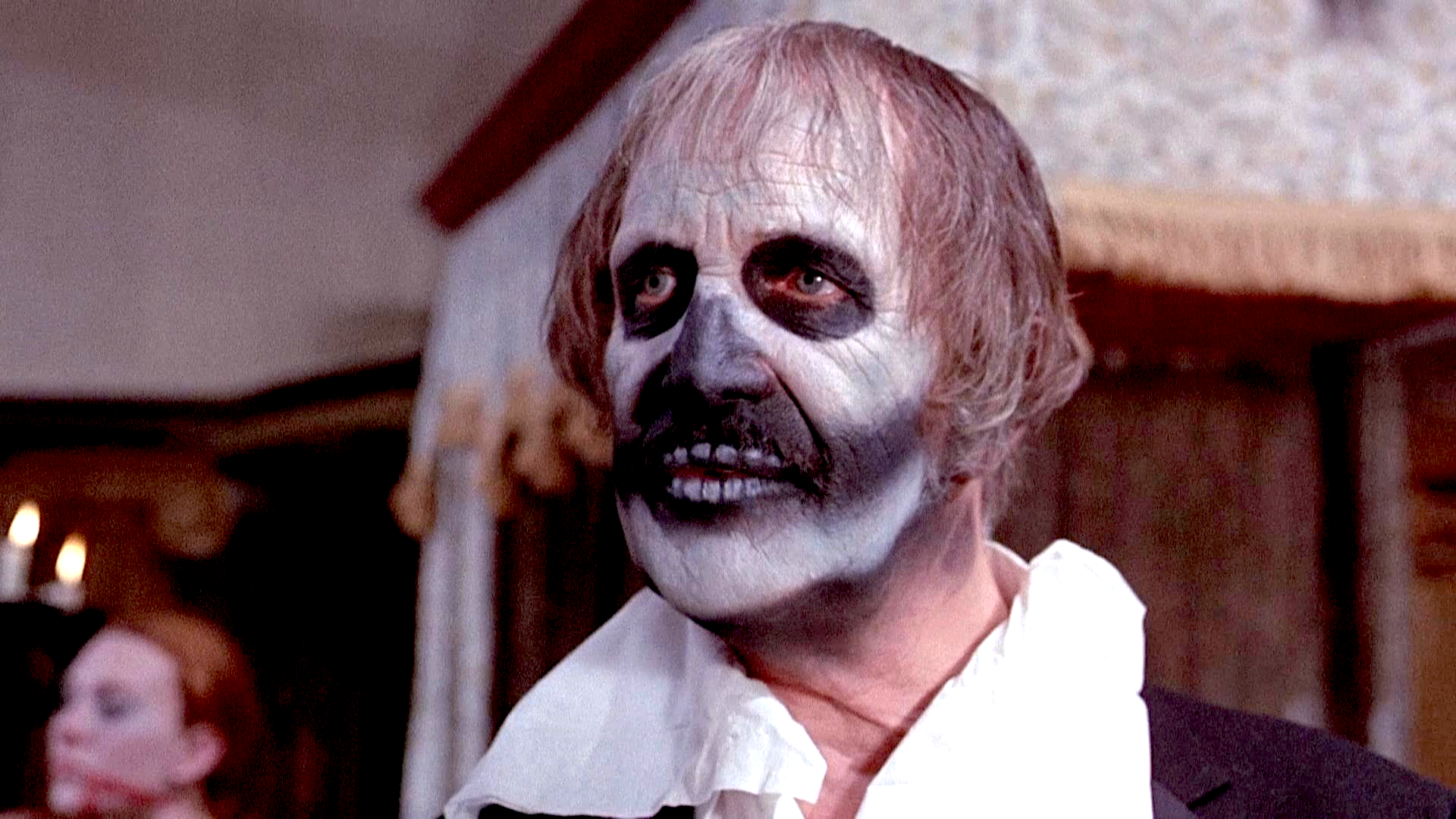
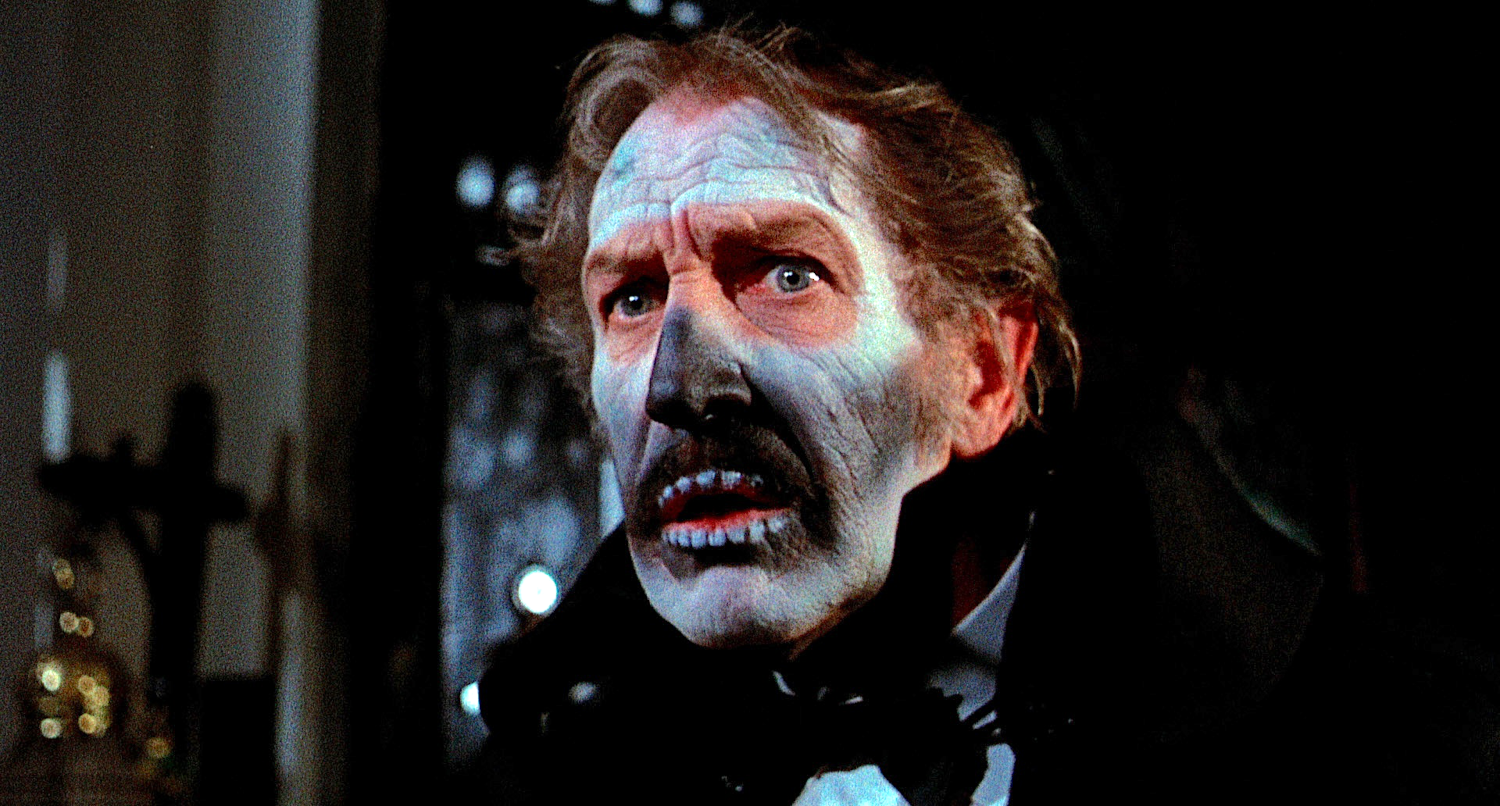
I thought (and still do) that Price looked amazing in his Dr. Death skull-face make-up and outfit, and I did enjoy the show. But I found the film’s finale somewhat hard to swallow on my initial viewing. Having come to appreciate, if not actively revel in, offbeat film endings during the intervening years, Madhouse’s bizarre but also remarkably sinister and disturbing finale sat much better with me when I revisited the film around the year 2000.
On reflection, Madhouse’s content does appear to mirror the divergent visions that Amicus and A.I.P. had for the film. On the one hand, we have the scenes that take place at Flay’s country pile, where Toombes stays as a guest. The manor house is creatively presented as a gothic abode. Mysterious statues litter its large gardens, its grounds feature an ominous-looking boathouse and fog-shrouded private access to the river Thames, and its gloomy interiors present much in the way of appropriately gothic decorations and atmosphere. It’s the kind of house that begs to be lit by candlelight. It’s therefore pleasing to have Toombes indulge in a bit of lengthy corridor wandering late at night with a candelabra in hand.
On one such wander Toombes discovers that a former actress friend, Faye Carstairs (Adrienne Corri), is now Flay’s wife. But the unfortunate woman has been reduced to living a life of crazed solitude in the house’s cellar, with only her pet spiders for company. It’s Faye’s unexpected appearance here that alerts us to the fact that, whether by accident or design, Madhouse is an atypical horror film and one that possesses the registers of an offbeat cult movie. That said, with set designs provided by Amicus’s regular art director Tony Curtis, music provided by Amicus’s regular composer Douglas Gamley, and camerawork by Ray Parlsow (who had shot the company’s The House That Dripped Blood [Peter Duffell, 1971]), the scenes at Flay’s country house certainly look and feel like scenes from an Amicus film.
By contrast, a good portion of Madhouse’s narrative is set within the modern TV world of the producer Quale and the busy London metropolis. And it seems logical to assume that the content of these scenes represents A.I.P.’s conflicting vision for the film. There’s a whiff of the gothic to be found in the sets built for the new Dr. Death TV series and in the clips from Toombes’s earlier works that are intermittently screened throughout Madhouse for one reason or another. These clips are actually lifted from Vincent Price’s older A.I.P. films. Given these reminders of A.I.P.’s filmic heritage, it’s a little surprising that the gothic vibe enjoyed at Flay’s house is largely absent from the remainder of the show.
In its place we have a series of modernist “stalk and slash” set-pieces that detail Dr. Death dispatching more victims. These sequences are well-realised and they give the impression that somebody at A.I.P. had recently viewed an Italian giallo or two, or perhaps a local production such as Pete Walker’s The Flesh and Blood Show (1972). Certainly the film looks as if instructions had been given to move its action in that generic direction, presumably in an effort to keep pace with the fast-changing trends in horror cinema. Dr. Death’s outfit and Ray Parlsow’s camerawork do lend themselves to the seemingly sought-after giallo aesthetic.
That still leaves the film’s strange supernatural finale, which demands an absolute suspension of disbelief on the part of the audience. It’s easy to imagine Milton Subotsky loving the finale. I wouldn’t be surprised to discover that he wrote it or saw a chance during re-editing to turn a more reality-based sequence into a supernatural one. I won’t spoil the finale, but it transforms Madhouse into a grim morality tale akin to those found in the E.C. horror comics of the 1950s. Indeed, the devilish contrivance that results in Toombes’s tormentor getting their comeuppance would have worked perfectly as an ending for one of E.C.’s horror strips.
Trimmed down, Madhouse’s narrative might have made suitable material for an episode in one of Amicus’s portmanteau horror films, where an ending featuring ironic justice of the supernatural kind would have been expected and applauded. As it is, Madhouse’s ending does play quite jarringly for first-time viewers since it sits at the end of a film that has up until that very final moment neither presented nor even hinted at anything of a supernatural nature. Either way, the show’s final word goes to Faye, who delivers a sly and very funny line of dialogue just as Flay’s mansion has become a truly mad house.
It’s hard to be overly critical of Madhouse, the effects of its troubled production history, its odd mix of gothic horror and slasher film tropes and its left-of-centre ending notwithstanding. Sure, it’s not as good as Price’s The Abominable Dr. Phibes or Theatre of Blood (Douglas Hickox, 1973), two films that it appears to reference at times. In fairness, Madhouse is a different kind of horror film altogether. More importantly, there remains much to enjoy and appreciate about Price’s performance here, which is actually very grounded and nuanced. Prior to Ellen’s demise, Price is on his expected form when Toombes delivers a delightfully theatrical speech to his assembled party guests.
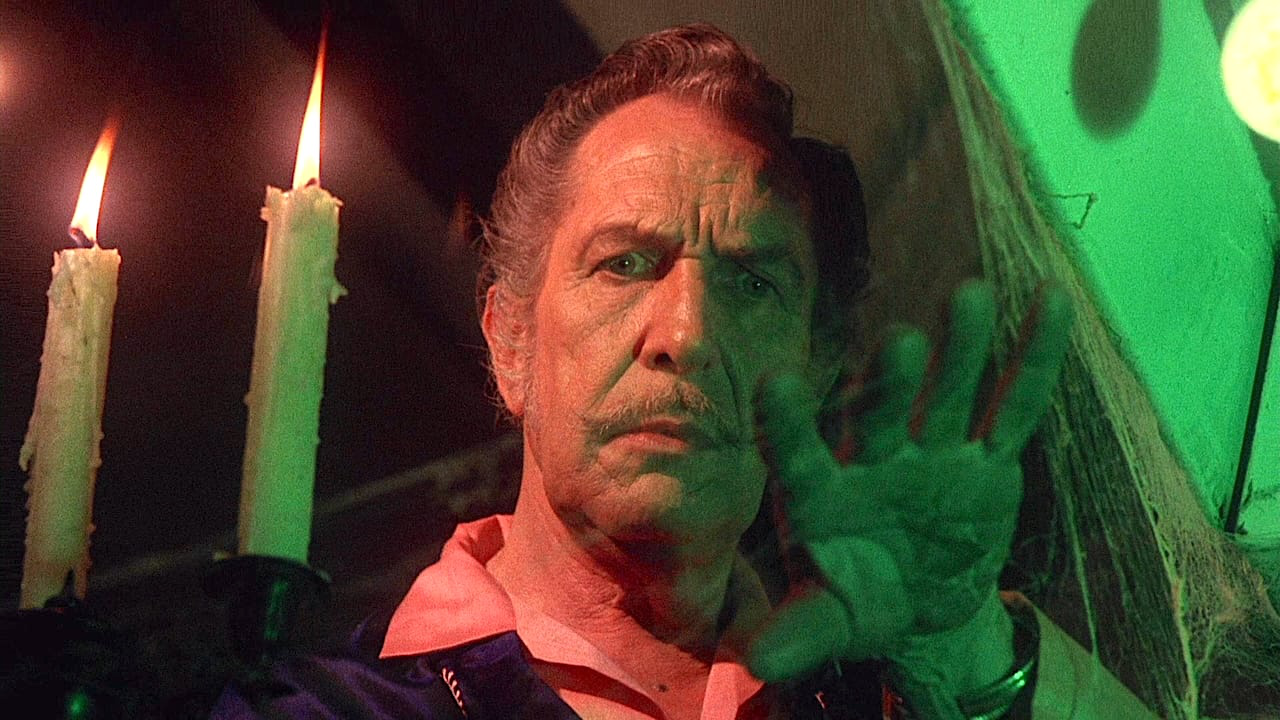
But when he reappears years later, Toombes is naturally somewhat subdued, cautious and at times confused. He’s also dismissive of his own abilities and of Dr. Death’s relevance. At other points, Toombes is angry, sarcastic and cantankerous and Price telegraphs all of these states of mind and actions very well. We’re also acutely aware that an ageing horror film icon at a career crossroads is playing an ageing horror film icon who is continually being forced to look back upon his once glorious career. This metatextual aspect of the film adds an extra layer of interest to the show and generates sympathy for Toombes.
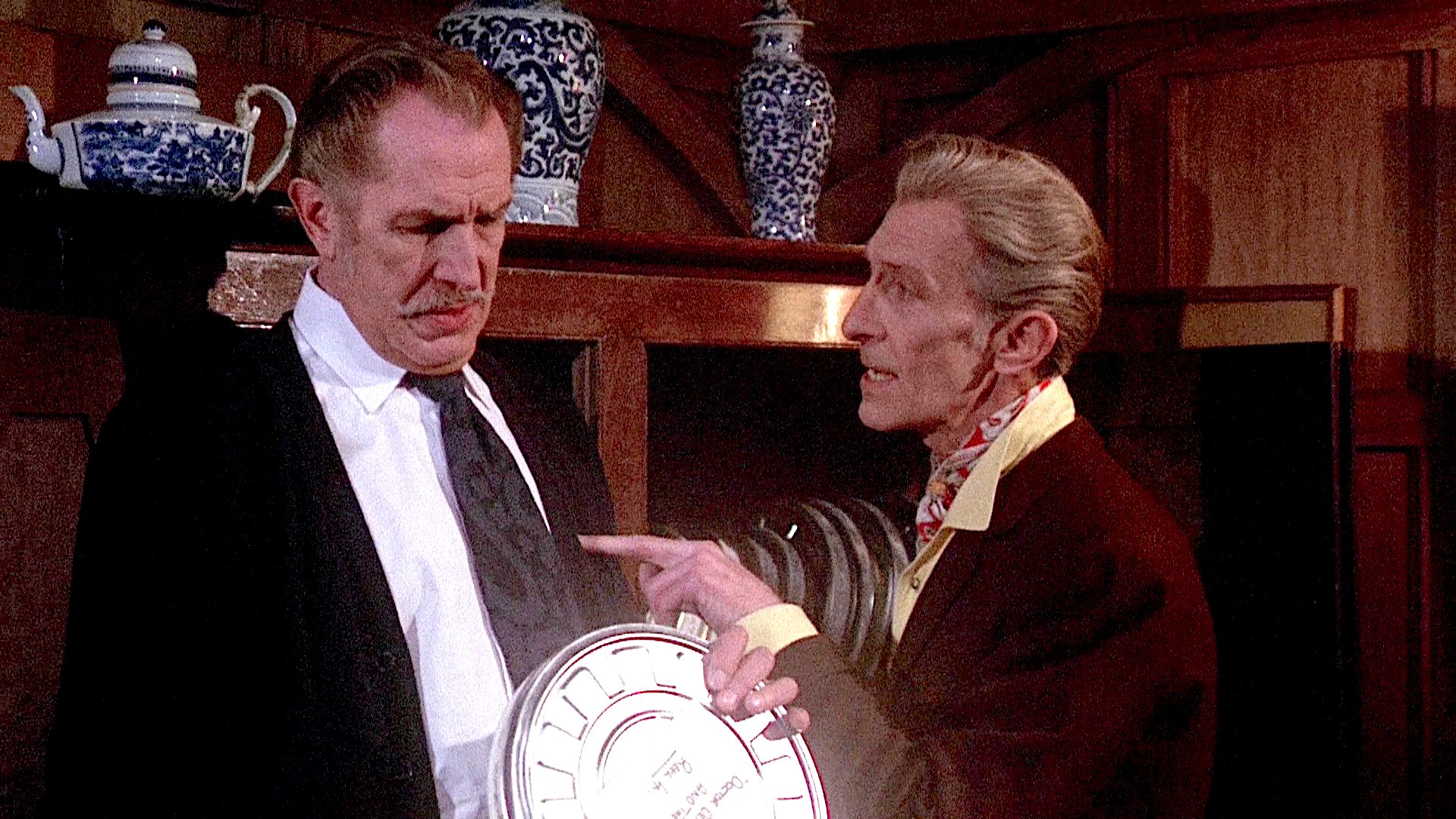
Beyond Price, it should be noted that A.I.P. and Amicus managed to assemble a really pleasing wider cast who are able to elevate the film just by their presence. Madhouse isn’t Peter Cushing’s best film for Amicus, and Flay isn’t his most interesting character, but it’s just so good to have him here sharing scenes with Price. The pair seem to be enjoying themselves enormously when they’re onscreen together. Cushing plays a crucial role towards the end of the film and he does so to great effect.
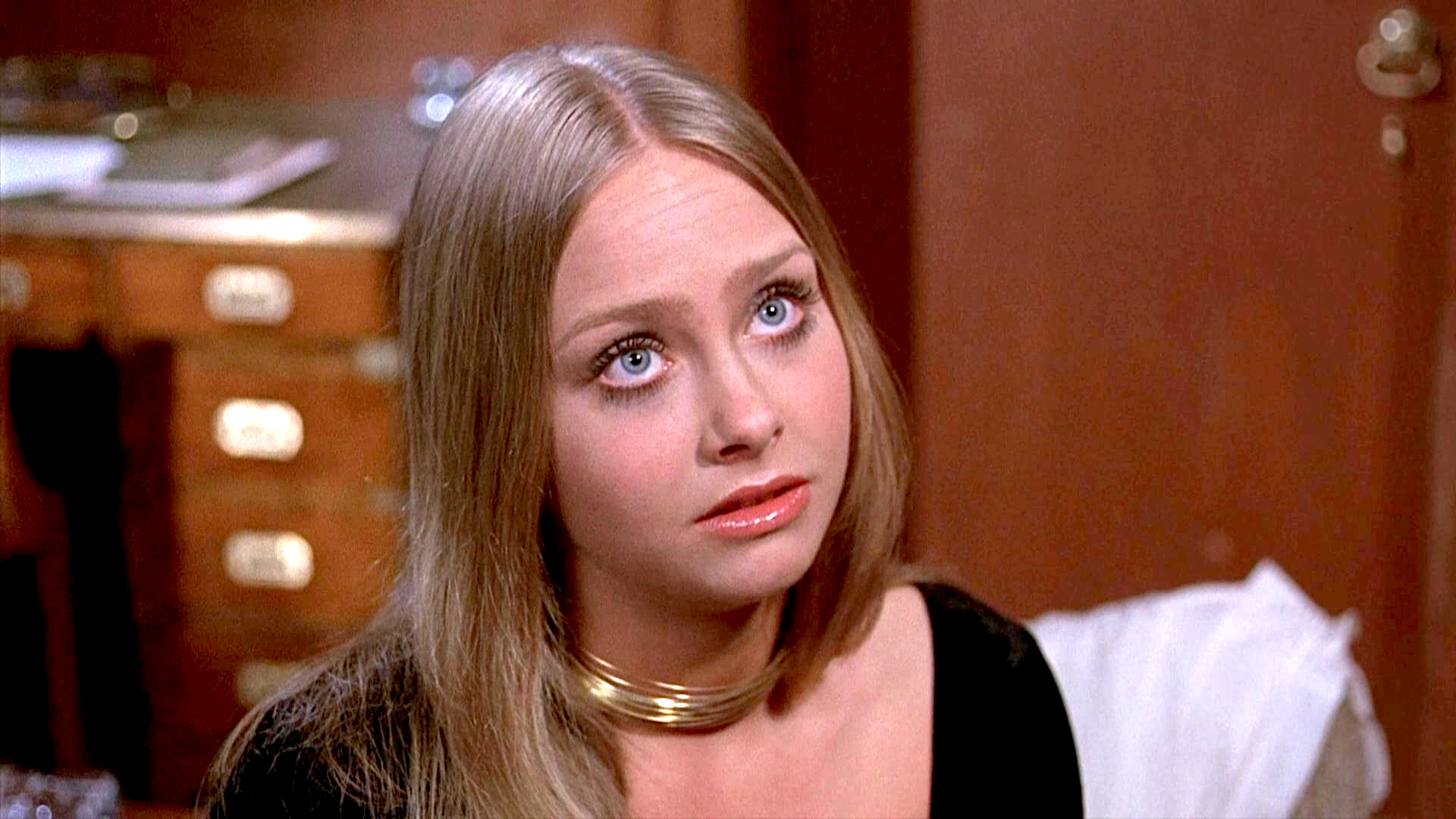
Fans of early 1970s horror films will also be happy to find Robert Quarry and Linda Hayden participating here too: a fun scene at a fancy-dress party has Quale dressed as Quarry’s A.I.P. vampire character, Count Yorga. Another shot of the same party’s masked guests, which is filmed from the point-of-view of the screen upon which another Dr. Death / A.I.P. Price film is being projected, looks like a flash-forward to something from the Milton Subotsky produced Vincent Price vehicle, The Monster Club (Roy Ward Baker, 1981).
Elsewhere, Natasha Pyne is absolutely charming as Julia Wilson, Quale’s PR girl, while Adrienne Corri tackles the strange role of the nocturnal spider woman Faye Carstairs very well. The popular British TV chat show host Michael Parkinson pops up as himself in a fun live television interview sequence. Toombes crashes the interview early and in a very distracted state. And, of course, Boris Karloff, Basil Rathbone and others appear courtesy of the various clips from Toombes’s / Price’s older films.
Jim Clark disowned Madhouse when Subotsky and Smith commenced a re-edit of his director’s cut. His negative experiences on Madhouse prompted Clark to give up directing feature films altogether. He returned to being a full-time editor, which is a shame because he had shown some promise with his two earlier directorial efforts. His Marty Feldman vehicle Every Home Should Have One (1970) is an enjoyable enough contemporary relationship-in-crisis romp that put Julie Ege on the map in the UK.
His second film Rentadick (1972) is undoubtedly the most crazed and silly private detective-cum-espionage spoof ever made. Originated by Graham Chapman and John Cleese, its fevered script shoots off in a million and one directions at once and its superb cast is chockfull of unruly comedic talent. But Clark somehow managed to wrangle it all into something of interest. Rentadick might best be described and appreciated as an idiosyncratic take on the popular British sex comedies of the time. Perhaps we should choose to appreciate Madhouse as an idiosyncratic take on the popular British horror films of the time.
In an archival interview reprinted in the booklet that accompanies Eureka’s new limited-edition Blu-ray, Jim Clark indicates that he felt that no amount of wrangling would have allowed him to deliver the film that he originally had in mind. There was just too much interference and distracting activity going on behind the scenes. What we’re left with is a curiosity that lacks the finesse of Price’s Dr. Phibes films and Theatre of Blood. But it’s a show that fans of Price, Cushing and early 1970s’ British horror films will be more than happy to have back on the market again.
I’m a fan of “Madhouse” having seen in theaters. While the ending just didn’t quite fit with the rest of the film, Price and Cushing are delightful together. The animosity between Price and Quarry in real life (or at least from Price) helped their scenes together.
I’ve liked every Vincent Price movie that I’ve seen. My mom recalls how, growing up in a small town, she always made an effort to see Price’s movies when they came to the local theater.