
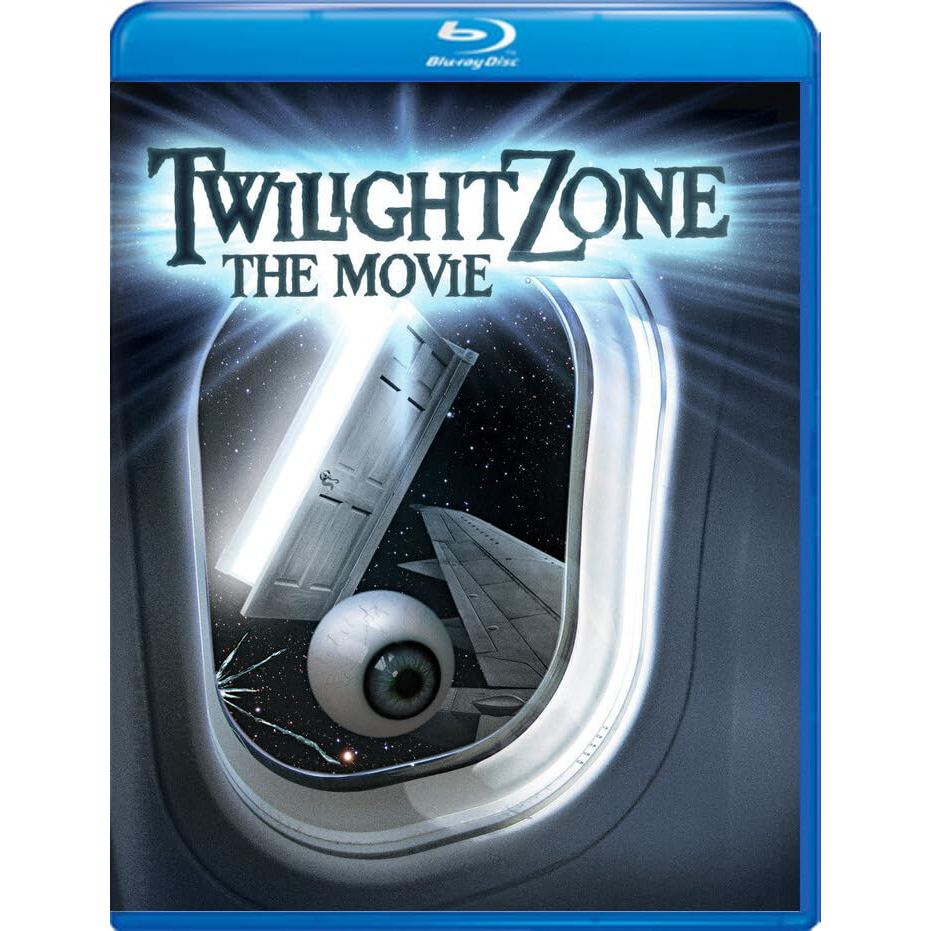

Steven Spielberg’s so-called flop ‘1941’ didn’t slow his rapid ascent to the top of Hollywood. After a reinvention of serial thrills, a heartwarmer about a lovable mushroom man from outer space and an attempt at a barnstorming horror show, Spielberg was canonized as an industry institution more powerful than any studio. He would soon branch out to TV with an ambitious ‘Twilight Zone’- type show called Amazing Stories. Anticipating that move, he put together an ode to the original Rod Serling series, an omnibus combining four remakes of classic episodes.
Twilight Zone: The Movie came together quickly, guided by a quartet of directors with impressive hits under their belts. Spielberg took one episode for himself. Co-producer John Landis wrote his own opening story, that reportedly rearranges ideas from multiple original TZ episodes. Joe Dante and George Miller each took on a vintage classic. Both were originally penned by Richard Matheson, who ended up a main writer on the movie. Although they share some personnel, the four major segments operated almost as separate productions.
The film’s accomplishment was overshadowed by a tragic accident during the filming, which became a major industry debacle that included a lengthy trial. John Landis’s segment was altered, and (according to my information) Spielberg’s choice of TZ episodes to remake was changed. The finished feature film went on to perform decently at the box office.
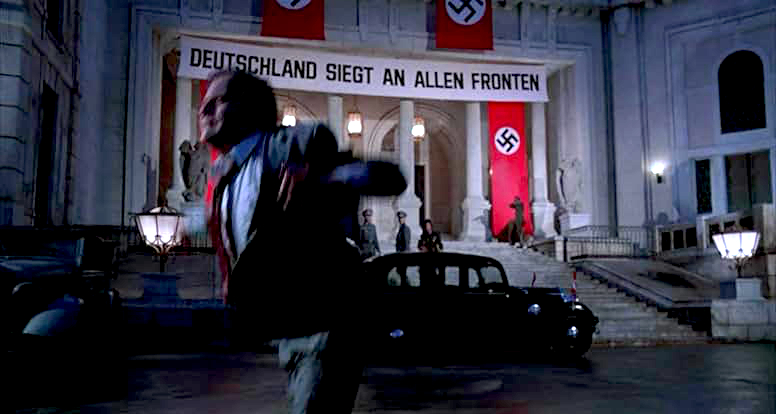
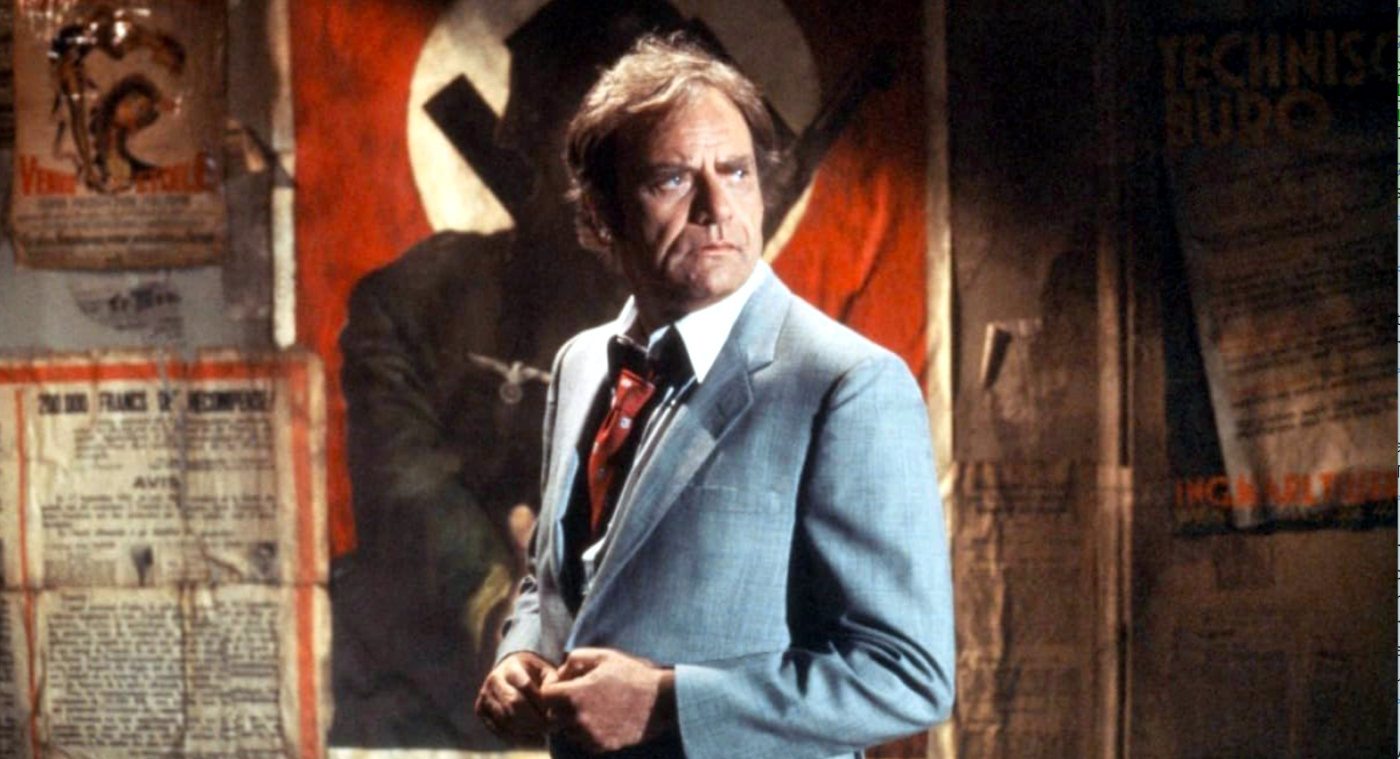
John Landis’s episode Time Out echoes the kind of ironic morality play favored by Rod Serling on the original series. It stars the talented Vic Morrow as Bill Connor, an embittered bigot who blames minorities for his bad luck. After throwing racist slurs around a bar, Bill is singled out for a cosmic schooling about minorities and oppression. It takes the form of a time-warp steeplechase into several different historical periods.
Bill’s harsh moral comeuppance give him a terror-tour of horrors suffered by Jews, blacks and Asians. Bill is pursued and shot at by SS officers in Nazi-occupied France, threatened with lynching by Ku Klux Klansmen in the South, and hunted in Vietnam by American soldiers who see him as a Viet Cong enemy. The episode is decently made, but rather schematic and predictable. For his last film role Mr. Morrow must play an unfunny, mean-spirited Archie Bunker type. It comes off as an exercise in wish-fulfillment: I should think that a genuine racist bigot would simply see his punishment as unjust, and feel all the more persecuted.

George Clayton Johnson wrote 8 or 9 original TZ episodes, and his original ‘Kick the Can’ is recommended as one of the series’ best. A group of disaffected retirees in an old folks home worry about one of their own, who ‘irrationally’ insists that he can become young by simply acting young. Steven Spielberg’s remake for TZ: The Movie takes on a directing challenge with a large ensemble cast, many of whom had to be doubled as children. It’s the kind of show that reminds us of Frank Capra folksiness … but we’re not sure that even Capra could make it work.
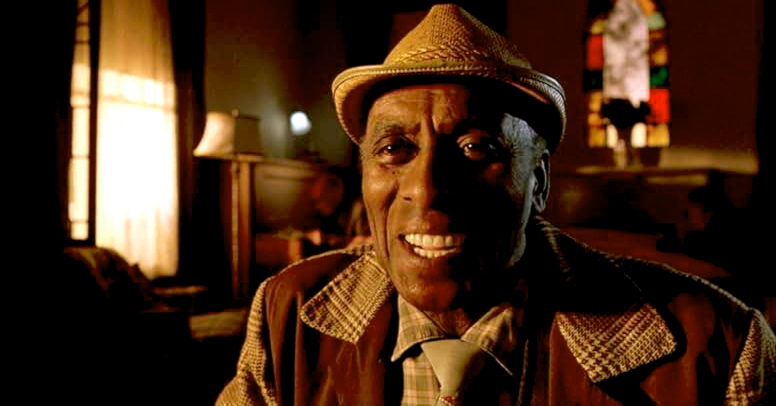
The 1983 remake turns the tale into a literal Peter Pan story, with the outsider Mr. Bloom (charismatic Scatman Crothers) inspiring the lethargic patients to ‘think young’ and learn how to play again. After a ‘magic’ playtime one of the oldsters (Murray Matheson of How to Succeed in Business Without Really Trying) chooses to remain young. Scatman Crothers’ literal ‘Magic Negro’ character moves on to his next retirement home miracle.
Spielberg gets fine performances from his veteran players, who include Peter Brocco and Priscilla Pointer, Amy Irving’s mother. Doing especially well is Bill Quinn. His sympathetic retiree feels abandoned by his son, and has difficulty re-learning how to play. Despite the episode’s attention to detail, we’re still stuck with a group of ‘cute’ old folks slowed down by generalized age-related impairments, as opposed to gnawing medical complaints. Positive thinking can be a great healer, but the spectacle of seeing these people rejuvenated doesn’t feel all that liberating. A simple brightening of attitude is what’s needed, and these nice folks aren’t stuck in the kind of elder care hellhole that many but the wealthy enjoy. The episode’s heart is in the right place, but the magic doesn’t gel.
We’ve watched the first two episodes a couple of times each, but in subsequent viewings we tended to skip from the end of the prologue and main title, down to episode #3. Remember the post-Star Wars moviegoing mantra, the 1980s promise of a thrilling rollercoaster ride at the movies? The second half of Twilight Zone: The Movie is outstanding fantastic filmmaking with human involvement and mind-bending ideas. *
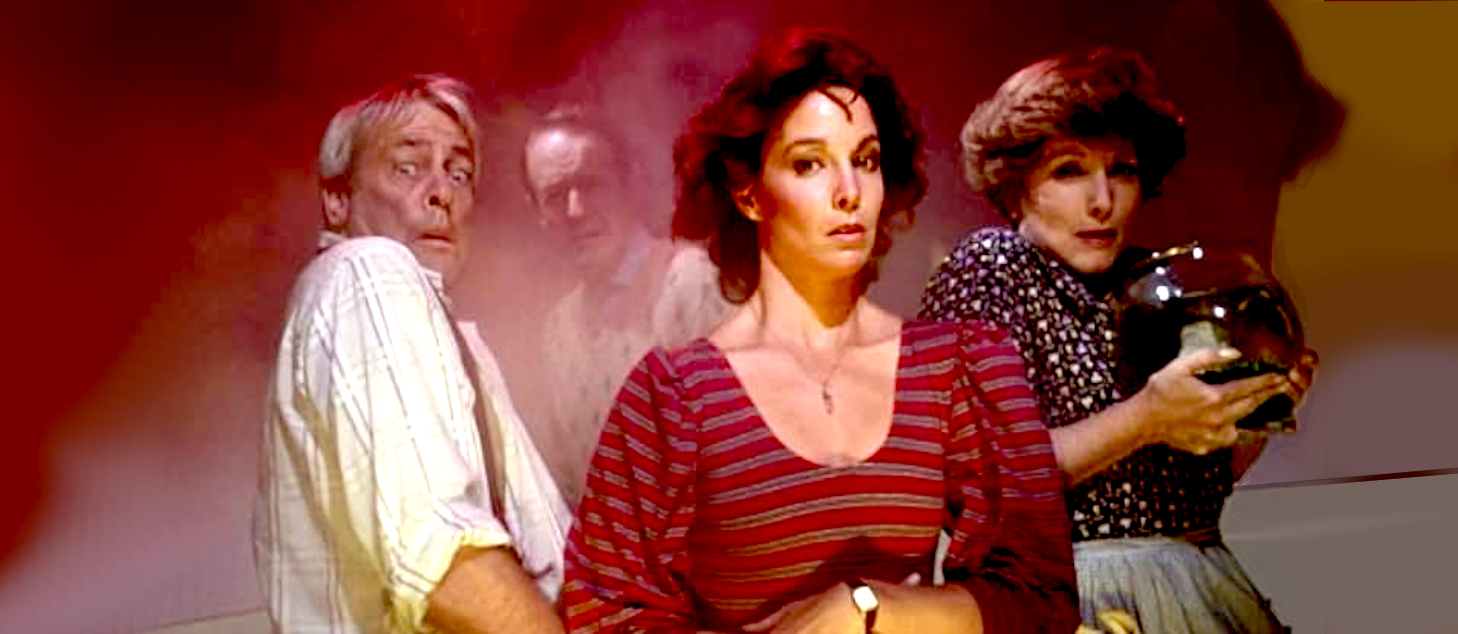
Nobody ever forgets It’s A Good Life, the stone classic 1961 Twilight Zone episode written by Rod Serling. Based on a short story by Jerome Bixby of It! The Terror from Beyond Space and Fantastic Voyage, the original features chilling performances from Billy Mumy, Max Showalter, Cloris Leachman and John Larch. The Richard Matheson-Joe Dante remake retains the horror and adds fresh and challenging new shocks. Dante makes excellent use of optical effects and the makeup wizardry of Rob Bottin, who three years before helped Dante turn The Howling into a horror classic.
Schoolteacher Helen (Kathleen Quinlan) meets little Anthony (Jeremy Licht) in a parking mishap. She drives him home, only to find that Anthony lives with a ‘family’ consisting of strangers he has forced to pretend are his relatives. How is this? The immature Anthony possesses an unexplained control over reality itself. He has apparently wiped out his real family; having little or no empathy for others, he runs ‘reality’ strictly for his own pleasure. Anthony’s home is a surreal nightmare tailored to his preferences. TVs in every room show bizarre cartoons night and day. He forces everyone to eat strange meals. He’s aware of the fear and loathing in his ‘family;’ when he loses his temper all bets are off. They live in terror: will they be transformed into inanimate objects, or be flung into some tortuous alternate reality?
An unhappy, mercurial boy has the power to control everything in the world, have anything he wants, and to torment those that displease him. How topical can a 43 year-old movie get?
Joe Dante’s episode embellishes the original without distorting its meaning. The director’s inclination toward horror laced with comedy is a perfect fit, as is Dante’s growing fascination with blending the ethos of old Warner Bros. cartoons into his feature work. Anthony’s horrid warpings of reality resemble the cartoons he loves — one crazy monster could be the Tasmanian Devil reimagined by a gore-obsessed ten year-old. In the original 1961 show, Anthony’s ultimate punishment for those who displease him was to ‘wish them into the cornfield.’ Dante’s Anthony throws his victims into ‘Cartoon Land,’ to become prey for cartoon monsters. Their demise becomes a show we can watch and laugh at.
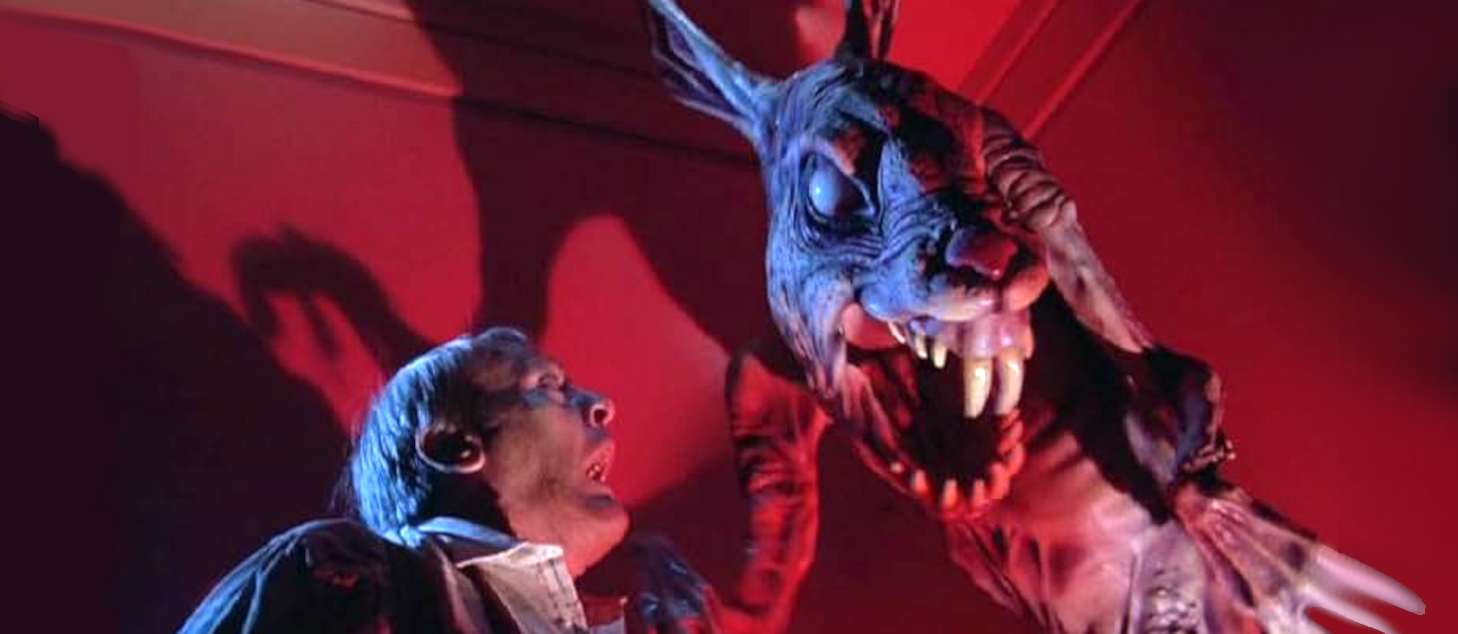
The show looks like an animated cartoon given a full nightmare treatment. The characters are framed in tight formation against bright walls, with dramatic lighting. Half the appeal is watching Anthony’s captives struggle to affect a normal composure, when they’re all but paralyzed with fear. As adapted by Richard Matheson, Joe Dante’s version goes in a different direction than the original. He does this by not letting Kathleen Quinlan’s schoolteacher succumb totally to the terror: Helen understands Anthony and may be able to influence him. That promises some hope for the world, as it appears at one point that Anthony has made all of creation disappear, except the space where he and Helen are standing.
Director Dante builds on his stock company of actors, adding William Schallert to his collaborators Dick Miller and Kevin McCarthy. Not hurting is the presence of Ms. Quinlan, who we fell in love with in American Graffiti … her characters always exude intelligence and integrity.
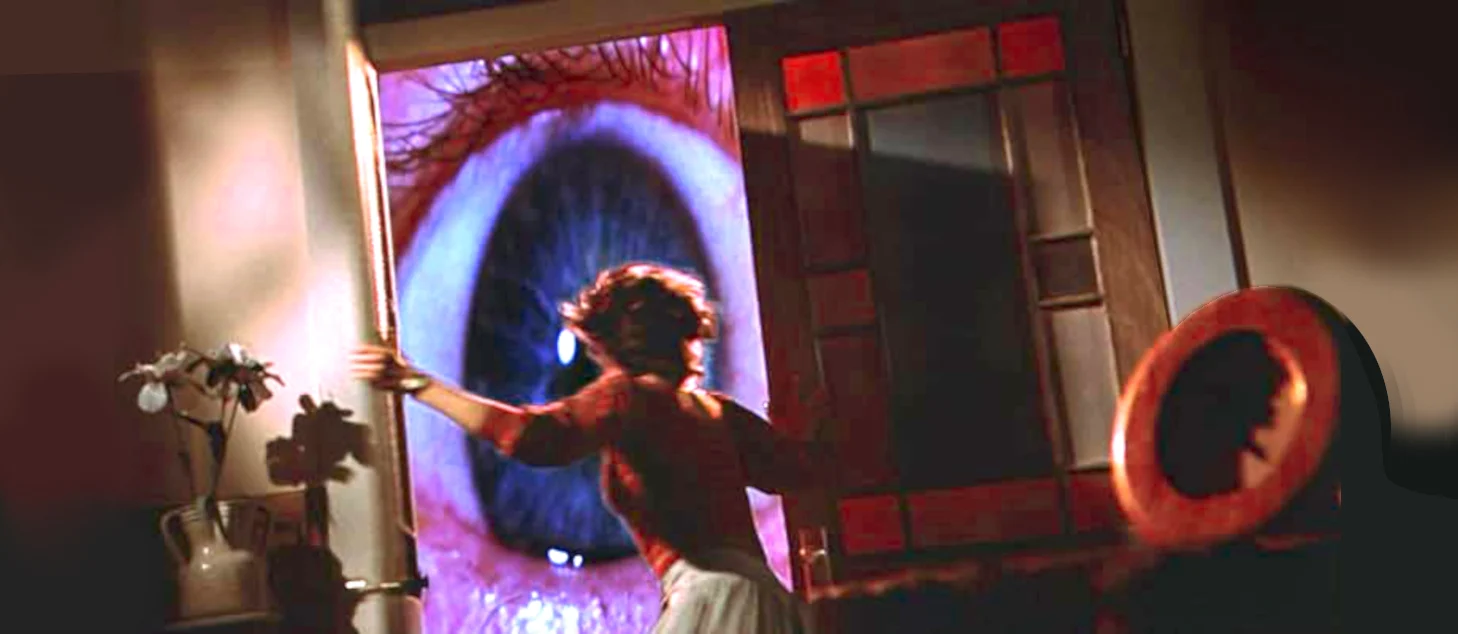
Anything can happen in Anthony’s ‘crazyworld.’ At one point the show recreates a surreal shock straight out of The Crawling Eye. The optical wizardry, the specially-created new animations and Rob Bottin’s show-stopping makeup effects don’t crowd out the scares. We stay focused on the personal dynamics of Anthony’s reign of pre-teen terror.
Some brilliant directorial bits are on view. Joe Dante’s unsung masterstroke is a dialogue scene between parallel copies of Anthony and Helen, accomplished with a simple double exposure. It expresses perfectly a spatial limbo where the rules of time and matter are no longer in force. It’s a clever yet subtle and organic bit of visual expression, the most original bit of fantasy creativity of the decade. The episode capper is a magical matte painting trick by artist Rocco Gioffre.
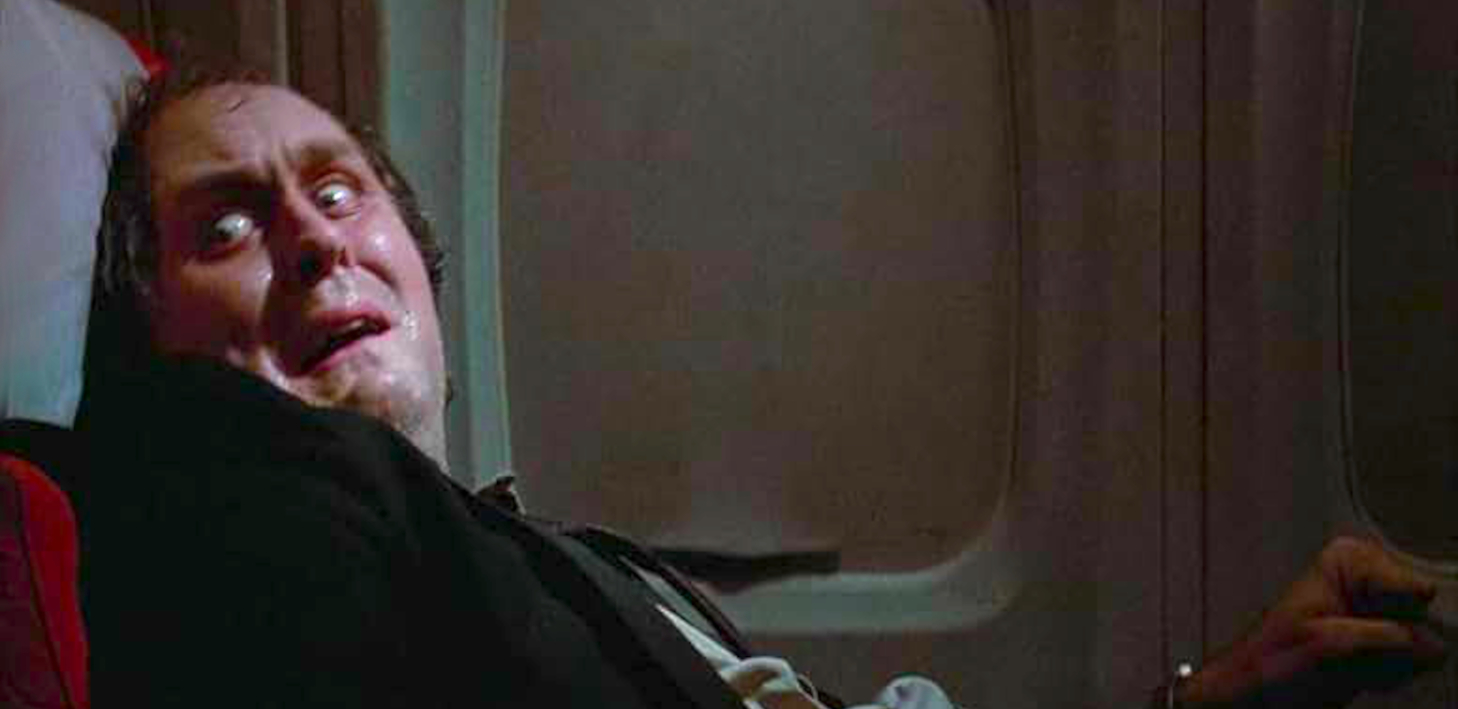
Equally in command of his fantasy filmmaking is director George Miller, whose episode Nightmare at 20,000 Feet delivers the knockout horror finale the omnibus film needs. The director of Mad Max 2: The Road Warrior applies all of his skill to make us share the clammy, shivering terror of his woeful airline passenger. The fluid camera ignores the conventions of ‘in-flight’ movies. Forget lame shots that say ‘air cabin mockup’ … we’re jammed in there to sweat right along with the guy.
The Joe Dante episode guaranteed viewer sympathy with Kathleen Quinlan; John Lithgow does the same with Nightmare, registering an unrelieved 20 minutes of white-knuckle hysteria. When not cowering in the airliner’s lavatory, Lithgow’s John Valentine squirms and twists in his seat, his face bloodless and his fingers twitching. And this is before he sees the creature on the wing, the famous gremlin that terrified William Shatner in the original 1963 TV episode. Most of the action is focused on John’s window. Only he sees the monster tearing away at engine number one.
This time around, writer Richard Matheson had the luxury of refining his own work. Poor Valentine flips out at least three times, but the reactions of passengers and crew are never exaggerated. Abbe Lane is the most soothing, professional flight attendant imaginable. Valentine takes rational steps to prove his hallucination, like trying to photograph the gremlin with a Polaroid swiped from a little girl. In one excellent speech, Valentine talks himself down with calming logic … only to go ballistic when again confronted by the demon outside his window port.
George Miller’s camera is as nervous as the editing; the segment’s mini-climaxes build to a ‘fight or flight’ panic situation. As crafted by makeup artist Craig Reardon, the gremlin is an acrobatic air demon with horrid teeth and claws that rip through the aircraft’s metal skin. He’s not pretty — all he wants is to make that plane crash.
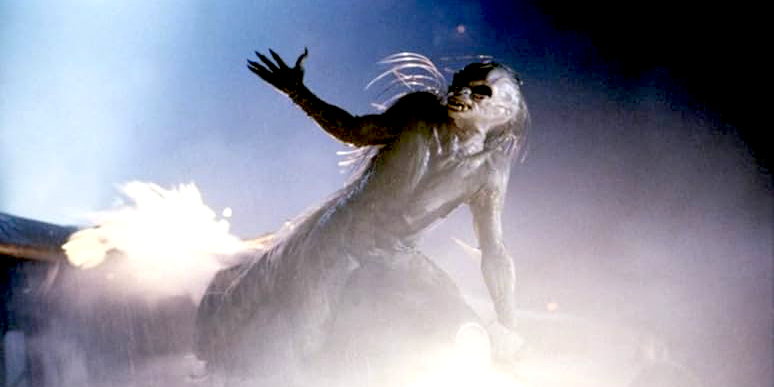
The new bits of action and chaos — a cabin window gets blown out — ratchet the tension two or three notches higher. With Reardon’s help, Miller pulls terrific little subliminal effects with Valentine and the gremlin nose-to-nose through the window glass. In the middle of a flurry of short cuts, Valentine’s eyes pop to twice their size, just for a flash. The makeup artist concocted the gag in just a few hours; Allen Daviau’s lighting and the handheld camerawork sell the effect. John Lithgow’s claustrophobic hysteria is appropriately BIG, and quite an acting achievement. The episode is the kicker that the show needed, putting Twilight Zone: The Movie over the top.
Craig Reardon was also called in at short notice to concoct a horror-face for John Landis’s prologue, in which Dan Aykroyd and Albert Brooks sing songs and play word games on a long-distance drive. Each story begins with a tilt-down from the sky accompanied by a portentous voiceover, as in the original show. Handling the inter-episode voiceover narration is Burgess Meredith and, at the finale, Rod Serling himself.
At one point the plan was to make the stories interlock with some framing device, perhaps sharing some characters, like the classic English film Dead of Night … but the plan settled into more or less straight remakes of favorite episodes.
In answer to the best Amicus episodes, I would nominate Sweets for the Sweet from The House That Dripped Blood, the Weird Tailor from Asylum, Poetic Justice from Tales from the Crypt and An Act of Justice from From Beyond the Grave. Kindness and Sweets are very arty and character based
Thanks Andre … that’s very helpful … !
The Dante and Miller segments are as good as the Landis and Spielberg segments are bad.
When the film was released I recall one critic (maybe Richard Schickel) saying that the Landis segment wasn’t even worth filming, much less dying for. He was right.
I thought it was a weird decision to turn “It’s A Good Life” into a sort of comedy. The original is one of the most original and terrifying episodes of the series, much more effective than any of Mr. Serling’s heavy-handed political fables. The re-make is just OK, enjoyable mostly to see a bunch of beloved character actors allowed to ham it up. I also thought the ending had some odd sexual overtones but that may be just because, like Glenn, I have a great fondness for Kathleen Quinlan.
I could never not hate Landis and a glitz-blinded jury after this criminal carelessness.
Part 3 brings new meaning to the phrase “and a child shall lead them”.
I was wondering if anyone knew if the film was a settlement to Richard Matheson from Steven Spielberg for borrowing the story of “Little Girl Lost” from the “Twilight Zone” and turning it into “Poltergeist”? The film seemed to come right after “Poltergeist” and would explain why Spielberg got involved with it in the first place. “Poltergeist” is famous for being a “cursed” film and it seems like the curse carried over to “Twilight Zone: The Movie”.
For me, the John Landis segment makes this film unwatchable.
The Spielberg segment is nothing to write home about either, but I know what you mean. I only watch two segments of the film.