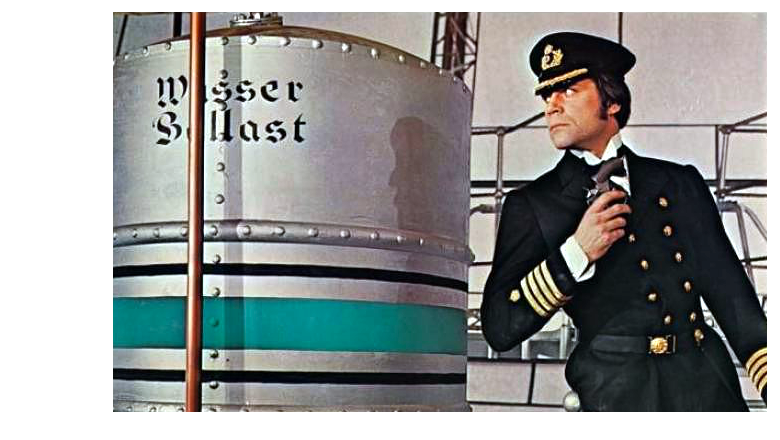


The tone of the Michael Relph / Basil Dearden vintage spy spoof The Assassination Bureau is summed up in a dialogue line by the head of a company specializing in extra-legal killings:
“We only kill people who deserve to die.”
Starting with the notion of James Bond 007’s license to kill — a nullification of ‘dull, old-fashioned’ morality, the motto of The Assassination Bureau, Ltd. addresses its main subject with a ’60s attitude called Tongue In Cheek: we’re only kidding, and if you don’t get the joke, the joke’s on you.
The Assassination Bureau uses a quasi-moral excuse for its mayhem — the handsome young hero believes in his impromptu murders by dynamite and poison. The politically ‘safe’ premise is that a pair of thoroughly dastardly villains want to jump-start a World War so they can sell armaments, and the killings of some people in high places should do the trick nicely. The shallow moralizing references both 1914 Sarajevo and 1969 Vietnam.
Relph and Dearden had been making excellent thrillers since 1946, and were trying to keep the British New Wave from embalming them as the Old Guard. It’s produced on a fairly lavish scale and played to the hilt by favorite character actors. The script lacks true wit and the direction isn’t particularly stylish, but we like the spirited performances, especially those of stars Oliver Reed and Diana Rigg. They get the joke, and play it with nary a false note.
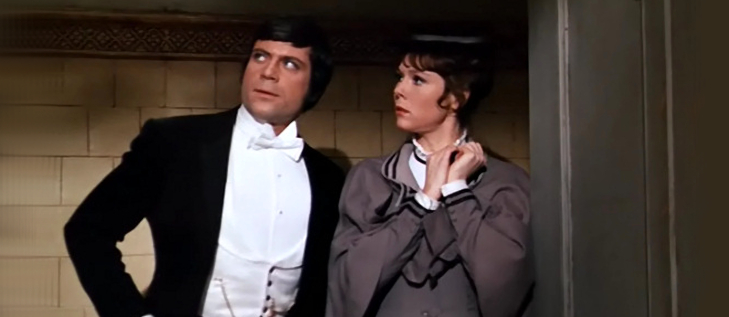
It’s 1900 in London. Aspiring reporter Sonya Winter (Diana Rigg) shows a newspaper staff how she’s detected a secret company of killers that use the want ads to communicate with clients. She talks the publisher Lord Bostwick (Telly Savalas) into bankrolling her investigation: with $20,000 pounds of the paper’s money, Sonya pretends to be a client soliciting a murder. She soon has an appointment with the charming, impish president of The Assassination Bureau, Ivan Dragomiloff (Oliver Reed). It’s smirking deceit at first sight: they’re mutually impressed with each other. When Sonya says she wants Ivan to kill himself, he’s delighted: it’ll be a great way to clear away the deadwood and the disloyal in his organization. He charges his key operatives to try to kill him — and he’ll try to kill them. Thus begins a merry chase: killers stalk killers across Europe, with Miss Winter tagging along, fully enjoying the experience.
There’s a lot to admire here — beautiful sets and some fun fin de siecle production design. The varied performers include names we like to see. But the much of the filmmaking is on the flat-footed side, and a lot of fun feels forced. The show never exactly falls flat, but it also never seems as inspired as it wants to be.


Could the wonderful Diana Rigg ever do wrong? Direct from her starmaking turn as Emma Peel in TV’s The Avengers, she effortlessly balances her end of the film’s extended joke. Sonya Winter is sexy yet completely self-possessed. She gets the joke. Sonya blinks distractedly at her male adversaries’ comic speeches, sharing the irony of the moment with us. Oliver Reed also displays a knack for sly comedy, even if he eventually mugs a bit too much, shooting asides toward the camera. Relph and Dearden impose quaint elements to try to give the show a period flavor, such as animated titles and transitions that mimic vintage film. We see old film clips of royal ceremonies, etc.; some scenes appear in B&W in a morticed frame, as if they were silent movies.
Despite the great costumes and sets, Relph and Dearden don’t try hard to evoke the Edwardian Era. The Assassination Bureau offers knowing jokes about anarchists and the coming debacle of WW2, as when a soldier scoffs at the idea that bombs will ever be dropped from the air. But the historical irony is just another joke. The members of the Assassination Bureau are no different than generic bad guys in modern spy spoofs. Simply transposing 007-like values to an earlier time frame doesn’t illuminate anything in either era.
Dearden’s film doesn’t fall into the faux-camp pit of many post- Batman thrillers and spy pix, where every joke had to break the fourth wall and be shared with the audience. Flat spy spoofs insist that nobody’s cooler than the star: Dean Martin in the Matt Helm movies, Peter Lawford and Sammy Davis. Jr. in Salt & Pepper. Michael Relph’s screenplay has the wink that says, “Ain’t I clever?,” yet Rigg and Reed try hard to bring the film class and panache.

Rigg and Reed often make The Assassination Bureau very engaging. The fine supporting actors are also often right on target. The brilliant Clive Revill (Avanti!) strikes a note of villainous fun — it’s a shame that he exits so quickly. Kenneth Griffith (Circus of Horrors) has a brief bit as a would-be assassin, but is hard to identify under his beard. Vernon Dobtcheff’s Russian spy is less amusing, with his predictably dour remarks about the sadness of the Russian soul.
The fancy conference room at the Bureau’s headquarters gets things off to a great start. A ‘futuristic’ sliding wall functions with the aid of an antiquated manual pully system, an arcane joke if there ever was one. The most lavish episode takes place in a Paris bordello run by Bureau member Philippe Noiret. He’s assisted by the diminutive Madame Otero (favorite Beryl Reid of The Killing of Sister George) who keeps busy herding the various prostitutes about. The antics in the bordello are regulation low-key Oo-la-lah!, illustrated with lots of low necklines and red velvet. Some of the girls and their costumes are genuinely in the right spirit, making the sequence far more fun than the next year’s tepid The Best House in London.
The comedy assassinations can’t quite match the gleeful mayhem of Robert Hamer’s Kind Hearts and Coronets. The main titles cover five or six killings, most via regulation anarchist percussion bombs. We note that our attitude to terror bombs has lost a lot of its comedy appeal in the years since 1969, which of course is not this movie’s fault. But the anticipation of a bomb dulls an episode in a Swiss bank run by a Bureau member played by Warren Mitchell (The Crawling Eye).

Given top bad guy status is Curd Jürgens, a Prussian established in a saber-fencing scene. He’s present for another bomb joke scene in a Viennese beer hall that also isn’t all that funny, an exploding blutwurst sausage. A number of innocent bystanders are apparently killed and maimed in this blast, but offscreen, bloodlessly. That’s standard operating procedure for comic ’60s spy mayhem.
The other main supporting villain Telly Savalas ‘gets’ the joke as well; Savalas always elevates this kind of spoofy show, but the script doesn’t afford him the kind of delicious verbal sparring we enjoyed in On Her Majesty’s Secret Service, a Bond movie that knows how to properly evoke old-fashioned notions of chivalry.

A lengthy episode, almost a story sidebar, is given over to a Borgia-like Venetian femme fatale, the spouse of a Bureau member. The wickedly greedy Eleanora (Annabella Incontrera) teams with her gondolier-lover for murder. Ms. Incontrera has a sly smile and her scheming (identity swaps, a trick coffin) show some cleverness, but this Eleanora seems subdued and reserved. Luciana Paluzzi of Thunderball might have been ideal — one look at her and we knew she was up to no good.
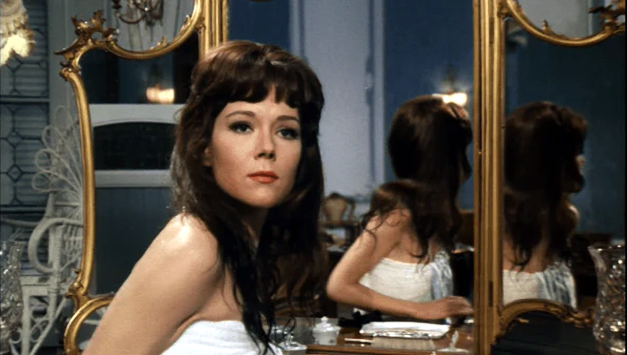
After enjoying the stylish post- Richard Lester comedy styles of Stanley Donen and Theodore J. Flicker, The Assassination Bureau does come off as a little pedestrian. The camera placement only occasionally exploits the beautiful sets. An over-use of the zoom lens also becomes annoying. A typical example: Rigg sits at a dressing table and then wheels to face herself in the mirror. The camera zooms in to a close up on her eyes in the mirror, and the shot dies because she must wait for the zoom to finish before continuing. Neither the wide part of the shot nor the telephoto is an optimized angle. One can easily imagine the take divided into two with a dynamic cut as punctuation.

The film’s special effects are standard for UK in the ’60s, which is no recommendation. A train scene uses distracting traveling mattes to show the moving view outside the windows. Many explosions just cut to tinted stock footage. The show finishes with a major set-piece involving a giant Zeppelin, just as does the next year’s The Best House in London. Effects master Les Bowie does the best he can for at least 20 demanding angles of the Zeppelin in flight, and closer shots of an extended battle on board. Every third shot is clever and creative but most are distracting sodium-vapor traveling mattes. Oddly, even though the movie seems to have constructed much of the Zeppelin in full scale, what sticks in the mind are the shots with a toy on strings.
Spirited playing by Reed, Savalas and Jürgens saves the Zeppelin scene, but just barely. The final act sees Ms. Rigg sidelined on the ground, running around disguised as a nun. That’s a writing problem, not an effects flaw. On Her Majesty’s Secret Service delivered Rigg at full power: when big action broke loose, she was at its center, outshining even 007.
At almost two hours the movie could have lost at least one reel. We like the Paris bordello and the clever treachery in the Venetian villa. Some of the action in the runaway Zeppelin is good, especially Oliver Reed’s clever escape method. The star performances do the film’s heavy lifting. Bruiser Oliver Reed is more genteel than we’d think possible. He and Diana Rigg haven’t a lot of chemistry together but their professionalism keeps things humming at a sub-screwball comedy level. When the emancipated Miss Winter finally melts for Dragomiroff, it is on her own ’emancipated’ terms. A Diana Rigg character never compromises — she maintains her dignity and our respect, which is why we love her so much.