


It was said that westerns went ‘adult’ and ‘psychological’ in the 1950s, which only means that big studios found that pitching them higher than the 9-year-old audience could earn big money. The first post-war ‘super-western’ was likely David O. Selznick’s Duel in the Sun, even if its epic template positions it outside the genre midstream. The ball really got rolling when James Stewart hit the jackpot with his first Anthony Mann western, and continued to clean up with succeeding westerns in Technicolor.
Male stars like Burt Lancaster and Kirk Douglas strayed from film noir to sagebrush; big directors no longer considered the western a down-grade genre. It’s arguable that the first ‘event’ western was George Stevens’ Shane, in 1953. The buzz was that the Alan Ladd movie was too good to be ‘just’ a western.
The top star Gary Cooper pulled in big box office in any movie where his character held a gun. When 20th-Fox premiered CinemaScope, one of its first super-scale westerns in the format was Cooper’s Garden of Evil, filmed on distant location in Mexico. But in 1952 Coop’s western output was Stanley Kramer’s low-budget ‘issue oater’ High Noon, and this handsome western ‘A’ produced by Warner Bros.
Springfield Rifle gives Coop a handsome production and a fine director in André De Toth, whose impressive work enhances a rather standard ‘undercover man’ storyline. De Toth gives the proceedings an unusually violent edge. He had made his name with the disturbing noir Pitfall and the powerful independent western Ramrod. Both features display De Toth’s less-than-trusting attitude toward human nature and his knack for hard-edged ruthlessness. This western must have cemented De Toth’s position as a favored Warners house director.
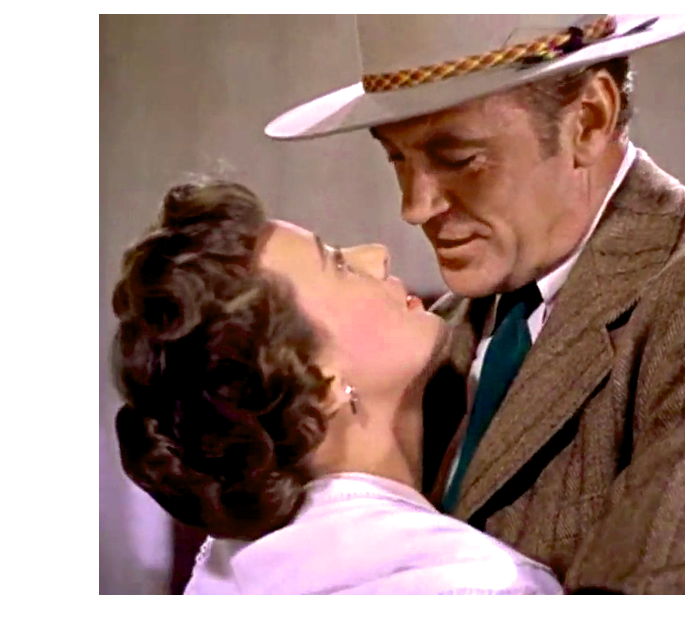
Gun-oriented movies were picking up steam in the early ’50s, as seen in the James Stewart vehicle Carbine Williams, the ‘inspirational’ story of the convict who invented the M1 Carbine rifle. This movie’s title refers to a rifle said to be still be experimental during the Civil War. Many movies set during that War ignore the fact that repeating rifles were not yet common. Actually, a better title might be ‘Springfield Horses,’ as the movie is really about big-scale horse thievery in Colorado — thievery that ‘could turn the tide of the war toward the Confederacy.’
The tight screenplay and De Toth’s even tighter direction gloss over historical issues … like, how fit could a horse be to the Union Army, after he’s been run all the way East from Colorado? Pro-Confederacy raiders are the bane of Cavalry Colonel John Hudson (Paul Kelly), whose shipments of Colorado horses keep getting intercepted by a large gang of wildcat thieves. A fancy detective (James Millican) thinks there must be a traitor in Hudson’s command, tipping off these unidentified raiders. Major Lex Kearney (Gary Cooper) tries to get a shipment through; when confronted by a superior raider force in a mountain pass, he shocks everyone by surrendering the horses and turning tail. Accused of cowardice by his second-in-command Captain Tennick (Philip Carey), Kearny stoically accepts a court-martial that sees him drummed out of the Army. He is literally kicked out of Hudson’s fort, with a big yellow stripe painted down his back.
Our Gary Cooper a yellow belly? No popcorn-eating kid would buy that for a minute. About five minutes later we learn that, yes, it’s all a ruse. Captain Tennick and a new officer from Washington are setting up Kearney as an undercover counter-espionage agent, to find and infiltrate the stealthy raiders.
Kearney makes rapid progress. Local rancher Austin McCool (David Brian) leads a double life as the leader of the horse raiders. McCool and his foreman Pete Elm (Lon Chaney Jr.) command a wild bunch of outcasts. They sell a few horses to Colonel Hudson, but ambush all of the shipments and sell them to Confederate agents. It helps the rebellion, but McCool’s motivation is quick profit. His gang consists of runaway Confederates, stray Indians, and local criminals. Identified specifically are ‘Jayhawkers,’ which would seem an odd choice – in ‘Bleeding Kansas,’ the Confederate irregulars were the ‘Bushwhackers.’ *
Complicating Kearney’s undercover mission is the fact that his wife Erin (Phyllis Thaxter) keeps showing up at the Colorado Fort. Kearney has no choice — he refuses to discuss his court-martial, and ignores her pleas that he return with her to the East. News of Kearney’s ‘treachery’ has motivated his son Jamie (unbilled Michael Chapin) to quit school and sneak away to join the Army.
Springfield Rifle really comes through with the desired big-scale action. Using Eastman monopack film stock, André De Toth’s camera is far more flexible than a Technicolor rig would be. The director rewards the audience with exciting horse action. The shootouts are staged on the slopes of the Eastern Sierra Nevadas, and in the Lone Pine locations familiar from Bogart’s High Sierra. We even see Cooper guiding his Army patrol through mountain snow, a preview of De Toth’s later snowbound western Day of the Outlaw.

With De Toth’s focused direction, Gary Cooper doesn’t fall back on his usual mannerisms or his ‘cute’ endearment tricks. We’re halfway through the court-martial before we realize, ‘hey, this has to be a charade … Coop cannot be a traitor.’ Cooper manages an okay vein of bitterness. He’s especially good when feigning a grudge feud with Philip Carey’s true-blue Captain. Six years later, in Anthony Mann’s revisionist Man of the West, Cooper never quite convinces us that his reformed outlaw could ever have been the cold-blooded sadist described in dialogue.
It makes sense that the film’s story came from a writer known mostly for Roy Rogers movies … the one female character barely makes an appearance. Phyllis Thaxter could have filmed her entire role in two days. Her Erin doesn’t understand Kearney’s crazy behavior; she eventually condemns him as an irresponsible heel who no longer cares about his son’s well-being.

The dependable David Brian is solid as the opportunist outlaw boss, and actor Paul Kelly is a good fit as the commander with a couple of surprises in his character. Now accepting smaller roles, Guinn ‘Big Boy’ Williams is the Sgt. who instinctively stands by the disgraced Kearney, stepping up to help him at the climax. Offering more excellent support is Lon Chaney Jr., whose brutish raider is not written or directed as a complete doofus. The movie has a number of unexpectedly violent events: for mistreating a horse, Chaney’s Pete Elm receives a weird punishment — Kearney slashes his buttocks with a knife (!!), which forces Pete to walk instead of ride a horse. There’s a shot of Pete being sewn up — is it his pants being stitched, or his rear end?
The movie makes room for scenes with a young Martin Milner, and Alan Hale Jr. puts in a good performance as an enthusiastic horse thief. Favorite Fess Parker has a couple of dialogue exchanges as a ‘decent’ Reb soldier raiding with McCool’s gang. The character would seem a bouquet thrown to Southern audiences. To insure that their films would be allowed to play the South, Hollywood studios perpetuated the idea that the Rebel cause was noble and justified.

It’s interesting that Cooper’s High Noon immediately preceded Springfield Rifle, as they are political opposites. The main screenwriter Charles Marquis Warren made other westerns with reactionary attitudes, that fit in well with Hollywood’s anti-Communist policies. In Warren’s Arrowhead, actor Jack Palance plays Toriano, a native American, who returns from an Eastern college that has apparently infected him with liberal ideas. Upon his arrival, the graduate lets his hair down and sets out to wage a reign of terror against the peace-loving whites occupying his homeland. Toriano might as well be Ho Chi Minh.
Westerns about undercover agents were nothing new, and the motif is of course central to many gangster pictures. But Springfield Rifle plays like a sagebrush adaptation of Warners’ 1951 contribution to the anti-Commie espionage subgenre, I Was a Communist for the F.B.I.. Both are about loyal Americans who purposely let their reputations be tarnished, so they can infiltrate villainous enemy organizations. Frank Lovejoy had starred in films noir by subversive directors; he may have signed on for I Was a Communist… to fend off suspicion of pinko sympathies. Both movies applaud dedicated patriots willing to alienate their family and loved ones, to fight the good fight against the Red Peril.
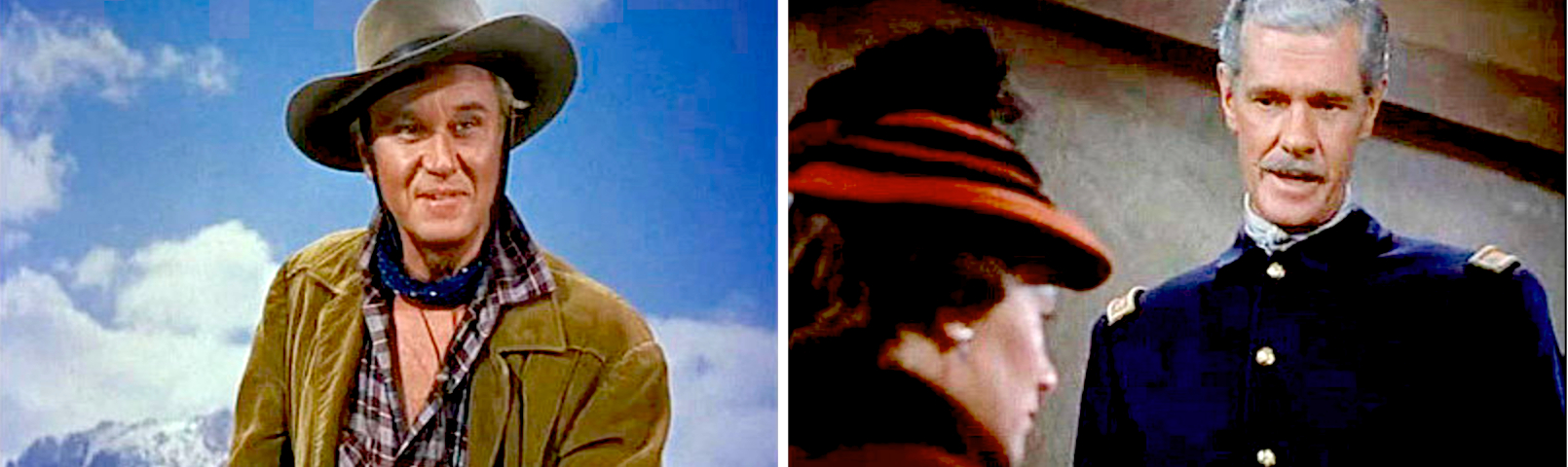
Another sidebar in Springfield Rifle argues the need for a dedicated military intelligence agency, an OSS or a CIA. Gary Cooper’s loyal Union major Kearney is sticking his neck out on a secret undercover mission that Washington would forbid — if they knew it existed. Secrecy is the first rule: Cooper must assume the public guise of a ‘dirty traitor’ and can explain nothing to his wife. He instead tells Erin to stop asking questions, to go home to take care of the kids. It’s the ultimate message for all loyal American women. By extension, good Americans are advised to stop worrying, shut up and fund our new secret police entities.
Placing that ‘open subtext’ aside, Springfield Rifle is a rousing action saga, half White Heat and half John Ford-style cavalry western. Ford would never depict the cavalry as rife with cynical intrigues, plots within plots and commanding officers who happen to be spies for the other side. Just keeping up with who knows what about whom sustains the story, and the good action scenes. There’s a heap o’ dyin’ goin’ on, with Guys Good and Bad biting the dust on all sides.
Springfield Rifle could be used to make a convincing case that some Hollywood productions were shaped by government policies. For a capper, the new guns that turns ‘one man into five, and fifty into an army,’ are brought in to give the Army an edge over the horse thieves. The repeated mantra that the army needs superior firepower fits in with Pentagon promoting more and more military funding to prevail in the Cold War. You wouldn’t want Coop to go up against a Guatemalan Commie armed with a bigger gun, would you?
A final question about the logic of transportation in the Civil War era. Erin Kearney travels between Colorado and ‘the East’ more than once; and at the end of the movie, an officer from the War Department in Washington apparently travels 1800 miles just to award Kearney a medal. The first railroad into Colorado wasn’t built until 1869; one would think the war might be over before these travelers (or all those horses) got to where they were going.


Glenn, being a cheapskate, I streamed this, it was obviously an old transfer, it’s full of warts. If you like the movie the Blu-ray is likely a visual upgrade. This movie had the potential for greatness but is let down by a myriad of constraints & Gary Cooper’s downbeat persona, even more so than usual, perhaps they weren’t paying him enough?
It should be pointed out that the plot of an American officer being drummed out of the military for disgraceful actions and actually assigned to use that as a ruse to be working undercover for his country is a plot device which pops up every so often. The most prominent antecedent I can think of is Humphrey Bogart in ACROSS THE PACIFIC.