
 For some directors a scream is as good as a standing ovation. William Castle spent his career chasing those screams and even when his movies veered from the implausible to the irrational, Castle soldiered on with the chutzpah of a born surrealist, demonstrating that when it came to scaring the audience, mere logic could be detrimental.
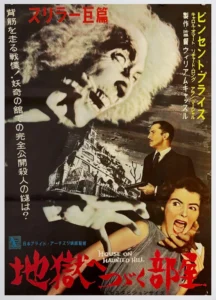
Castle’s most beloved films are rife with nonsense—moments that would sink better movies actually enhanced the William Castle Experience. Featuring a parasitic caterpillar that fed on fear, 1959’s The Tingler was premised on the notion that a scream could actually save your life. A genuinely hallucinatory shocker (Vincent Price’s character takes LSD to experience the slimy monster’s attack), the film is a sober exercise in critical thinking next to House on Haunted Hill, which unrolls in a series of increasingly absurd, not to mention impossible plot turns: one character fakes her own hanging only to appear seconds later floating outside a window as a rope slithers around her neck. Of course Castle won his precious screams from an audience who, like the director, cared more about the thrill of being terrified than common sense.
 Castle began his career churning out murky murder mysteries based on radio’s The Whistler for Columbia. “Crime dramas with a horror movie heart,” they were crude but undeniably compelling—their melancholy spirit could linger long past the end credits. Castle, whose interviews would have us believe he was a cheery fellow, seemed to find the gloomy atmospherics to his liking.
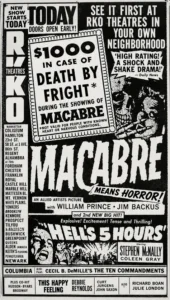
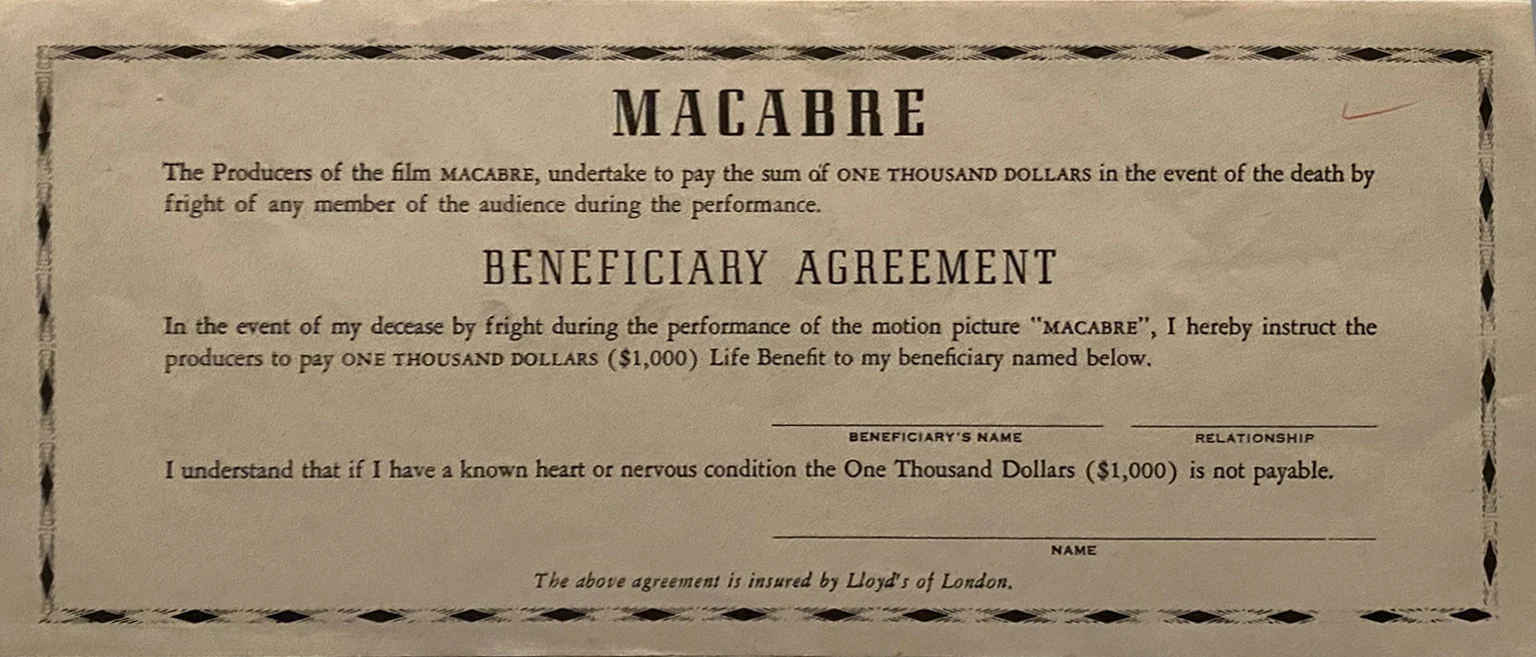
In 1958 he escaped Columbia, transitioning from company man to the master of his own peculiar domain, the carny barker auteur. His first film as an independent producer/director was called Macabre. Though a bargain basement production (the intrepid Castle mortgaged his house to cover production), it showed off the filmmaker’s secret weapon, his marketing skills. Macabre boasted the first of the so-called “Castle-gimmicks,” offering a $1,000 life insurance policy to all patrons who died of fright while watching the film. The insurer was in fact the staid Lloyds of London who, though making a very safe bet with their money, still requested that their name not be used in the advertising.
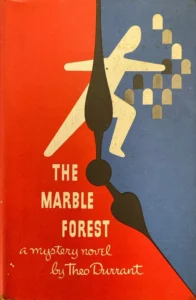 The movie had another gimmick. The screenplay was based on 1951’s The Marble Forest written by Theo Durrant, and “Theo Durrant” is the gimmick; it’s a pseudonym for the twelve mystery writers* who put all 120 of their fingers into the stew—and it shows. The story of a kidnapped child who may have been buried alive, the film stars William Prince as Rodney Barrett, a sneaky small town physician, Jacqueline Scott as Polly, his smitten nurse, and Jim Backus playing against type as a surly, suspicious police chief. Robb White, a specialist in adventure tales and frequent contributor to Boy’s Life magazine, was hired to make sense of the 12-headed scribe’s tangled web, a grisly soap opera loaded with more flashbacks inside flashbacks than The Odyssey (though in some respects, Barrett shares a few sleazy characteristics with Ulysses).
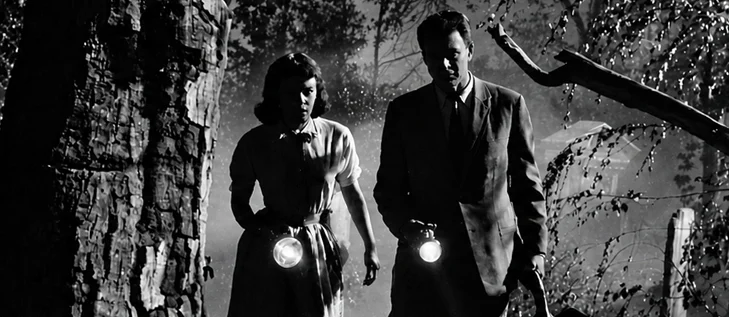
Thanks to the director’s jovial on-screen appearances, most of Castle’s later horrors have a mordant, Addams Family vibe. But Macabre could have been titled Morbid; the majority of the running time takes place in a claustrophobic funeral home or a rain-drenched cemetery where the protagonists dig up one grave after another. And more’s the pity; Vincent Price, Castle’s go-to for graveyard humor, is nowhere to be found. Shot in the modest confines of Ziv Studios (home to Highway Patrol and Sea Hunt), the low budget suits the film like a well-worn glove. Produced in just two weeks in the summer of 1957, Macabre was photographed by Carl Guthrie, a veteran cameraman (Christmas in Connecticut) whose speedy work ethic paved the way to his decades-long employment on dozens of TV shows. His plain-Jane lighting for Macabre suggests a spartan, lived-in environment that somehow enhanced the tawdry goings-on. Black and gray, not black and white set the grim tone.
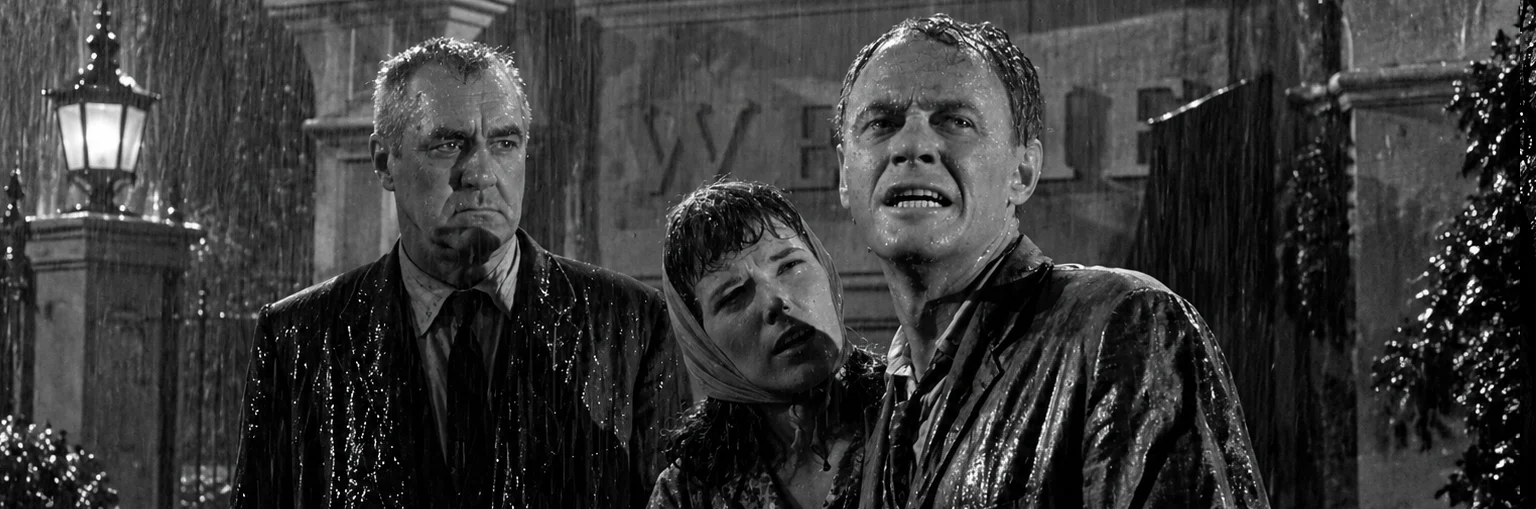
It’s a stranger’s muffled phone call that alerts Barrett to his daughter’s having been kidnapped, placed in a coffin, and buried… somewhere. He has five hours to find the child before she runs out of air while cutaways to a ticking clock remind us of the stakes. Those 12 mystery writers dreamed up a sordid storyline stocked with a dozen Peyton Place also-rans, but Castle and White couldn’t solve the problem of the book’s many flashbacks. The characters are introduced with little explanation as to who they are or why we should care; there’s Alice, Barrett’s nervous wife who dies during childbirth, her equally beleaguered sister, Nancy, blind at birth and wasting her life with endless flings, and the family’s patriarch, an old man with a bad heart. Not to mention a busy body maid (played by Ellen Corby) and a shady undertaker. There’s too much plot and too little substance (the movie is but 72 minutes long).
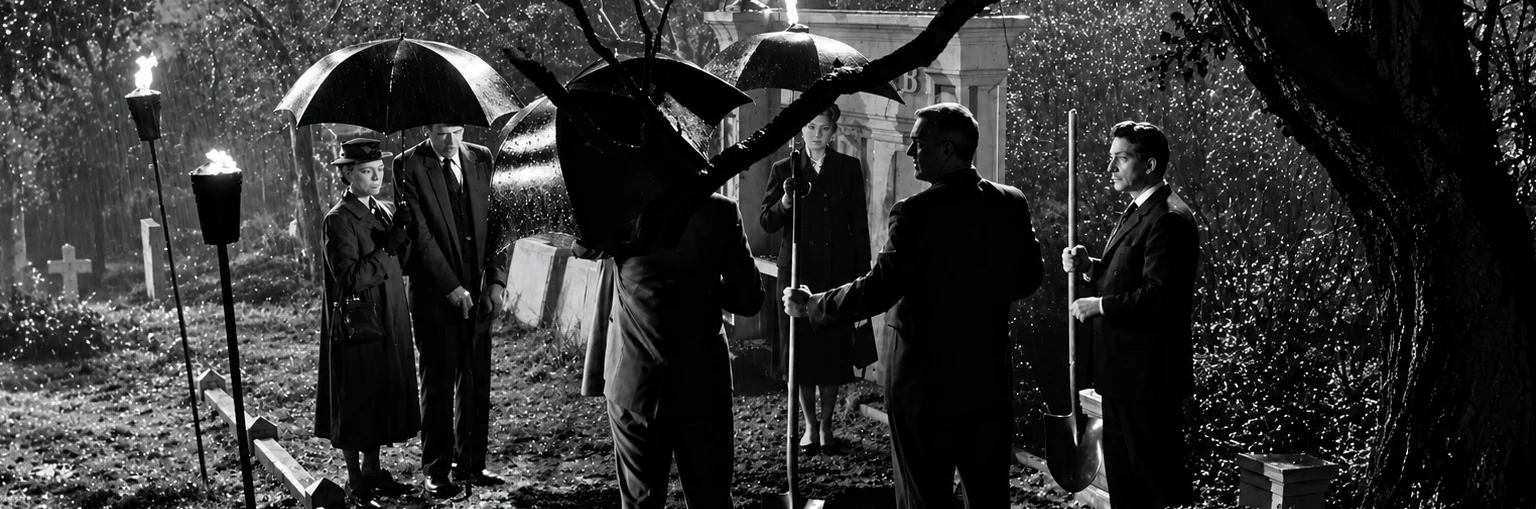
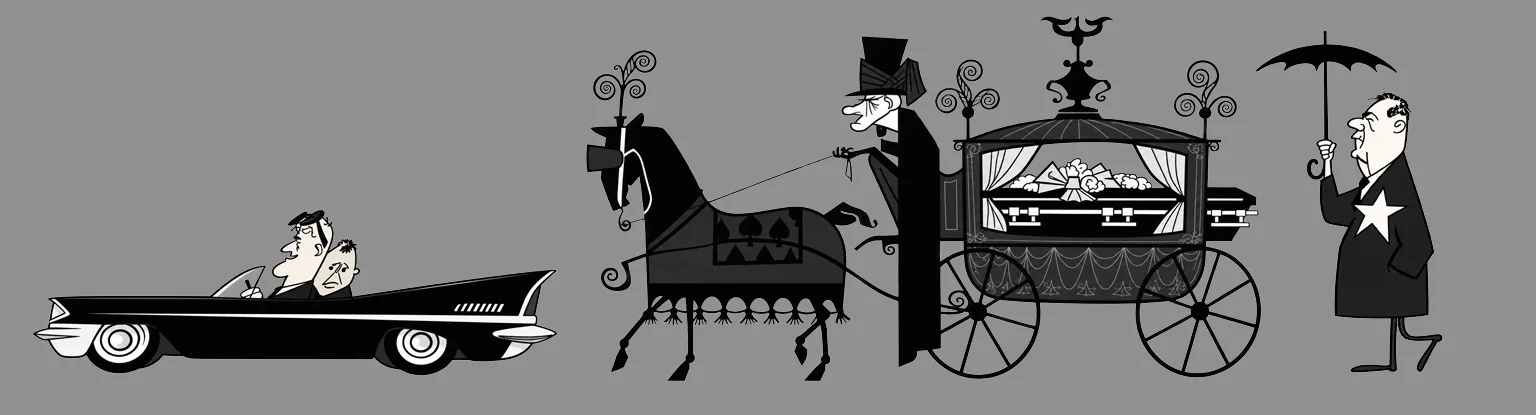
The film’s rain-swept finale reveals the killer’s thinly veiled identity and culminates in an end credit sequence that can only be described as charming, an animated funeral procession featuring the cast and crew (in a couple of years the stars of House on Haunted Hill would be introduced in hearses). The director’s heart was really in the promotion of a film, and in Macabre’s case he himself became the star of the show and primary tub-thumper, a position Hitchcock assumed, albeit in a more sophisticated vein, during his great run as the “Master of Suspense.” Castle barnstormed American movie theaters with fake nurses stationed in lobbies and hearses out front for that homey touch (he popped out of a coffin for the film’s premiere). It says something about Macabre, The Tingler, and House on Haunted Hill, that the director’s outlandish gimmicks remain more memorable than the films themselves. One assumes Mr. Castle, the author of Step Right Up! I’m Gonna Scare the Pants Off America, would consider that a standing ovation.
Warner Archive released a good looking DVD in October 12, 2010 and it’s still available in disc and digital incarnations.
*Terry Adler, Anthony Boucher, Eunice Mays Boyd, Florence Ostern Faulkner, Allen Hymson, Cary Lucas, Dana Lyon, Lenore Glen Offord, Virginia Rath, Richard Shattuck, Darwin L. Teilhet and William Worley.
Here’s Joe Dante on William Castle’s screamfest: