
 One of the pleasures of being a cinephile is watching a young filmmaker find their voice and get better as they make more movies. There’s something exciting in seeing potential in an artist early on and then seeing that promise fulfilled and hopefully exceeded. Writer/director Jane Schoenbrun first got noticed with 2021’s We’re All Going to the World’s Fair, which was compelling if a bit vague. I Saw the TV Glow (2024) was a stronger film and had a distinctive viewpoint. Schoenbrun’s latest movie, Teenage Sex and Death at Camp Miasma, however, announces that they have fully arrived as an artist. This is an assured, sharply funny and completely unique vision that creates a Venn diagram which overlaps Eighties slasher flicks and the quirks of sexual desire. It’s the definition of niche, but if you’re open to its wavelength, it’s a deliriously delightful ride.
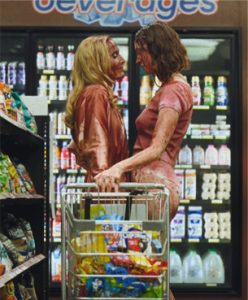
Kris (Hannah Einbinder) has been hired to helm a reboot of famed slasher series “Camp Miasma.” This would be great, except that the original films were based upon transphobia – the person who would become killer Little Death (Jack Haven) was murdered for being transgender. Kris knows that the studio is attempting to solve this controversy by “hiring a queer director to paper over it,” but she’s still very excited at the prospect of working on the project. She’s especially intrigued about meeting the “final girl” from the first Camp Miasma movie, Billy (Gillian Anderson), who lives at Camp Tivoli, the shooting site of the original film. As the two women get to know each other, their perceptions of reality begin to alter and Little Death begins to stir in the Flesh Palace, their lair in the bottom of the lake.
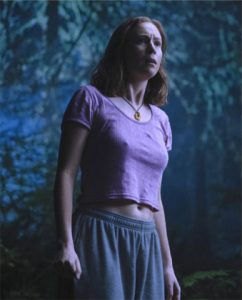
 Einbinder is very good as Kris, a role not initially dissimilar to the one she played on Hacks, but the characterization goes deeper here. Kris seems happy with her sexual identity if not as happy with her polyamorous partners. Something is missing; she’s looking for something more. Einbinder takes Kris’s journey seriously and finds the joy in it, as in a scene in which she stops like a fangirl while Little Death is chasing her. I found Anderson’s performance to be a bit more opaque, but that may be by design of the writing, to make her more mysterious. Kevin McDonald and Patrick Fischler have small but amusing roles playing stock characters from every camp-based slasher film – the sheriff and the guy at the service station warning foolish teens not to go to the camp.
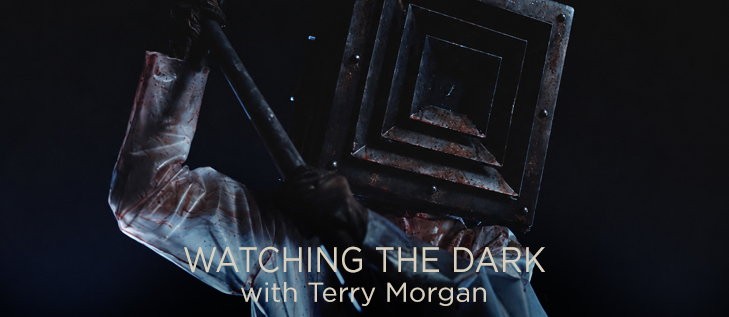
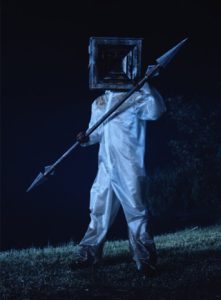
As a director, Schoenbrun is clearly having a blast here, their deep knowledge of camp slasher films informing every scene. From the opening montage of Camp Miasma merch and news articles delineating the decline of the franchise to the over-the-top fountains of blood spewing from the killer’s victims, the vibe is affectionate to the genre. The use of painted backdrops for some scenes creates a deliberately heightened emotional state, and the look of Little Death – a ventilation duct headpiece and a transparent plastic suit to shield off all the gore – is a singular and oddly charming creation.
 For me, the highlight of the entire film is an intricately designed one-shot sequence in which Little Death takes out an entire camp edited to the Counting Crows’ song, “A Long December.” It’s unusual in that the camera focus is on Little Death and not the unfortunate campers, looking at LD’s emotionless mask while we see the carnage in the background. The song is plaintive, replacing the sounds of death with tuneful depression, one line saying, “Maybe this year will be better than the last,” as if Little Death is stuck in this endless loop of murder and maybe wants out. It’s a bravura piece of filmmaking, pulsing with visual energy but vividly undercut with lyrical sadness.
Schoenbrun’s clever script is a clear take on the Friday the 13th series, but even more specifically on Sleepaway Camp, borrowing a famous visual from the film. The story is a response to the homophobia of many classic horror movies, such as The Silence of the Lambs, except here the spotlight is specifically on transphobia. Little Death is an English version of the French phrase for orgasm, la petite mort, literalizing the connection between sex and death. Schoenbrun also has fun with somewhat pretentious arty filmmakers, having Kris’ previous movie described as “Psycho from the point of view of the shower curtain.”
Teenage Sex and Death at Camp Miasma is not going to be for all tastes, but not all art is meant to be. It’s an extremely well-made film, brimming with visual creativity, intelligence and humor, and a lot of art cinema or horror fans should appreciate it on that level. But it’s also very personal and specific in where its story ultimately goes, and if that conclusion isn’t for everyone, I think other viewers might very well feel seen, which is great.
 Terry Morgan has been writing professionally since 1990 for publications such as L.A Weekly, Backstage West and Variety, among others. His love of horror cinema knows no bounds, though some have suggested that a few bounds might not be a bad thing.