
Hi, Mom! — 4K
Brian DePalma’s wild skit + provocation comedy cemented his status as a capable, meaningful filmmaker just before he turned to a commercial career dedicated to the screen effects of Alfred Hitchcock. This new release brings this early Robert De Niro tale, which now resembles an alternate-universe prequel to Taxi Driver, to disc in a new 4K remaster and encoding. De Palma addicts take note: a prime HD extra is the entire feature film Dionysus in 69, a multi-image recording of an experimental play by Richard Schechner’s The Performance Group.
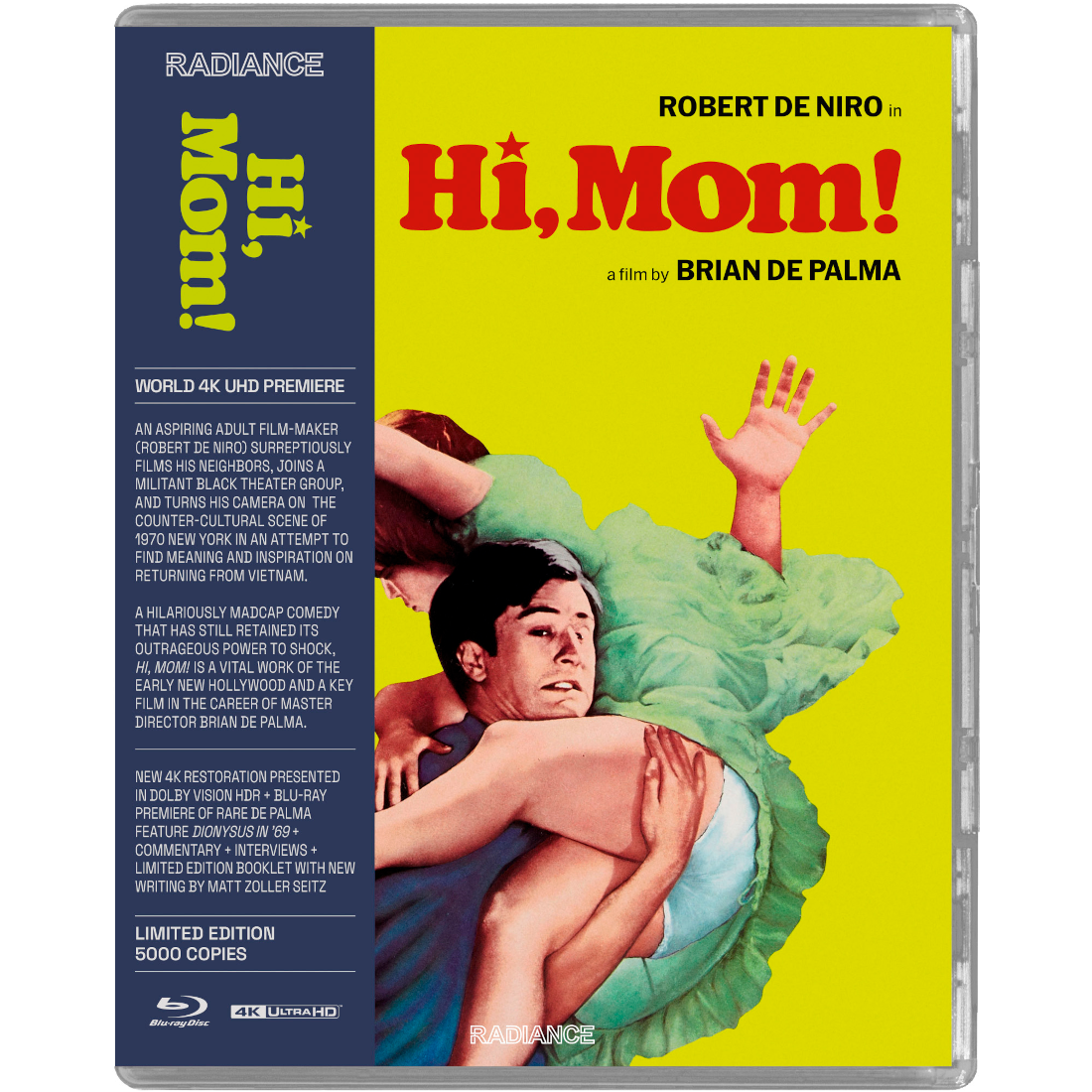
Hi, Mom!
4K Ultra HD + Blu-ray
Radiance Films
1970 / Color + B&W / 1:85 widescreen / 87 min. / Street Date May 19, 2026 / Available from Diabolik DVD / 33.99
Starring: Robert De Niro, Allen Garfield, Charles Durning, Lara Parker, Jennifer Salt, Paul Bartel, Garrit Wood, Bettina Kugel, Rutanya Alda, Carolyn Craven, Peter Maloney, Paul Hirsch.
Cinematography: Robert Elfstrom
Chuck Shields: costumes
Assistant Director: Bruce Joel Rubin
Film Editor: Paul Hirsch
Composers: Eric Kaz, Stephen Soles, Artie Traum
Written by Brian De Palma & Charles Hirsch
Produced by Charles Hirsch
Directed by Brian De Palma
 The young Brian De Palma hustled his way from film student to film maker by a series of unlikely film adventures, most of which have now been released on good Blu-ray encodings. Film student prodigies were a new thing in the second half of the 1960s. Brian De Palma’s name recognition seemed neck-and-neck with Paul Bartel and ahead of Martin Scorsese.
De Palma’s first official feature Murder à la Mod may have begun shooting as early as 1964, but is officially listed as a 1968 film. A grab-bag of experimental techniques tied to exploitative elements, the B&W shows a film student working on overdrive, doing riffs on Alfred Hitchcock and playing around with multi-screen ideas and the concept of the subjective camera.
Perhaps filmed in 1966 first but not released until 1969 is the somewhat weak The Wedding Party. A comedy about an afternoon on a fancy Long Island estate, it introduced actor Robert De Niro but remains an iffy collection of improvisations, only a few of which are funny. The reason to see it is an impossibly young and endearing Jill Clayburgh; she’s not to be missed.
Also in 1968, De Palma teamed with producer Charles Hirsch to ‘break in to the youth market’ with an off-the-wall color feature, a comedy about draft dodgers. Greetings is a collection of skit-like scenes in which three friends (Gerrit Graham, Jonathan Warden & Robert De Niro) work their schemes on the Selective Service registration system, and pull off even more elaborate ruses to try to seduce women. Graham’s slacker talks a young woman into letting him make magic marker lines all over her naked body, to prove a JFK consipiracy theory about entrance and exit wounds. The enterprising De Niro talks a shoplifter (Rutanya Alda) into disrobing, to help him with his attempt to create a new art form, ‘Peep Art.’ Also making an impact in his first movie is actor Allen Garfield, as a thoroughly slimy smut peddler. Greetings concludes with a none-too-convincing scene in Vietnam, where De Niro’s conscripted soldier, having captured a Vietnamese woman, tries his ‘Peep Art’ routine on her as well.
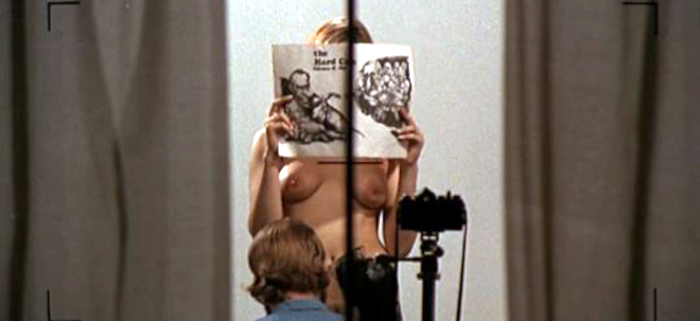
Originally meant to be titled Son of Greetings, 1970’s Hi, Mom! is the movie that might convince a studio exec to invest in Brian De Palma as a future moneymaker, to bring in, you know, ‘the kids.’ It didn’t hurt that 1970 was the year of a giant industry shakedown, when Easy Rider gave selected long-haired outsiders creative access previously denied.
Hi, Mom! picks up right where Greetings left off, continuing the wayward adventures of Robert De Niro’s character, the mischievous Jon Rubin. Having returned intact from molesting women in Indochina, Jon now pursues his ‘Peep Art’ concept full-time. This may be the first film in which De Palma’s cinematic indulgences bear fruit, as the film feels greater than its parts. Besides the scattershot satire, it makes some surprisingly challenging, radical statements about the American scene in 1969, particularly the theater scene.
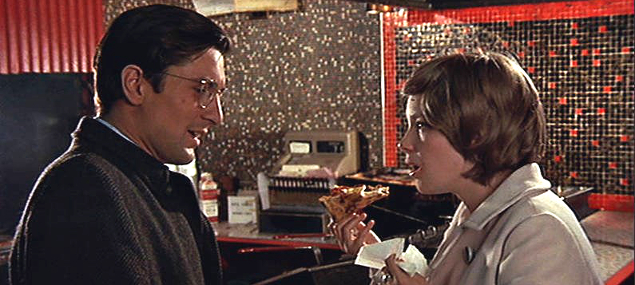
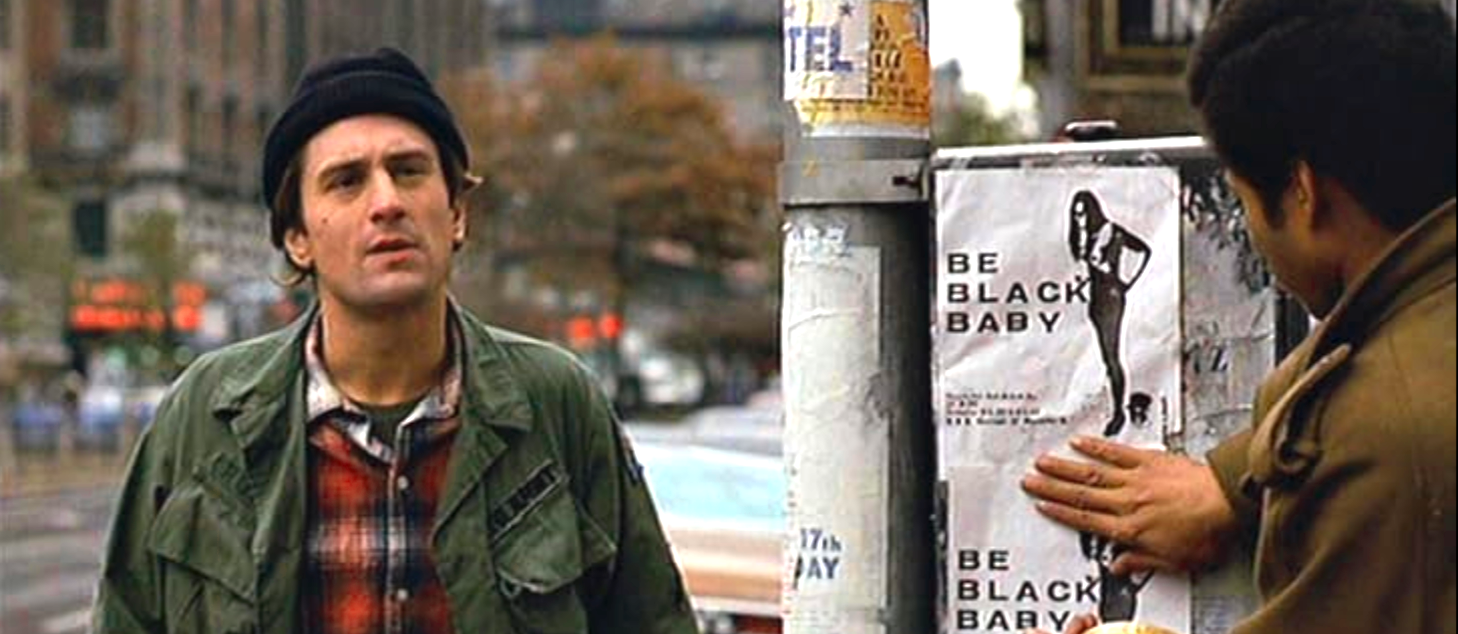
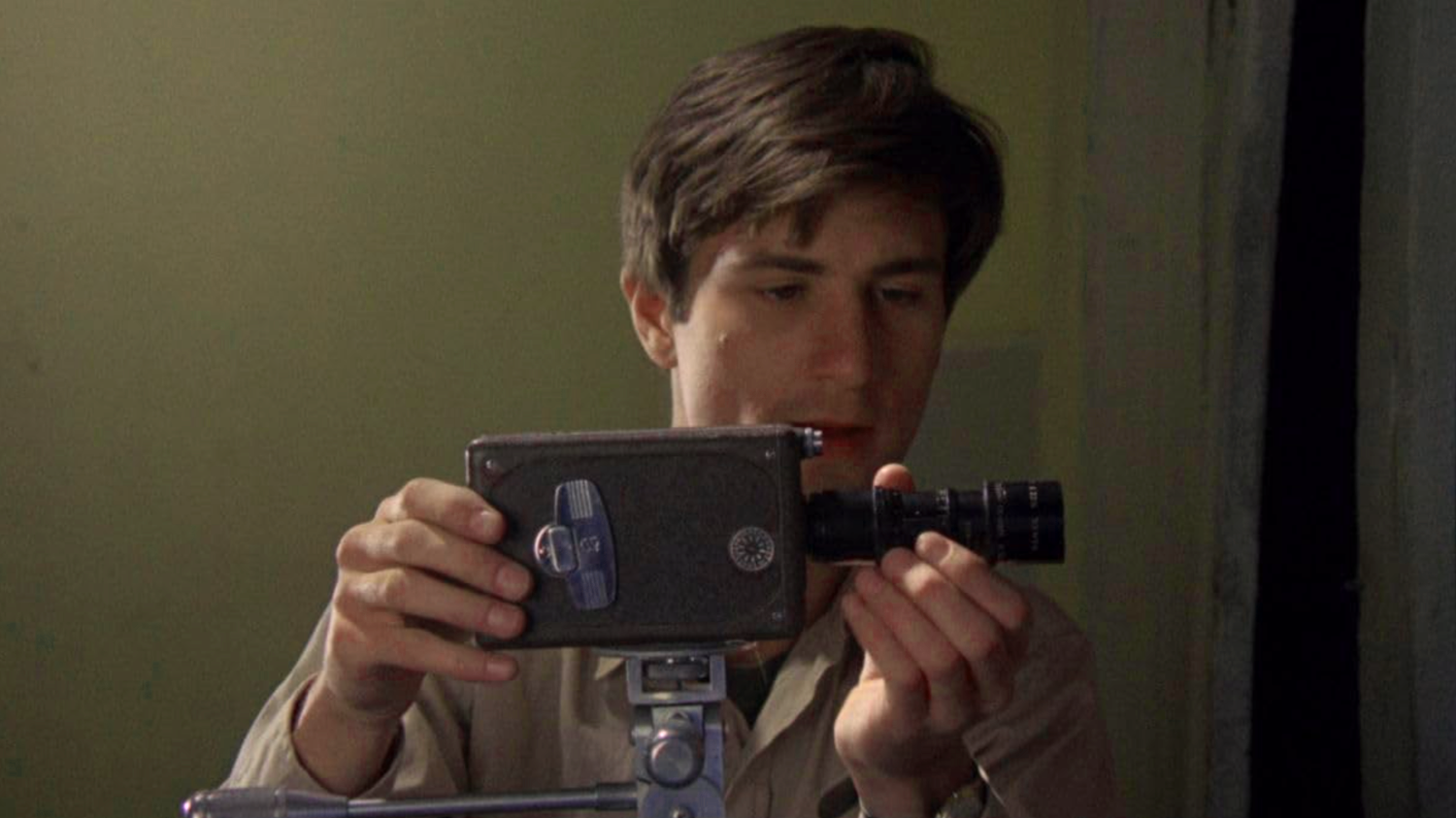
With his pals from the previous show killed off, Robert De Niro carries Hi, Mom! alone, which is a good thing. Various scenes make the film now seem like a comedy prequel to Taxi Driver. De Niro’s Jon Rubin even wears his army fatigue jacket at one point. He finds a crummy apartment that happens to have an excellent ‘Rear Window‘ relationship with an adjoining apartment building, for his telephoto lens. The view gives him a peeping vantage point at four strangers. One of his targets is Judy Bishop (Jennifer Salt), a correlative to the ‘Miss Lonelyhearts’ tenant in the Hitchcock movie.
Allen Garfield returns, having graduated from smut peddler to an equally sleazy porn producer, which gives us a peek into an X-rated New York movie theater. Garfield’s entrepreneur hires Jon to film a sex movie, but Jon only wants to advance his personal Peep Art crusade. He throws himself bodily into the funny, misogynistic situation of seducing Judy Bishop. Ms Salt is great as a man-hungry wallflower, who on her comic date regales Jon with her take on the psychology of the movie David and Lisa. Jon sets out to seduce Judy for his Peep Art movie camera back in his apartment, which is already trained on Judy’s couch. The Big Seduction must play out on a strict schedule, because the camera has been clockwork-set to start rolling at a specific time.
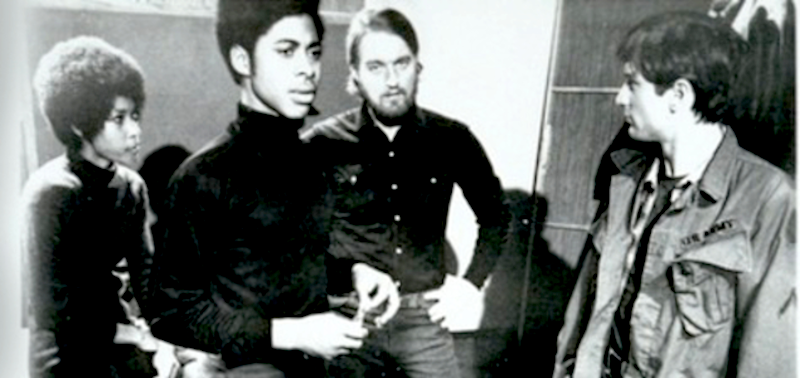
The picture’s second half plunges into heavy-duty satire that will probably still make the average white audiences cringe. Jon auditions to play the ‘pig cop’ in a revolutionary play. “Be Black, Baby” is an hilarious lampoon of the kind of living theater experiments in which actors draw the audience into the performance. The cast of blacks (and the white Gerrit Graham) put on whiteface and subject the paying audience to several hours of terror, so they can share in the black experience. ‘Being black’ is to have greasepaint smeared on one’s face, to be verbally and physically abused, and finally to be robbed, beaten and in one case raped. Art imitates life, get it?
Filmed handheld in grainy B&W, the sequence is uncomfortably convincing, even frightening. The performance concludes in a monumental sardonic joke. When finally released, the terrorized upscale white audience gives the play high marks as a life-changing experience, high art.
A second level of satire is present. The performance is also being documented by a B&W camera from the public television show N.I.T. Journal, aka “National Intellectual Television.” Jon watches as an N.I.T. announcer says, “This concludes our program of ‘music to write checks by.’ Thank you for your generous contributions.” It’s the best satire-redux of PBS I’ve ever heard.
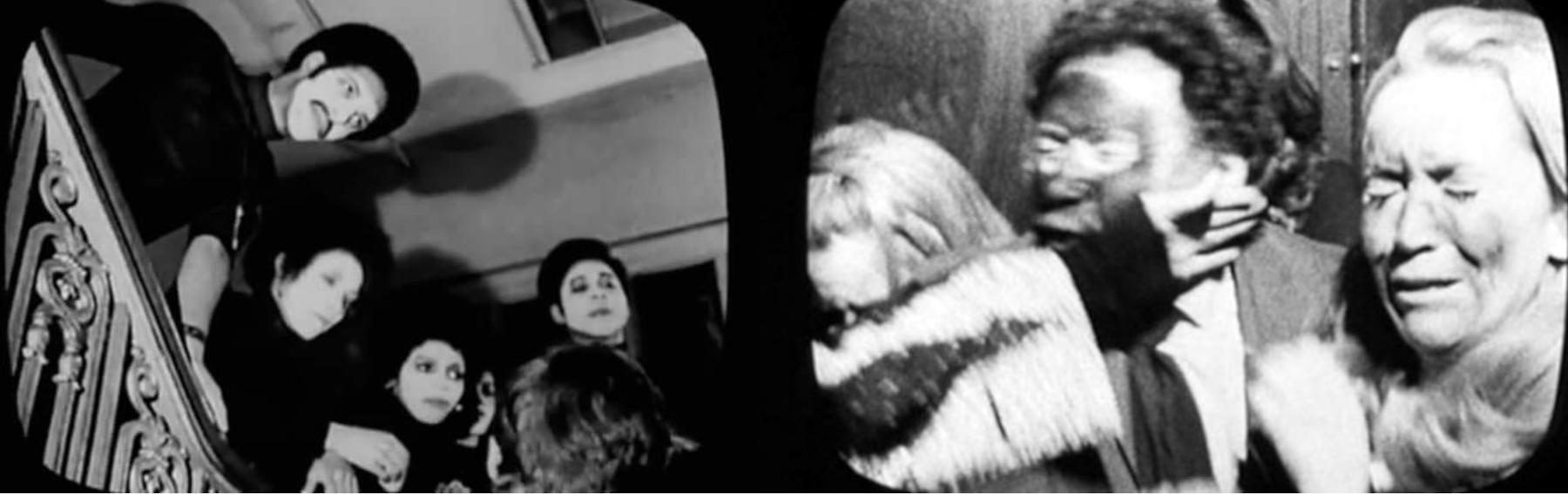
The “Be Black Baby” sequence is filmed in a guerrilla cinema style that’s suddenly quite convincing, even scary. The rape is frighteningly staged. The black satire continues. N.I.T.’s cameras cover the machine gun- toting revolutionaries as they invade an apartment block, just like the Marxist radicals in Robert Kramer’s Ice.
De Palma and Charles Hirsch manage a satisfying conclusion for their off-balance black comedy, with Jon Rubin settling into a bourgeois home life with Judy Bishop … but not really. N.I.T. programming motivates Jon’s conversion to committed radicalism. Almost as in Taxi Driver, he knocks his TV over and shoots it with a pistol. The movie has already played the ‘how far will you go?’ game once or twice, with surprising results — full frontal Gerrit Graham, anyone? With its use of taboos to provoke the audience, Hi, Mom! has a good grip on the creative anarchy of filmmaking in the late 1960s.
De Palma’s direction in Hi, Mom! is becoming more adept and flexible. Scenes are no longer flat-minimalist, even those covered in just one angle. The improvisations are less amateurish. The show begins with an odd scene with actor Charles Durning — so young! — which will only make sense to New Yorkers of the late 1960s. We love it anyway. Allen Garfield and Jennifer Salt are marvelous when verbally sparring with De Niro, and Ms. Salt’s love-crazy performance is so funny and charming, it disarms the sick-o aspects of Jon Rubin’s Peep Art deception. Some of the dialogue is inspired: “You know, tragedy is a funny thing.”
Hi, Mom! simply hangs together better than De Palma’s other early films. It ventures beyond the influence of the New Wave, and it has more on the ball than most youth comedies attempting imitations of Richard Lester. It engages with its revolution theme with more wit than anything produced in Hollywood, and it doesn’t try to soften its genuinely dangerous content. We haven’t much use for some of Brian De Palma’s later exercises in exploitative misogyny, but the sophomoric hijinks here seem liberating.

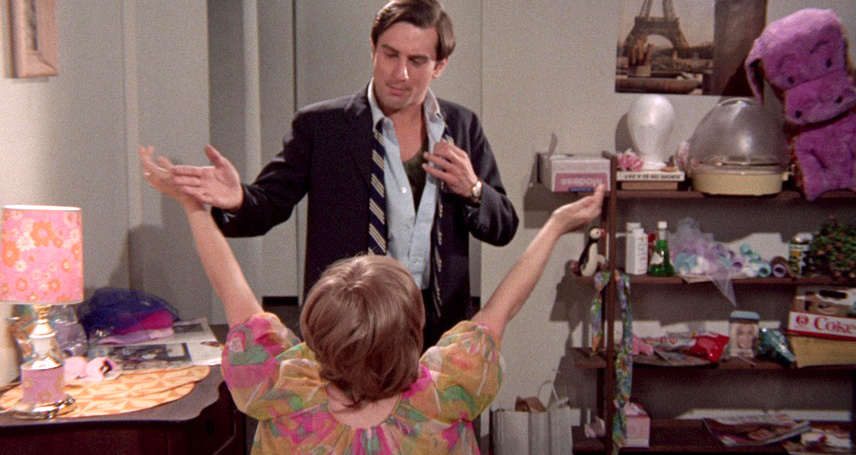
Radiance Films’ 4K Ultra HD + Blu-ray of Hi, Mom! looks bright and colorful, with the enhanced image quality making cameraman Robert Elfstrom’s images pop in Dolby Vision and HDR. Some high-key scenes are so bright, they almost look like 4K video. Elfstrom was a master at handheld camerawork pre-Steadicam; he manned a cameraman on Gimme Shelter. De Palma thought enough of his skill to bring him back for a special sequence for his Phantom of the Paradise.
Radiance’s extras almost always pack at least one surprise; this time the special item is an entire Brian De Palma feature that (in our case, anyway) has been difficult to see. In the midst of his other projects, De Palma filmed two entire performances of Richard Schechner’s play Dionysus in 69, a theater workshop creation performed in a garage space. There are no chairs; the audience hangs around the periphery and might find itself confronted by an actor and drawn into the performance. It’s a theoretical, liberated construction from Euripides’ The Bacchae. The film has three credited directors, adding Robert Fiore and Bruce Rubin to De Palma’s name. De Palma would seem to be the strongest influence, as the entire B&W picture consists of side-by-side synchronized images taken by roving cameras. Schechner’s The Performance Group follows the direction of other theatrical experiments, with a large cast creating a sense of chaos. A center section depicts an orgy, with a lot of nudity.
The confrontational aspect of the play reminds us of the film-within-a-film Be Black, Baby, as does the finale, in which the play bursts from its enclosed space and moves into the street.
Radiance’s extras give us an enthusiastic new commentary by film writer Travis Woods (of Bright Wall Dark Room?), for whom Brian De Palma can do no wrong. 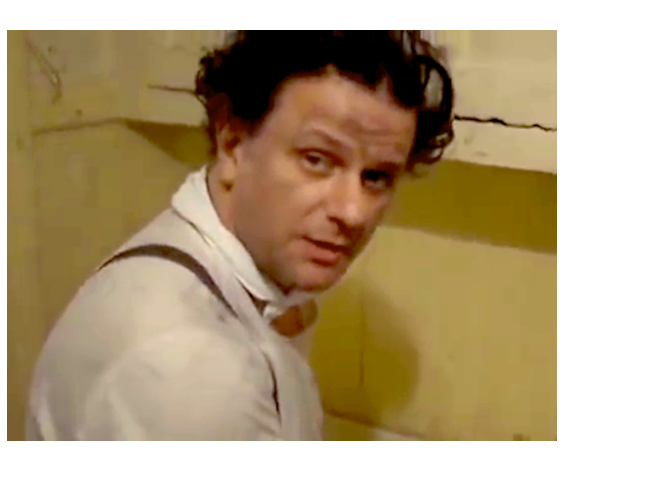 Woods explains the context and point of the opening sequence with Charles Durning — it’s a parody of a Public Service Ad then being shown on New York Television stations. ←
Also new is a talk about Hi, Mom!’s race provocations by Ellen E. Jones, the author of 2024’s Screen Deep: How film and TV can solve racism and save the world.
Retained from a 2018 Arrow disc is an excellent talk by producer & co-writer Charles Hirsch. Matt Zoller Seitz contributes a new essay to the disc’s insert booklet.
Reviewed by Glenn Erickson

Hi, Mom!
4K Ultra HD + Blu-ray rates:
Movie: Excellent
Video: Excellent
Sound: Excellent
Supplements:
Audio commentary by writer Travis Woods (2026)
Interview with critic Ellen E Jones (2026)
Additional feature Dionysus in ’69 filmed by Brian de Palma (1970, 85 mins)
Archival interview with co-writer Charles Hirsch (2018)
Trailer
Limited edition booklet featuring new writing by Matt Zoller Seitz
Limited edition of 5000 copies, presented in full-height Scanavo packaging with removable OBI strip leaving packaging free of certificates and markings.
Deaf and Hearing-impaired Friendly? YES; Subtitles: English (feature only)
Packaging: One 4K Ultra HD and one Blu-ray disc in Keep case
Reviewed: May 20, 2026
(7518mom)
Visit CineSavant’s Main Column Page
Glenn Erickson answers most reader mail: cinesavant@gmail.com

Text © Copyright 2026 Glenn Erickson
About Glenn Erickson

Glenn Erickson left a small town for UCLA film school, where his spooky student movie about a haunted window landed him a job on the CLOSE ENCOUNTERS effects crew. He’s a writer and a film editor experienced in features, TV commercials, Cannon movie trailers, special montages and disc docus. But he’s most proud of finding the lost ending for a famous film noir, that few people knew was missing. Glenn is grateful for Trailers From Hell’s generous offer of a guest reviewing haven for CineSavant.
DePalma made such impressive stuff in the ’70s and ’80s (his all-time masterpiece remains Phantom of the Paradise). Why’d he have to get on a Hollywood kick with Mission Impossible?