
Swashbuckler
Spectacular! Colorful! Action-packed! A big production, big stars, but where’s the movie? James Goldstone’s pirate picture has energetic action and little else; we salute Robert Shaw and Genevieve Bujold, who generate the star personality needed to keep it on its feet. A bounty of screen talent is marooned in unflattering roles: James Earl Jones, Peter Boyle, Beau Bridges, Geoffrey Holder, Dorothy Tristan. Anjelica Huston doesn’t even speak, but a chicken gets screen credit. Enjoy it for the beautiful locations, worthy stunt work and clever visual effects.

Swashbuckler
Blu-ray
KL Studio Classics
1976 / Color / 2:35 widescreen / 101 min. / The Scarlet Buccaneer, The Blarney Cock / Street Date May 19, 2026 / available through Kino Lorber / 29.95
Starring: Robert Shaw, James Earl Jones, Peter Boyle, Genevieve Bujold, Beau Bridges, Geoffrey Holder, Avery Schreiber, Tom Clancy, Anjelica Huston, Bernard Behrens, Dorothy Tristan, Kip Niven, Mark Baker, Tom Fitzsimmons, Louisa Horton, Sid Haig, Jon Cedar, Rutanya Alda, The Golden Hinde.
Cinematography: Philip H. Lathrop
Production Designer: John Robert Lloyd
Costumes: Burton Miller
Film Editor: Edward A. Biery
Music Composer: John Addison
Visual Effects: Bill Taylor, Albert Whitlock
Stunt coordinator: Buddy Van Horn
Choreographer: Geoffrey Holder
Written by Jeffrey Bloom story by Paul Wheeler
Executive Producers: William S. Gilmore, Elliott Kastner
Produced by Jennings Lang
Directed by James Goldstone
 Had agent-turned-producer Jennings Lang wanted to make the juciest Hollywood insider movie of the century, he certainly was close to the original story source. But no, once he was rewarded with a major producing deal at Universal he turned out Clint Eastwood movies and Airport sequels, along with some real winners by George Roy Hill, Philip Kaufman and Don Siegel. He’s the producer of 1976’s Swashbuckler, a return to old fashioned pirate thrills.
Pirate movies died in the 1960s when they became associated with weak foreign product and no-budget American movies. Alexander MacKendrick directed A High Wind in Jamaica, a serious pirate picture with Anthony Quinn and James Coburn, but it pretty much tanked at the box office. Producer Lang put together a typical Universal show for the mid-1970s, using stars that owed the studio a movie and mixing big-budget strategies with Universal’s tendency toward TV-movie blandness.
Directed by James Goldstone of 1971’s fairly creative Red Sky at Morning, Lang’s pirate picture was shot partly on location near Puerto Vallarta in Mexico, but with most interiors filmed on sound stages at Universal City. The cast certainly gives the show their best, especially the leads Robert Shaw (recently of Jaws) and Genevieve Bujold (recently of Lang’s Earthquake). The movie delivers at least a solid hour of action scenes but almost nothing in the screenplay department. After the tradition of Errol Flynn and Burt Lancaster, a pirate tale needs something to set it apart. The characters and dialogue here are pretty hollow; we can tell that a committee is in charge because the Robert Shaw and James Earl Jones pirates establish their jokey relationship by trading bawdy limericks, an idea lifted directly from Shaw’s Captain Quint character in Jaws.
The show begins with text crawls over a map, explaining that ‘rogue governors’ in the Colonial West Indies, not the European countries themselves, are responsible for terrible conditions for the citizenry. We’re also told that outlaw pirates are actually beloved by the public at large, because they oppose the local despots. In other words, the movie is a Robin Hood fantasy.
Perhaps it doesn’t matter, for what follows could have been written for a Saturday morning cartoon show. Jamaica’s governor Lord Durant (Peter Boyle) loves fencing and debauchery and robbing the treasury. He finishes his campaign of suppressing dissent by imprisoning Jamaica’s Lord Chief Justice Sir James Barnet (Bernard Behrens) and confiscating his properties. Barnet’s wife (Louisa Horton) and daughter Jane (Genevieve Bujold) must relocate to a shack in the harbor.
Meanwhile, the always jolly pirate Ned Lynch (Robert Shaw) rescues his best buddy Nick Debrett (James Earl Jones) from a hanging overseen by the incompetent & ineffectual Major Folly (Beau Bridges). Jane easily outwits Major Folly as well, in the current faux-liberated fashion: instead of fainting or screaming, she kicks royal guards in the groin. She is soon outraged by / allied with Ned Lynch’s pirates. He admires Jane’s fighting skill when Durant’s soldiers try to make an arrest in a barroom; he also admires her form when she skinny-dips off the pirate ship. Jane is angry that Ned won’t return a brooch she’s lost, and they fence on a beach with the other pirates watching.
They part, but Jane returns to ask Ned to put his men into action. Lord Durant is going to sneak away to Europe. She offers to help Ned kill the governor and steal all of his stolen booty, if Ned will free her father. The remainder of the storyline is more ambushes, skirmishes and sword duels. Lord Durant is a sword master who practices by defeating other sword masters in duels that draw blood, so we anticipate a final swashbuckling showdown.
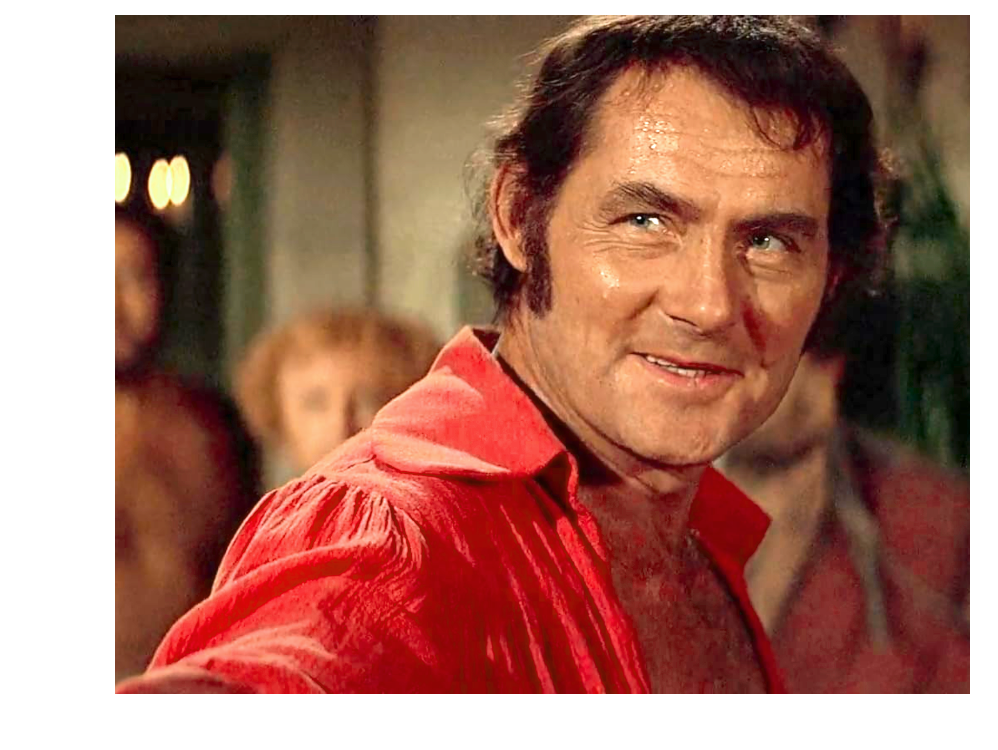
There isn’t much for the actors to work with in Swashbuckler but everyone does their best. These are jolly pirates that enjoy a fight and laugh at adversity, when not laughing away their evenings carousing with equally happy wenches. Therefore, the actors are laughing and smiling at all times, which gets more than a little frustrating. Robert Shaw is very good at inventing new amused faces, so he keeps the tone from falling. What he can’t overcome is the cartoonish distraction of his bright red costume. Shaw is too good of an actor to let a costume wear him, but that suit belongs on an extra member of The Village People, a pirate to go with the cowboy and the construction worker.
We’d give Shaw the 1970s top prize for overcoming an impossible costume, but that honor goes to Sean Connery for rocking his red diaper in John Boorman’s goofball Sci-fi epic Zardoz.
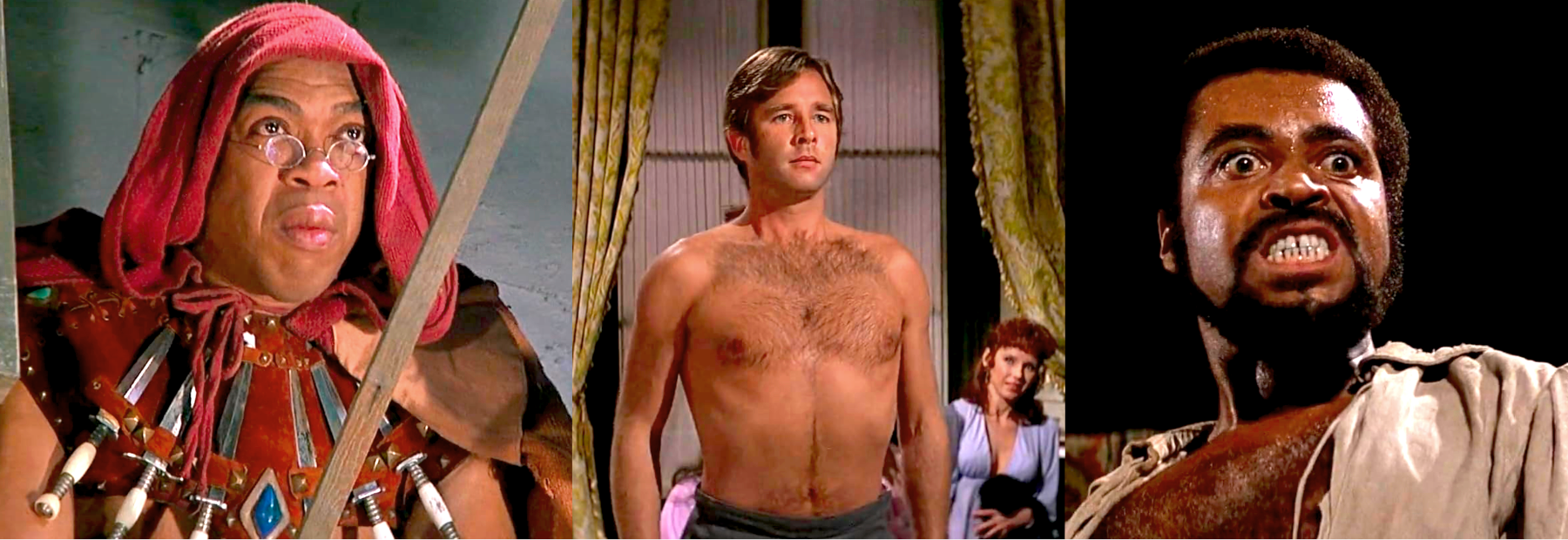
James Earl Jones is still muscular and thin here, and looks great. He’s in great spirits, but ends up standing around a lot and flexing his Jamaican-inflected accent. The pirates have a friend in Cudjo (Geoffrey Holder of Live and Let Die), a prodigious knife thrower who runs a band of street performers and acrobats. Holder is also credited for choreography — were some dances cut? The role isn’t much more than bellowing in his distinctive voice and exchanging a few 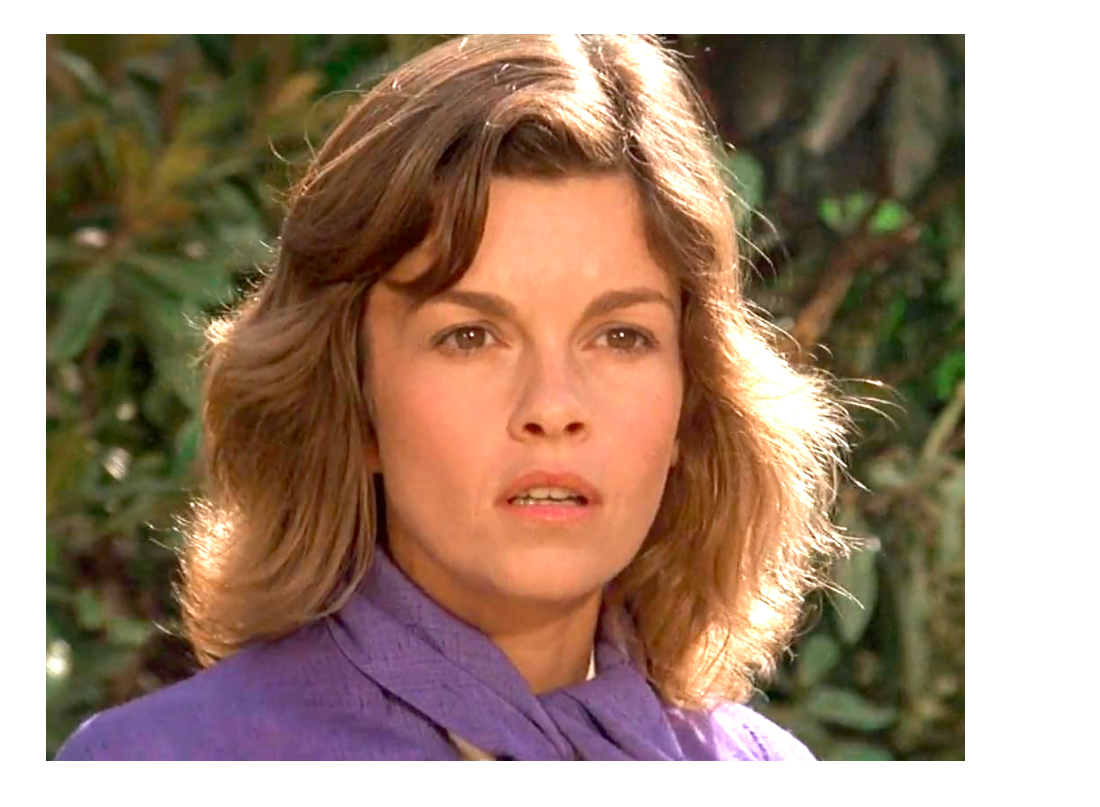 hugs with Jones. Frankly, at only 46 years of age Geoffrey Holder is beginning to resemble the old-time actress Edna May Oliver.
The costume designer was told to not worry about authenticity, so all the women have low-cut or exaggerated necklines. Most do standard Wench Duty, entertaining men as eye candy in a party atmosphere, where nothing really is happening. The respected actress Dorothy Tristan (End of the Road) is has just a couple of scenes as Ned Lynch’s floozie. The same goes for the notable actress Rutanya Alda. Did all these players have more substantial roles in the shooting script?
We love Genevieve Bujold dearly, respect her talent and are impressed with her commitment to the show. She looks like she’s enjoying wearing the sexy costuming. Jane’s nude swim is as unmotivated as her attraction/rejection of Ned, but it’s in surprisingly good taste. A double likely performs the nude dive, but Bujold is the one to show off underwater nudity while unaccountably setting herself up as romantic/sexual bait for Ned.
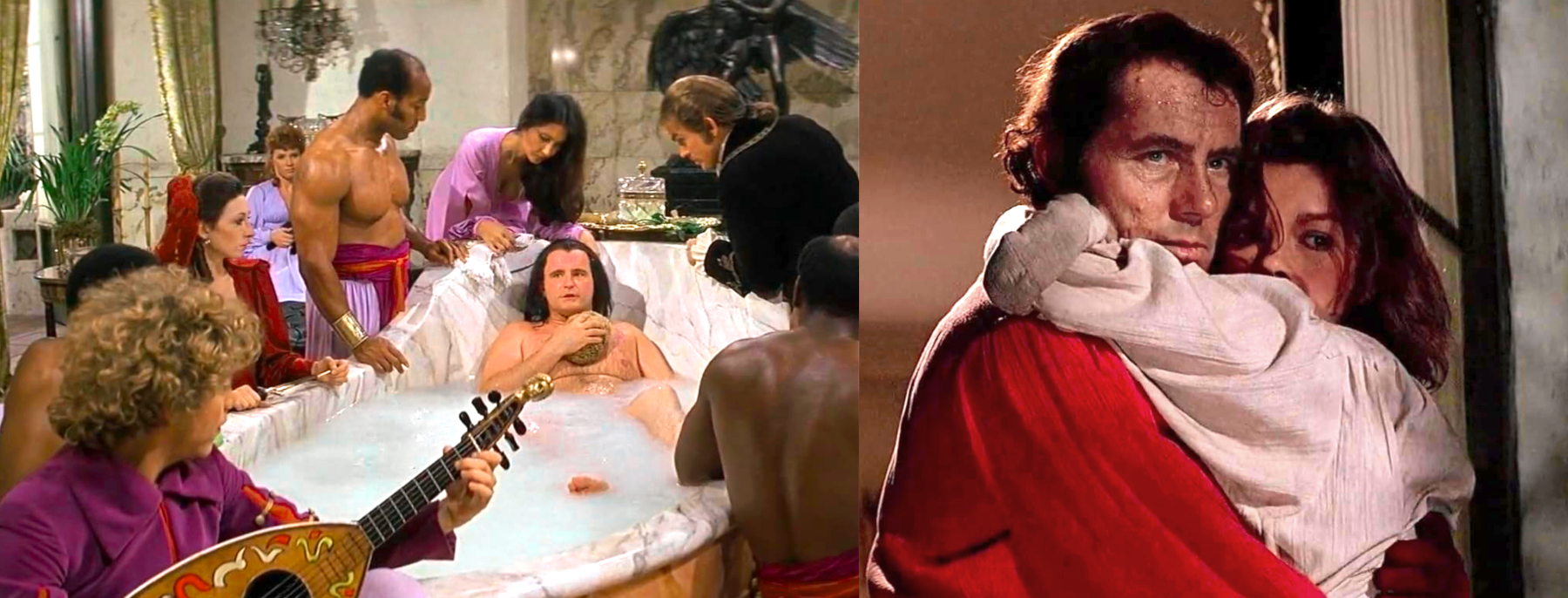
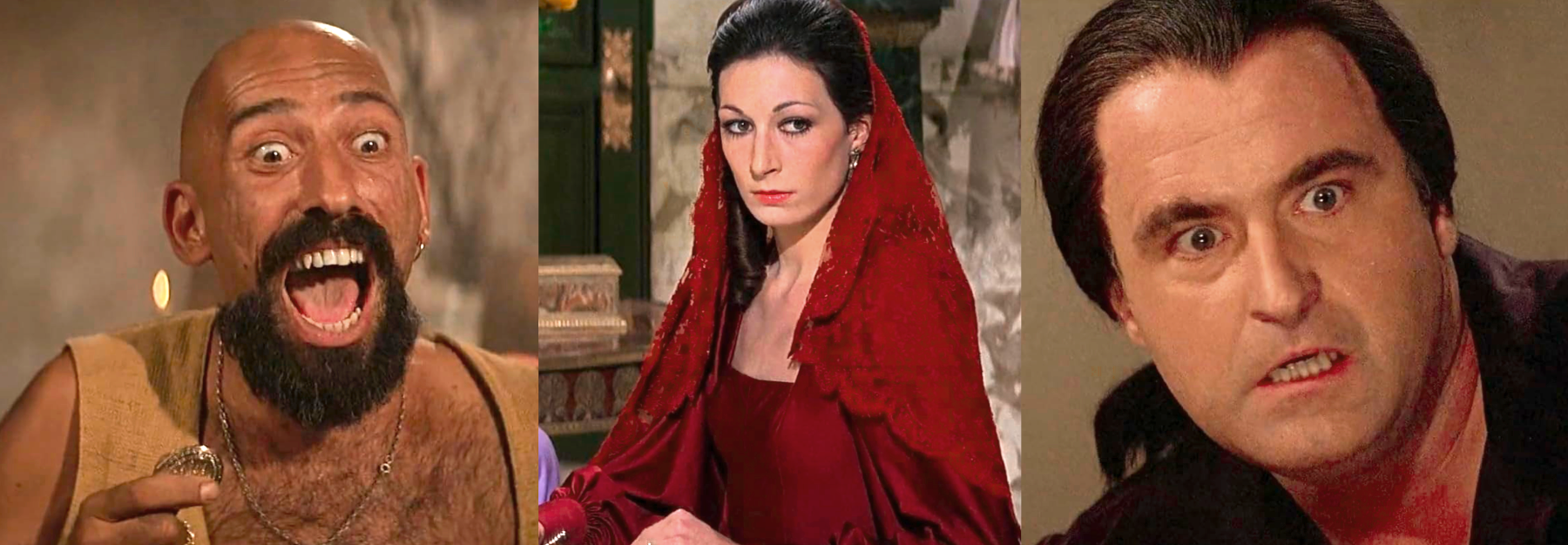
We really can’t account for the lack of fun in Lord Durant’s chambers. Peter Boyle almost always brings something to a role, but his evil governor projects almost zero personality. The script overloads him with ‘evil’ qualities, as when he cruelly scars all three of his fencing opponents. Body slaves dote on him in his bath, and he’s amused by a boy-toy lute player (Mark Baker) whose fingers are outfitted with knives and needles. The oddest member of Durant’s entourage is the ‘Woman of Dark Visage,’ a dour royal companion who is always present but never speaks or shows emotion. She’s played by none other than Anjelica Huston. Did the actress insist on being a cipher? After various roles good and bad, Huston finally broke through in her father’s film Prizzi’s Honor.
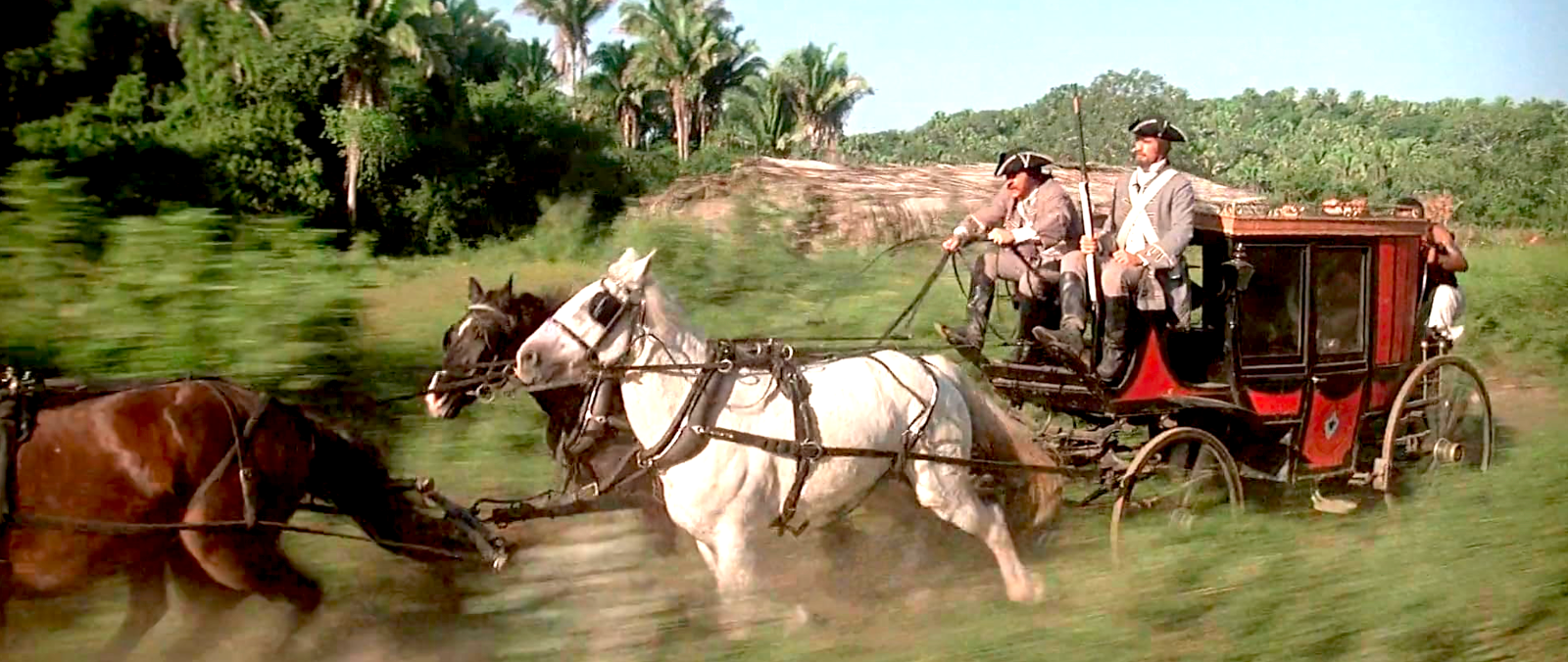
Swashbuckler is so thin for characterization that we mostly remember Robert Shaw’s endearing grins, in between fencing lunges. The nonstop action is well-blocked and the stunts are good. Shaw may have performed the big rope swing in the first scene, and it’s definitely him atop a racing carriage. One shot of said carriage plunging off a cliff has excellent doubles for all three passengers. They tumble at least 60 feet into the water.
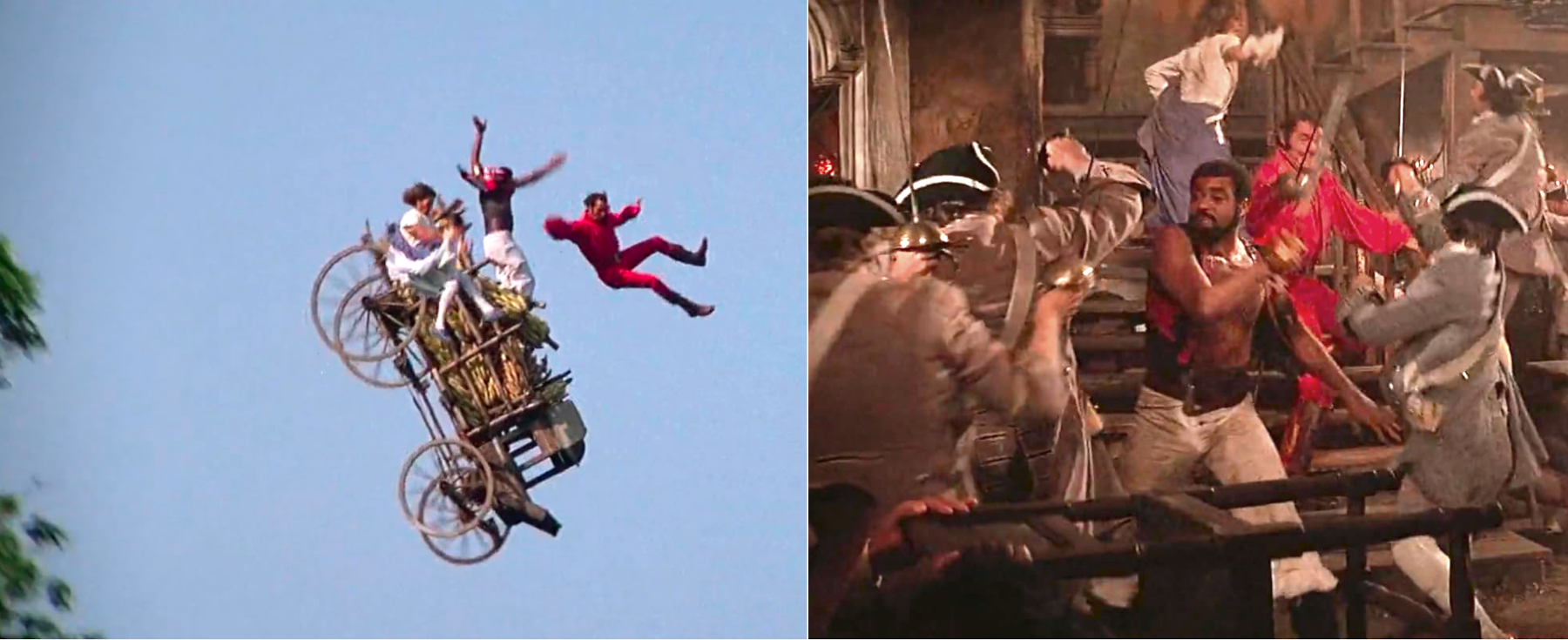
James Goldstone covers all the scenes with multiple camera angles, yielding a show that lacks a sense of direction. That goes for the many vigorous action scenes — it’s on the screen, but we aren’t fully invested in it. It’s all staged only for spectacle, and the zooms and sweeping helicopter shots serve to take us out of the 18th century. Characters tend to come out of action in the same state they went in. There are at least 4 big-scale sword battles, not to mention individual duels, and none make a big impact.
As if trying to remake a 1940s Universal sword-and-turban costume movie, there are constant side gags featuring Ned Lynch’s colorful crew, who laugh their way through anything. A mustachio’d Avery Schreiber cues a few Polish jokes. Tom Clancy waxes Irish and sings bits of songs. From farther down the cast list, the bald pirate Sid Haig has no dialogue but gets in some serious mugging. None of it is particularly witty. Fifth-billed star Beau Bridges has a demeaning small part as that silly-ass Major, present only to be made the butt of jokes. Did the studio do a script bait-and-switch with these respected actors, or did they use the movie to fulfill standing commitments to Universal?
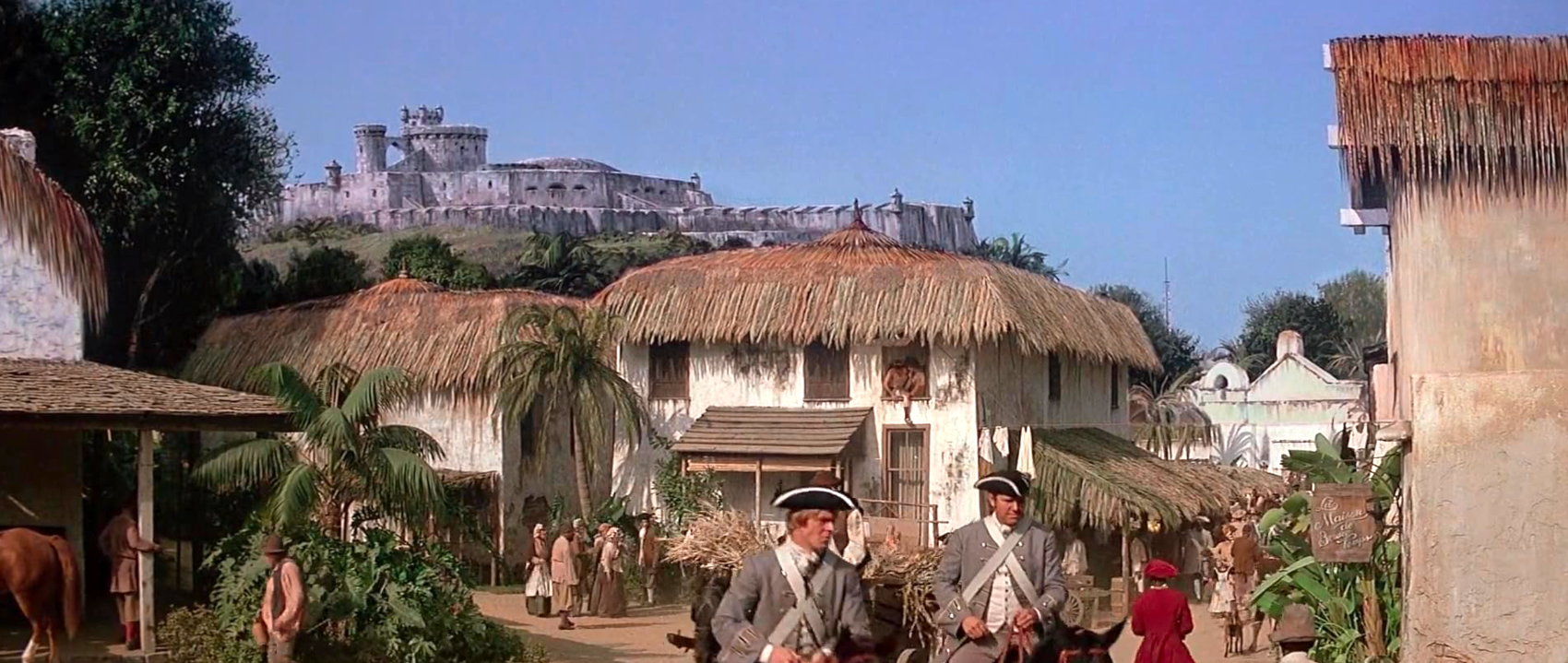
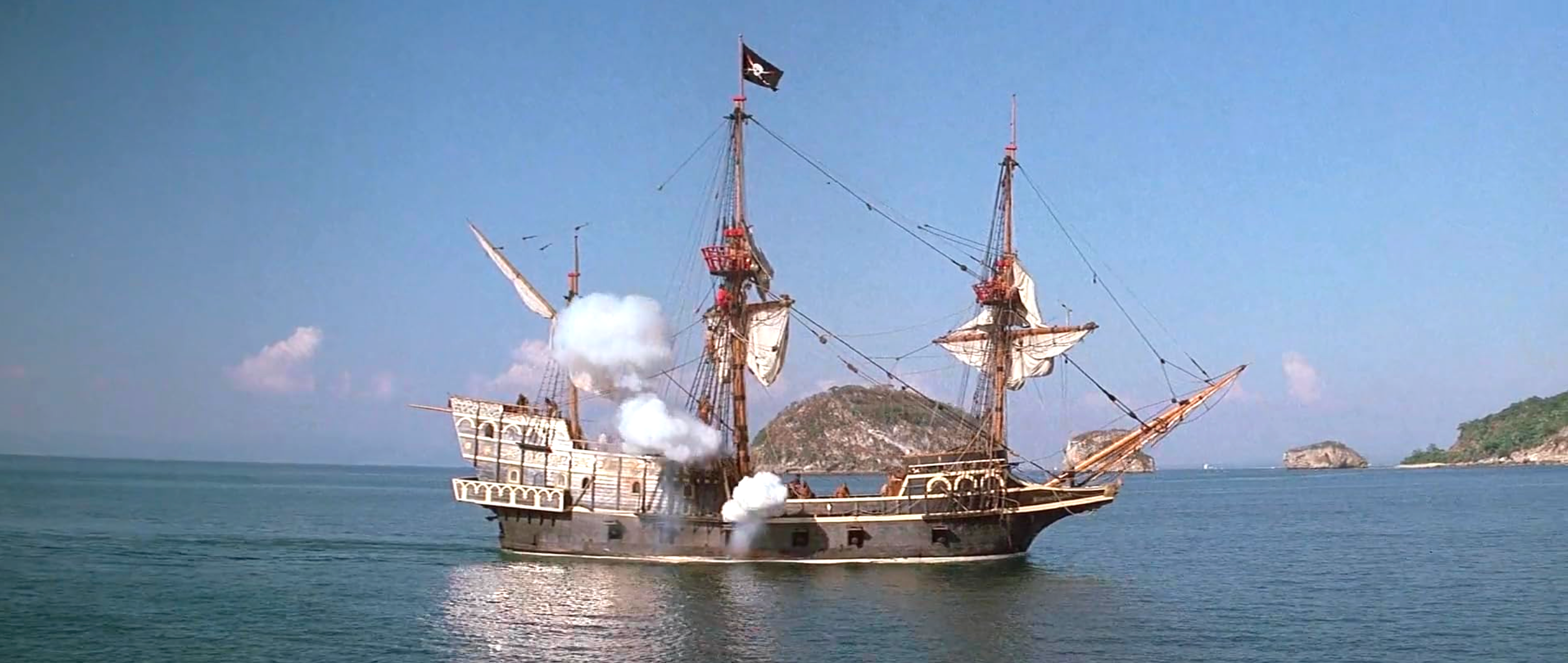
Most of our attention went to Swashbuckler’s compromised production. Half of the film is gorgeous Mexican scenery, and the other half gives us the Universal City lot, with exteriors that look exactly like what tourists see on the studio tour. Tying the locations together and lending an epic quality are Albert Whitlock’s matte paintings, which augment studio streets with background fortresses, pulling off a great many clever illusions. Ned Lynch’s pirate ship was a full-scale reproduction, rented for the film. As it isn’t easy to find a solid, static camera position from which to view that ship, so various shots taken from the same sea cliff use different matte additions — island, boats — painted in as needed. Most of these shots are truly beautiful, except for one matte in which the real and painted skies fail to match … what looks like a big oil stain curves through the sky.
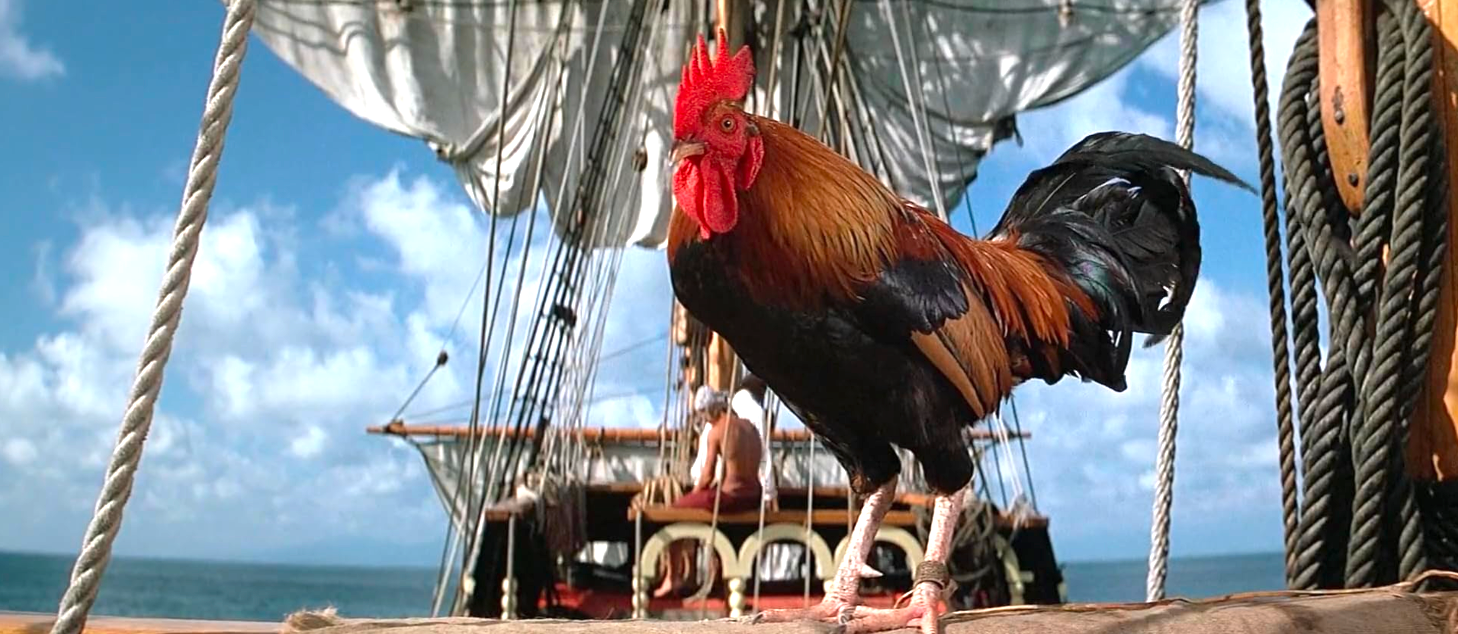
Robert Shaw and Genevieve Bujold certainly give it their best. He gives forth with 20 different cute grins, and she joins the other actresses in the art of making it look as if their costume tops are about to come off. Otherwise Swashbuckler has only a few distinguishing touches. An early title was The Blarney Cock, which explains why scene transitions repeatedly cut to the ship’s carved bow ornament — a chicken’s head. There a couple of animal gags with a monkey, but the ship’s mascot is a proud red cock of the walk. He just sits there, looking cocky in Panavision and Technicolor. (top image) ↑ Is he a remnant of an earlier script?

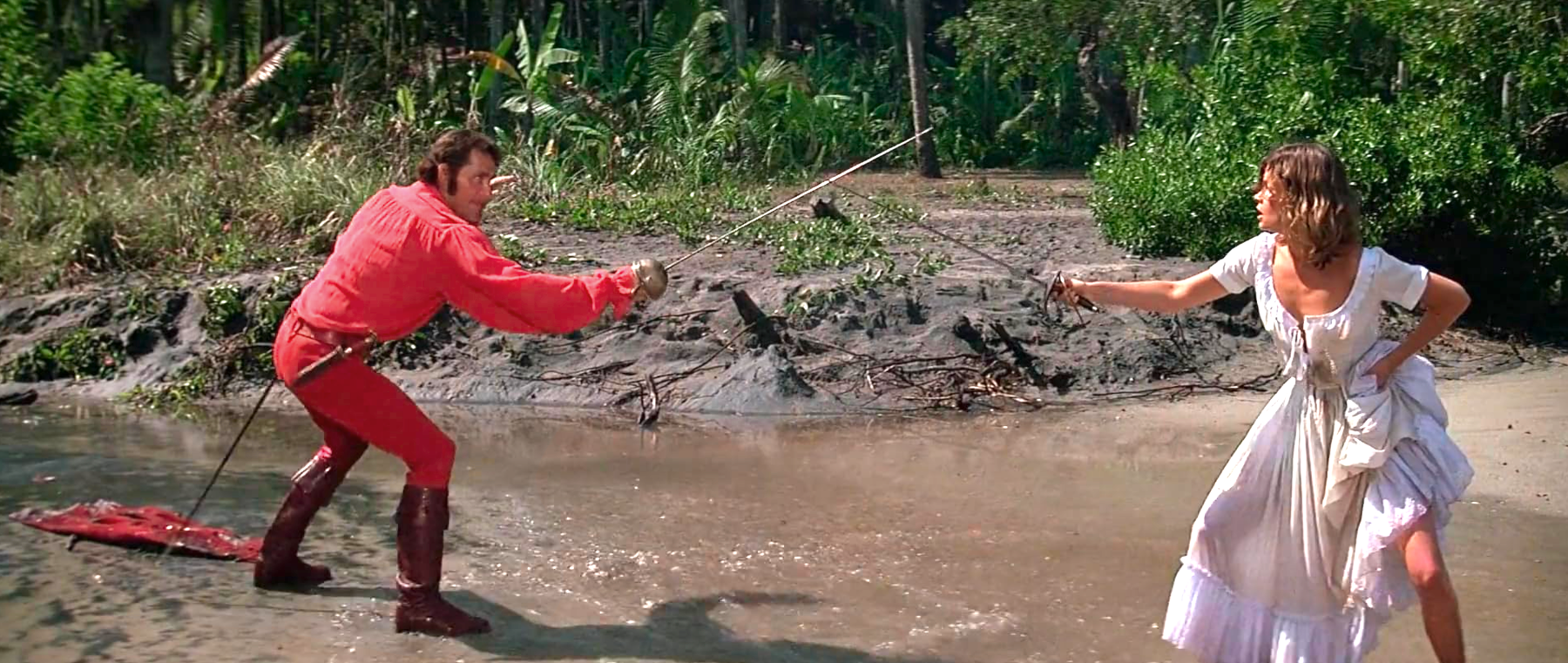
The KL Studio Classics Blu-ray of Swashbuckler is a flawless encoding that shows every scene to its fullest potential. It’s a bright, picturesque show, with many attractive shots and a lot of stunt work and visual effects to admire. We only wish it had more personality and less of a movie-by-committee quality. The later New Zealand pirate picture Nate and Hayes has no reputation, but it at least looks like it had a director who believed in it and cared.
Not helping is John Addison’s busy but undistinguished music score. We know it’s there but we stop paying attention to it.
We think it interesting that Swashbuckler should make old movie tropes about adventure, corny heroes and blushing dames seem so old-hat: just one year later, George Lucas would conquer Hollywood by folding all those cornball thrills into a witty reinvention of the long-gone Buck Rogers space adventure. Seen almost 50 years later Star Wars’ most powerful element is its great music score.
Taking Swashbuckler out of the disc player, my monitor defaulted to Robert Siodmak’s The Crimson Pirate on TCM, where Burt Lancaster was swapping tough pirate talk with Torin Thatcher. That old movie is not at all serious, yet everything about it holds our attention. In Goldstone’s show the dialogue is all limp throwaways, even when Robert Shaw is speaking. The Crimson Pirate was all post-dubbed, but instead of sounding fake, every line has a feeling of importance, a gotta-listen quality.
Reviewed by Glenn Erickson

Swashbuckler
Blu-ray rates:
Movie: Good – minus
Video: Excellent
Sound: Excellent
Supplements:
Audio Commentary by Howard S. Berger and Steve Mitchell
Original promo featurette The Making of Swashbuckler
Theatrical Trailer.
Deaf and Hearing-impaired Friendly? YES; Subtitles: English (feature only)
Packaging: One Blu-ray in Keep case
Reviewed: May 17, 2026
(7515swas)
Visit CineSavant’s Main Column Page
Glenn Erickson answers most reader mail: cinesavant@gmail.com

Text © Copyright 2026 Glenn Erickson
About Glenn Erickson

Glenn Erickson left a small town for UCLA film school, where his spooky student movie about a haunted window landed him a job on the CLOSE ENCOUNTERS effects crew. He’s a writer and a film editor experienced in features, TV commercials, Cannon movie trailers, special montages and disc docus. But he’s most proud of finding the lost ending for a famous film noir, that few people knew was missing. Glenn is grateful for Trailers From Hell’s generous offer of a guest reviewing haven for CineSavant.
Caught this on a double bill with ‘My Name Is Nobody’. 🙂
I always wondered what movie it was that bothered me as a little kid in the 70s in which a character had some kind of knives or needles on the ends of his fingers…Now I know!
Thank you for pointing out the “TV movie feel” penchant that Universal had in the 1970s. Revisiting my favorite movies as a kid (THE HINDENBURG, EARTHQUAKE, etc.) just amplifies how cheap everything looked from Universal then… especially for someone who had been on the studio tour and recognized all the streets and buildings that were used over and over again.
Some of the music in this turned up in the Jackie Chan movie Half a Loaf of Kung Fu,
Genevieve Bujold is one actress who’s never gotten the recognition that she deserves.
I disagree completely on the Addison score which, which I thought had a lyrical, rollicking quality to it, capturing the fun of make believe pirate play, especially the chase and fight scenes.