
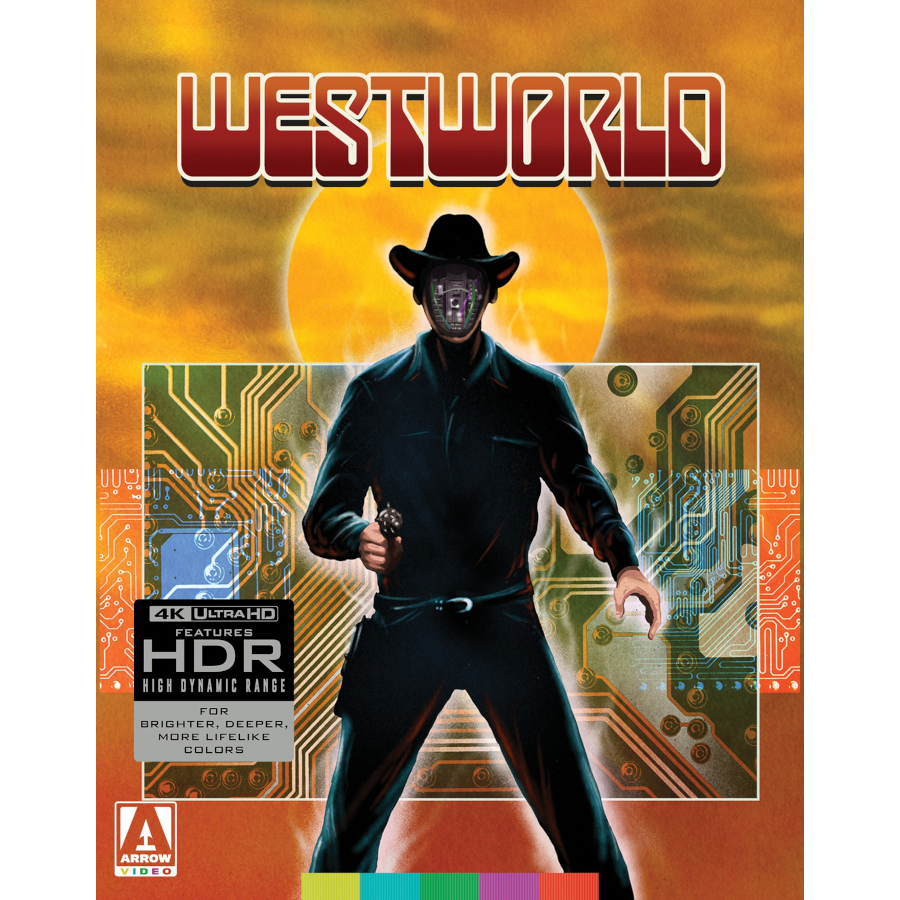

Michael Crichton always knew what he was doing. He finished medical school but instead chose careers in writing and filmmaking, finding success in each. After his medically-savvy novel The Andromeda Strain became a hit under the direction of Robert Wise, Crichton repeatedly returned to Science Fiction stories. Using pen names, he wrote books that became a drug bust movie and a medical murder mystery. He also managed to direct a TV movie of his own.
Crichton was tall and good-looking, a gracious fellow who was often the Smartest Person in the Room. He knew well that Hollywood was capricious and the public fickle. His start was decent, but he knew he had to make a directorial splash while he had the chance, before his name could become associated with a career-sinking flop. *
Crichton’s saving grace was a knack for arresting, un-killable story concepts — reformatting Sci-fi exploitation into mainstream audience-pleasers. This would pay off again and again. Andromeda Strain framed the basic alien invasion story as a problem for a genius microbiological team. Coma was one of the first thrillers to exploit the scary notion of criminal organ harvesting. The time has finally come for his somewhat awkward Looker, now that its concept has relevance in the present AI debate.
Michael Crichton’s most brilliant concept was to come up with a semi-plausible ‘DNA’ rationale to depict living dinosaurs. His book Jurassic Park also recycles a concept from the film that became his directorial breakthrough. 1973’s Westworld is another futuristic amusement park that breaks down. The attraction is robots, not resurrected dinosaurs. Westworld was revisited fairly recently as a streaming series, but the original 1973 feature maintains its cultural position through one indelible, iconic image: Yul Brynner’s gunslinger from The Magnificent Seven reincarnated as a robot simulacrum, whose face pops off to reveal the solid state circuitry of a transistor radio.
High tech industry seems intent on robotizing everything. Have you seen the recent news footage of those sinister Chinese dancing robots? What they can do still seems impossible. In 1973 the notion of a robots that can pass for human was the province of allegorical stories, like The Stepford Wives. Westworld is the same kind of what-if tale, pushing an idea just far enough to amuse an audience. No ‘big ideas’ here; the raw concept was enough to fully engage the imagination.
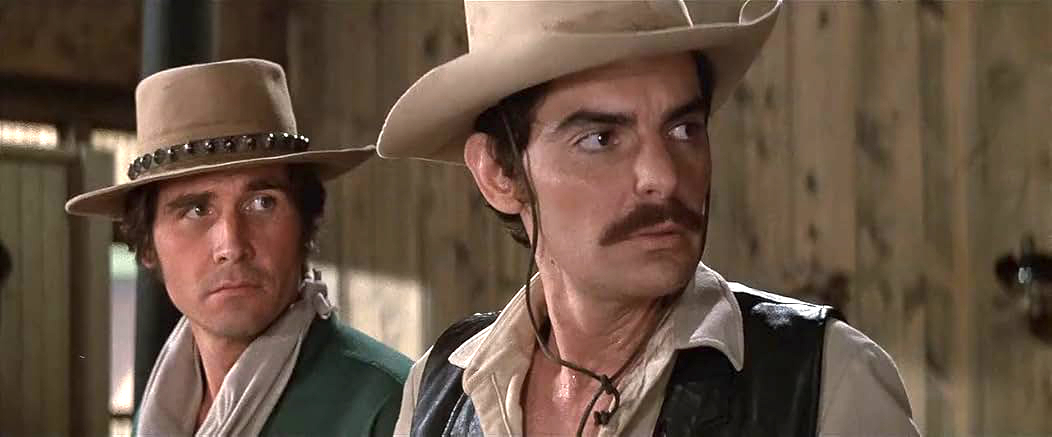
Crichton sets his story in 1983. An expensive amusement park called Delos is a playground for the wealthy, a kind of Disneyland of fantasy role-playing in two ‘worlds,’ Medieval World and Western World. The novelty is personal interactivity with sophisticated robots that look and act just like people. Peter and John (Richard Benjamin & James Brolin) pay top dollar for several days’ fun in Western World, where they get to ‘be’ western gunmen as if in a standard Hollywood oater. They’ll shoot down bad guys and have sex with robotic saloon girls. The two executives play out fantasies both childish and adult. John has fun behaving like Clint Eastwood’s Man With No Name. The less assertive Peter overcomes his trepidation and ‘gets into’ blasting down barroom opponents, that spurt blood realistically as they die. John explains that the robotic guns can’t be fired at human guests, an obvious safety factor. They go upstairs with seductive robot prostitutes.
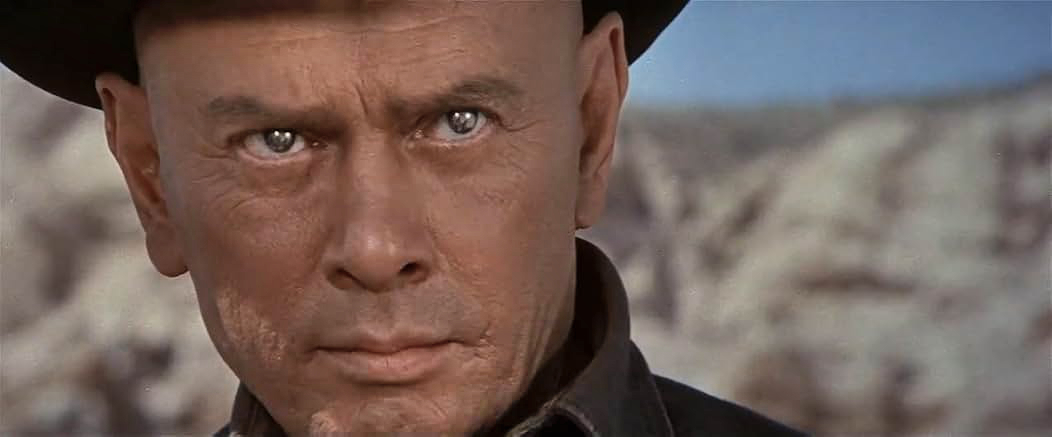
Their main adversary is The Gunslinger, a black-clad killer with silvery eyes who continually challenges them to draw, and obligingly loses each contest. He’s played by cast top-liner Yul Brynner as a close copy of Brynner’s ‘Chris Adams’ from The Magnificent Seven. The ‘special guest robot’ concept is somewhat unnerving, thanks to Brynner’s steely performance. The actor clearly gets the joke … the robot is more intense than Brynner’s laconic, tightly controlled western gunmen in Mag Seven and Invitation to a Gunfighter.
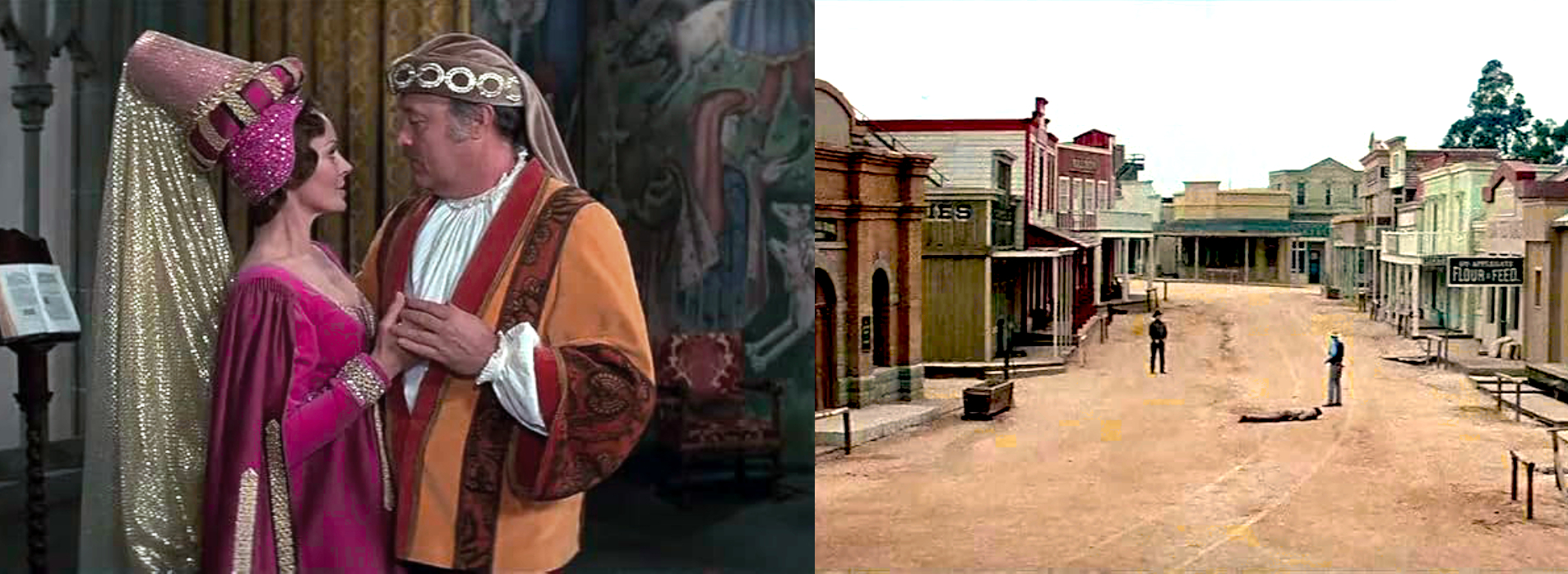
Over in Medieval World, a middle-aged couple get to play feudal nobles in a King Arthur-like castle. Hubby fights duels with a burly bad-guy knight; both of them look forward to sex encounters with robotic damsels and knights. Delos is a ‘safe’ sex vacation for husband and wife. How can one be unfaithful with a robot?
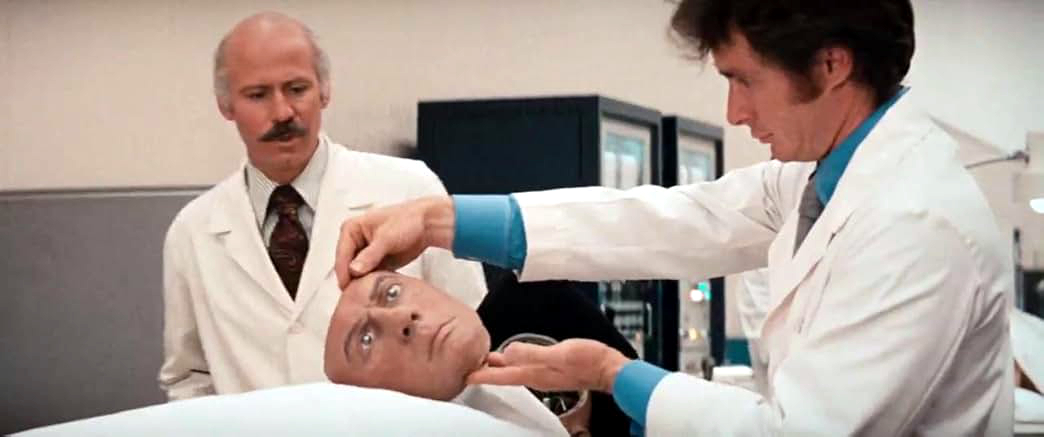
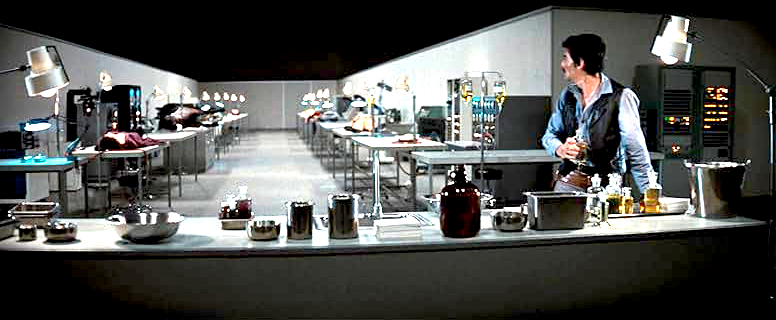
Parallel action backstage shows that every corner of Delos is monitored from a subterranean control room, via video surveillance. Clean-up crews work ’round the clock to keep the park’s illusions on track. Maintenance men ‘reset’ a barroom where guests staged a big brawl, and collect robot ‘corpses’ strewn about the grounds. In a vast underground support level, technicians repair damaged robots, which pop apart to reveal electronic innards. The chief supervisor (Alan Oppenheimer) notes that not everything seems right. There are more breakdowns than normal, and odd spurts of un-programmed behavior from individual robots. The main Delos computer seems to be affected by a ‘central mechanism psychosis,’ essentially a Computer Virus. Westworld is therefore connected to both The Andromeda Strain (a runaway virus) and Jurassic Park (a short-circuiting amusement park).
Sure enough, the robotic psychosis strikes the entire park, in the form of a violent mutiny. The humans are denied control, as if Delos’ mainframe computer had become sentient and decided to rebel, a la our favorite Heuristically Programmed Algorithmic Computer. The guests are in for some nasty surprises. The ‘bad’ knight robot refuses to lose a duel, and runs our flabby park guest through with a broadsword. Western World guests are shot down in the street. Peter finds himself alone and pursued by the implacable, unstoppable (and freshly repaired ) Mag 7 Gunslinger. The Yul Brynner robot chases Peter across the desert to Medieval World, and eventually into the service tunnels below. Discovering that the park’s human staff is completely out of commission, Peter begins a struggle to neutralize the un-kill-able robot gunslinger — who keeps popping back to ‘life.’
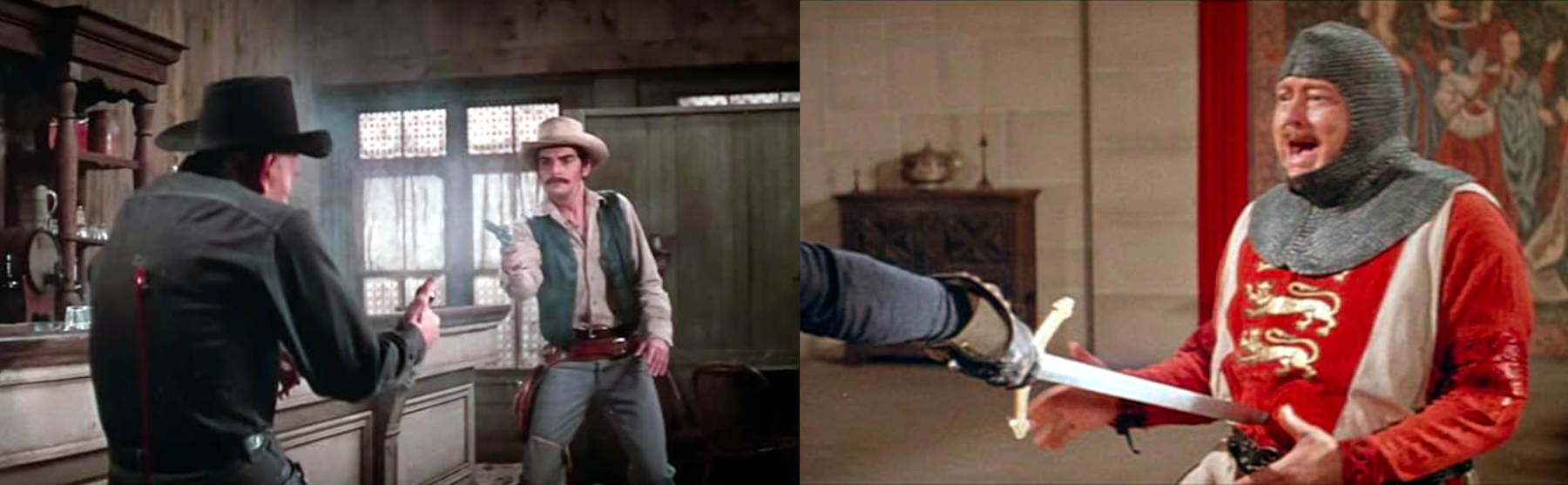
Westworld must have appealed to MGM’s production head James T. Aubrey, as it doesn’t overtax the shrunken studio’s resources. The western street and the castle interiors are represented by existing plain-wrap movie sets, just real enough for the guests to play dress-up cowboys and knights. The castle’s garden is actually silent star Harold Lloyd’s beautiful property in Beverly Hills. The unusual cathedral cliffs of the oft-filmed Red Rock Canyon location already look like something designed for an amusement park. Matthew Yuricich adds some okay matte paintings, and we see a decent-looking futuristic jet-hovercraft. Not bad at all are the robot players in the repair facility, shown in various states of disassembly. The ‘Yul Brynner’ face is a bit disturbing when detached.
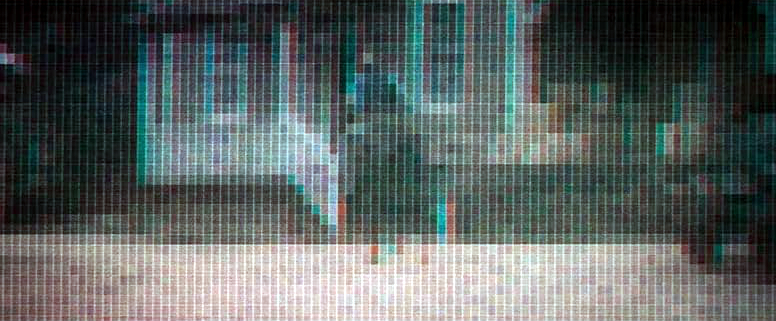
This may have been the first time that a faux-digitized ‘robo-vision’ POV was confected for a Sci-fi picture. It made a big impact back in the day. A robot rattlesnake is a nice touch as well.
The storytelling is clear, but the visuals are undistinguished. Most of the show looks like a TV movie. Michael Creighton’s efficient direction has a just-get-it-done quality that Aubrey must have loved. The stunt work and stage effects are consistently good, even if the barroom brawl is an unfunny bore, padded out with conventional gags. We don’t bother to challenge the premise; it should be obvious that Delos couldn’t turn a profit operating like this. Why aren’t a DOZEN guests crowded into that saloon, waiting their turn to shoot a robot? It’s like putting on an opera for an audience of two. The maintenance bill would require the customers to fork over millions, not thousands.
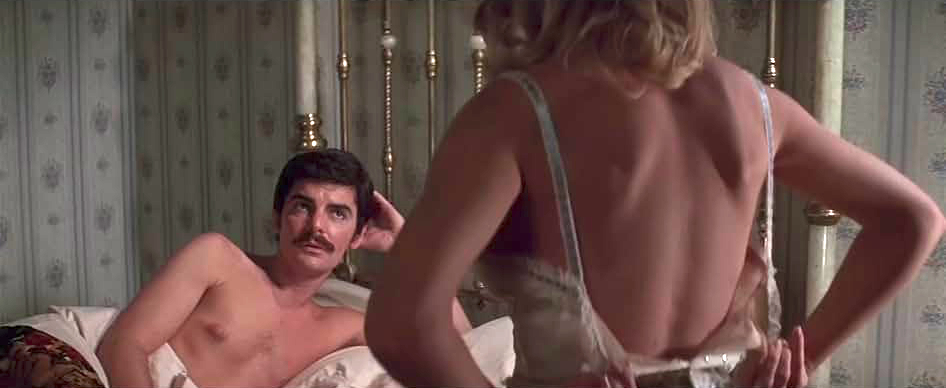
Forget dinner theater. Delos guests get to ‘be’ Marshall Dillon.
They can &#@% Miss Kitty too!

Richard Benjamin and James Brolin are adequate in parts that require them to react to the park’s wonders, and then fight for their lives. We love Benjamin, even with that overstated mustache. Most of the ‘robotic’ playing is okay. We feel a bit concerned for the actresses that portray the automated sex dolls. The robot ‘characters’ are not much different from the girlfriend and bedmate roles Hollywood hopefuls are normally asked to play … only here they can’t even pretend to be human. The 2016 HBO series was all about sex and nudity, even with its more sophisticated approach to the concept. It still felt like Cheap Thrills.
Although there’s no overt ‘movie’ connection in Delos’s advertising, the park guests pay to indulge movie fantasies, augmented by sex fantasies. Westworld is a decadent brothel with surrogate sex partners. 1973 was right in the middle of the Deep Throat years in which some pundits thought that all limits in sex entertainment would disappear. By mostly skipping the bedroom action, Crichton and company steer clear of the slimier possibilities of Peter and John’s sex vacation. But a sex doll is a sex doll. Peter’s encounter with a ‘willing’ saloon girl is a sleazy masturbatory fantasy. Westworld was rated PG, but in concept it is an R.
We admire Michael Crichton’s Hollywood strategizing, to fashion Westworld as a career stepping stone. He wrote directly for the screen, as the idea is so easily understood that a novel was unnecessary. Crichton reportedly got along with MGM’s James Aubrey, possibly because he positioned himself as a commercial moviemaker, not an auteur sparring for creative control. The name directors Robert Altman and Sam Peckinpah despised Aubrey’s ruthlessness. The production head cancelled Fred Zinnemann’s giant epic Man’s Fate literally on the eve of principal photography. Producer-director Blake Edwards thought Aubrey’s meddling ruined his The Wild Rovers and The Carey Treatment. The latter film is from a book by Michael Crichton, so we assume that he knew exactly what he was getting into with James Aubrey, whose nickname was ‘The Smiling Cobra.’

Benjamin’s ‘stache aside, I always have time for this.
I prefer Yul, though, in 1970’s ‘Adios, Sabata’.
I love this movie. The recent HBO series? Not so much.
Excellent movie I’ve watched many times. Can this disc play in a multi-national Blu-ray player?
My information is that 4K discs do not have region coding…
My mom told me about this movie when I was ten, and just a few weeks later, that week’s Simpsons episode depicted Itchy & Scratchy Land, where the robots malfunction (an obvious reference to the movie). So I watched Westworld, and it was my introduction to Richard Benjamin (who by that point had swapped acting for directing).
I seem to recall that the movie also depicted Roman World.