
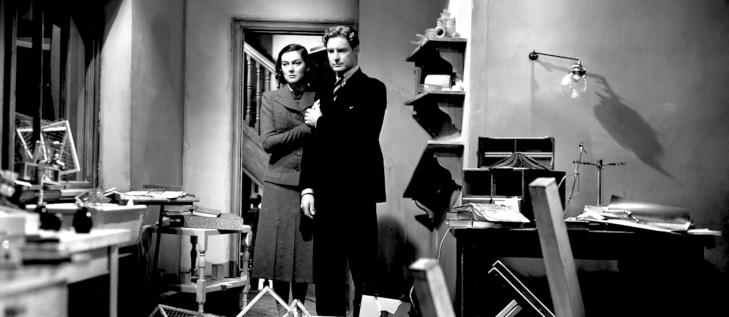


King Vidor didn’t sell himself as a progressive artist, yet he consistently gravitated toward subject matter with the public interest in mind. The respected veteran producer-director made all kinds of movies in his time, but he also took a shine to socially progressive fare: Hallelujah, Street Scene, the now-obscure An American Romance. His work could be uneven but it was always bold; we hope that when the maker of the very leftist Our Daily Bread filmed the radical The Fountainhead, it was as a technical storytelling challenge. The Ayn Rand screenplay may be insane, but the film is brilliant.

The Citadel is from an ‘important’ novel by A. J. Cronin urging reforms in the medical profession, much the same as Cronyn’s The Stars Look Down, a critique of the coal mining industry. Hollywood wasn’t known for criticizing the medical establishment, but this show could sneak by because it was set in Scotland, Wales and London. It was MGM’s second film of four to be filmed at their new British studio. The first was the Robert Taylor feature A Yank at Oxford. We were wondering what writer Frank Wead, who wrote mainly military adventures, was doing with a screenplay credit on Citadel. He has a minor credit on Oxford as well, so perhaps he was tapped because he was on-site in London.
John Ford’s inspiring movie Arrowsmith had adapted a similarly ‘important’ medically-themed book by Sinclair Lewis. Both films sentimentalize their subject matter, and The Citadel takes on the broad subject of medical ethics. It makes its points clearly even if the arguments are simplified. It’s good that MGM borrowed the charismatic Robert Donat from Samuel Goldwyn, because a good actor was needed to navigate the hero doctor’s twisting character arc. In just a few minutes’ time Donat transforms from a naíve beginner to a disillusioned researcher, and then to a greedy society doctor.

King Vidor’s direction is direct and effective, and he has the cream of English actors to bring the story to life. Newly minted doctor Andrew Manson (Donat) is assigned to a small Scottish town as an assistant, being paid nothing while the wife of the on-the-books doctor cheats him in every way she can. When typhoid threatens, Manson and surgeon Denny (Ralph Richardson) find they cannot persuade the authorities to replace the bad sewer line responsible. They resort to getting drunk and blowing it up with nitroglycerine, a risky move that has a good result. Manson then moves to a job as a full doctor in a mining town. He takes with him a new wife, Christine (Rosalind Russell), and uses the opportunity to study coal miner’s diseases. His doctoring wins respect, but the prejudiced and ignorant locals turn against him. Vigilantes destroy his laboratory and end his promising research.
Moving to London, Christine and Manson grow threadbare as his practice fails to attract patients. A chance meeting with his old school chum Dr. Lawford (Rex Harrison) then brings Andrew Manson a highly lucrative position in Lawford’s clinic, which appears to cater to wealthy hypochondriacs, and patients that like the luxury of being attended by expensive doctors. As Andrew thinks more about cars and golf, Christine sees his idealism fading — he no longer wants to ‘assault the Citadel’ of disease and suffering. What can steer him back to the side of medical righteousness?
The film’s many episodes mark strong changes in tone. Andrew Manson sees small-mindedness and resistance to new ideas wherever he goes. Thanks to Donat and Vidor, a standard ‘save the baby’ childbirth scene is an emotional highlight, even when an obvious baby doll is on screen far too long. Donat and Richardson’s reckless stunt to wreck the sewer turns out a smashing success, introducing the notion that enlightened men sometimes must break the law to ‘do good.’ That theme returns at the finale, substituting for more specific problems with the medical establishment.

At the mining town Andrew Manson takes a nicely-done rescue trip into a crumbling mineshaft; the only way he can free a trapped miner trapped is to perform an ad hoc amputation. ↑ But the locals don’t really believe in science or real medicine, and attack his lab as if he were Dr. Frankenstein. Some of Manson’s peers don’t mind when he’s driven from the community. He threatens the status quo because he won’t join in the local medical corruption, giving medical deferments to miners that are perfectly healthy.
Rosalind Russell is the only Yankee in the production, save for director King Vidor. Andrew and Christine meet in his first posting; they see each other only a few times before Manson’s new job comes with the requirement of a wife. That awkward one-scene courtship suddenly requires the good doctor to behave like a clueless schoolboy. That the scene works can be attributed to Donat and Russell’s fresh approact to insufferably ‘cute’ material. Later on, wen Manson joins Rex Harrison’s smarmy clinic owner in fleecing the rich, Christine becomes the good doctor’s conscience. But a tragedy is required to get him to remember his oath as a doctor.
Manson preaches high ideals, but the values on screen still reflect the norms of the day. When lecturing a spoiled society woman, he insists that her problem is that she ought to be married, with children. The issue of kids never comes up between Andrew and Christine, keeping with the film’s simplified focus on the issue of medical ethics. But neither do they seem to have any parents or other family members, either.

In the ritzy society clinic, all emphasis is on maximizing profits. Andrew’s character arc too abruptly sees him adopting Dr. Lawford’s mercenary attitude. The ‘new’ Andrew Manson ignores the idealistic overtures of two colleagues who still believe in doing good for society. Surgeon Danny’s grand idea is to found a socialized clinic where people subscribe to a socialized fund, and draw medical care as needed. Critics have asserted that A.J. Cronin’s book (and partly this movie) had a big influence on the acceptance of the National Health system that England adopted post- World War II.
But Manson prefers to enjoy his new sports car. He turns Denny down flat, and also rejects an offer to collaborate with an expatriate American researcher who runs his own clinic, studying the same pulmonary diseases that Manson had worked on. The third act opts for MGM schmaltz, when Manson ignores a medical crisis. At this point the character logic breaks down. Even Donat can not make Andrew’s new callousness believable. The adorable child of his friend, Italian restauranteur Mrs. Orlando (Mary Clare), just happens to have a critical pulmonary problem.
Dr. Manson’s atonement comes after a dramatic accident and an incident of outright medical incompetence. To save the child’s life, he commits a serious procedural offense. The Phillistines on the medical council smell blood and move to have Manson disbarred or defrocked or whatever. With his license to practice on the line, Manson makes an oratorical appeal to a gallery of suspicious doctors, pleading his moral case. It’s a good speech but not a show-stopper. Robert Donat’s oratory may not be quite as compelling as that of Paul Muni in The Life of Emile Zola, but it is miles ahead of the average Frank Capra / James Stewart spectacle of whining and pleading. *

It’s great fun to see Ralph Richardson nailing his eccentric, smart-talking surgeon so well. An almost grotesquely young Rex Harrison is aptly cast as the posh medic who uses his profession to fleece high society. Francis L. Sullivan and Edward Chapman are working-class folk, while Cecil Parker is effective as another of Harrison’s swank clinic frauds. An especially fun contribution comes from Athene Seyler as a nutty rich hypochondriac. We love her voice and manner from the genre classic Night of the Demon.
Although Robert Donat is not as successful as in his Goodbye, Mr. Chips, King Vidor’s The Citadel is a decent stab at a social problem movie, ten full years before Hollywood filmmakers like Stanley Kramer discovered that, given a sufficiently sensational subject, message pix could be big box office. If The Citadel really did help bring about the transformation of British medicine, then it was a lot more effective than our movies about race prejudice, lynching and economic oppression.

7 years later we got the national health service. The US still has the worst healthcare in the developed world. Films matter
The opposite is that the United States has the most sophisticated healthcare system.
In his Sicko, Michael Moore interviews citizens of countries that have single-payer healthcare, and they affirm that they wouldn’t give it up for anything. To be certain, Tony Benn said that if the British government tried to repeal the NHS, the UK would have a revolution.