
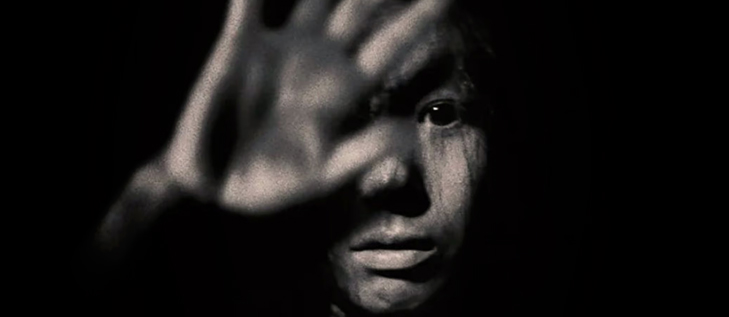
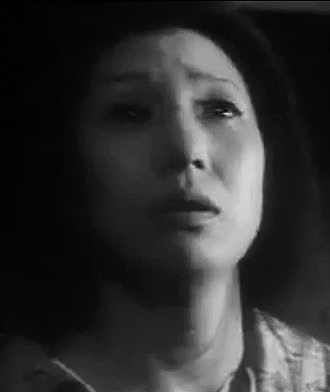
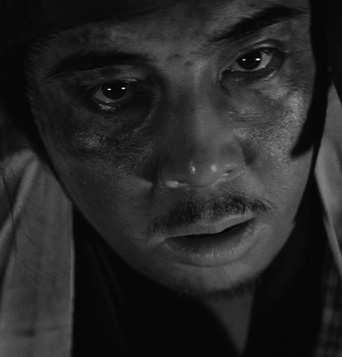
 No silent film star ever suffered quite so much as Yoshiko Fujishiro, the star-crossed heroine of The Tale of Oiwa’s Ghost. Fujishiro plays Oiwa, a prototypically obedient housewife of the Edo era living under the heel of an unscrupulous husband named Tamiya lemon. Tomisaburô Wakayama plays Tamiya and no matter how many demons populate this film, let it be known that he is the movie’s true monster. Though you might need a scorecard to keep the plot lines and characters straight, this is no daytime soap opera; Tai Katô’s film begins life as a frenetic yakuza thriller and transforms, like Oiwa herself, into something both terrifying and pitiable.
Katô’s career as a filmmaker was interrupted by the war but he returned in 1946 as an assistant director for Daiei where he rose in the ranks as Kurosawa’s right-hand man on 1950’s Rashomon. A year later the ambitious 35 year-old made his directorial debut with the two-part Troubles with Swords and Women—what could have served as a more pragmatic title for the story of Oiwa. For the next thirty years Katô devoted himself to the art of swordplay in a series of Yakuza films that showed off his affinity for split-level storytelling inspired by Kurosawa’s kaleidoscopic camera moves and Yasujirō Ozu’s delicate dramaturgy. Though Katô followed Kurosawa’s lead in exploring Shakespeare (a 1960 version of Hamlet, Throne of Flame), the director’s instincts ran more to the grindhouse than the arthouse; in 1973 he condensed Hiroshi Inagaki’s iridescent, if bloody, Miyamoto Musashi (a three-part epic) into one visceral samurai shocker.
 Katô consolidates his split personality in Oiwa; under the perennially gray sky (the superb widescreen cinematography is by Osamu Furuya) the world is a forever war where blades flash at a moment’s notice—in these scenes Katô is in full Kurosawa-battle mode. Once inside Oiwa’s relatively peaceful living room, the violence is expressed in more subtle ways.
Katô frames the scenes of marital strife with the camera low on the floor as in Ozu’s own family dramas. Poor Oiwa simpers rather than speaks, always at the ready to do lemon’s bidding. The contrasts between the delicate Fujishiro and the savage Wakayama, best known as the scowling samurai of the Lone Wolf series, couldn’t be more stark—we expect the worst to happen and it does. With his eye on Oiwa’s beautiful sister Oume, played by Yumiko Mihara, lemon poisons Oiwa with an otherworldly potion that destroys her face, a soul-killing attack that leads to her suicide. Like many of history’s great villains, lemon goes mad; Oiwa’s visage begins to appear on the faces of his own family and in one spectacularly supernatural moment she rises from the swamp to accuse him—it all leads to a bloodbath of Shakespearean proportions.
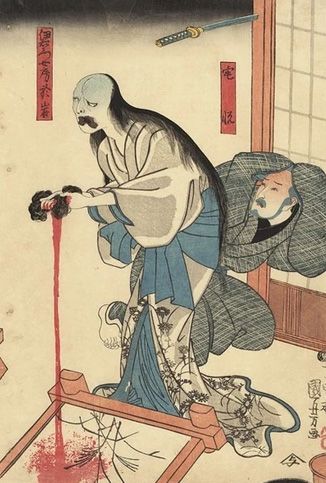 Oiwa’s story has been told and retold in all manner of media with dozens of books, plays, and a parade of films including 1927’s Yotsuya Ghost Story directed by Daisuke Ito, and the wonderfully titled Illusion of Blood directed by Shiro Toyoda in 1965. The story’s influence on contemporary Japanese horror is incalculable, from The Ring to Ju-on. The simultaneous beatification and demonization of women—the basis for Bruno Bettelheim’s concept of the mother figure as both witch and good fairy in 1976’s The Uses of Enchantment—found a resilient soapbox in Japanese cinema, particularly in the legend of Yotsuya which will be relevant as long as there are good women and bad men.
Oiwa finally finds a good home with Radiance Films—the company serves up a fine transfer for Katô’s film and added a few worthy extras. There’s an interview with director Mari Asato (Ju-On: Black Ghost, Fatal Frame) and a visual essay by Lindsay Nelson that charts the history of female spirits from the Yotsuya films so we might compare and contrast the various incarnations (though the presentation of these spooky, wayward souls has grown along with the special effects industry, these spirits stay true to their feudal inspirations). There’s also a booklet inside the keep case featuring new writing by Tom Mes.