

Making a futuristic science fiction movie that doesn’t become obsolete has never been easy, as the future is just too unpredictable. Makers of cheap pictures rarely looked further than ten years ahead, in the hope that clothing styles wouldn’t change radically. When the year 2001 rolled around critics noted that Stanley Kubrick hadn’t foreseen the end of the Cold War or the demise of Pan Am. Wim Wenders’ marvelous Until the End of the World dared to peek only nine years ahead, and failed to predict The Internet. Then again, who did?
There is no longer any gold standard for Sci-fi futures on film. Ridley Scott’s stylish Blade Runner is now also ‘in the past.’ It happened in 2019, but Los Angeles doesn’t look like an Asian city under perpetual rainfall. Even the best efforts of the past can date quickly because of the Devil that lives in the Details.
1973’s Soylent Green is Old News as well, having happened in 2022. When new, Walter Seltzer’s production was distinguishable from 90% of what passed for film Sci-fi by the fact that it had no monsters or rampaging robots. It’s not a high-budget feature, but thanks to good acting and direction in service of an interesting idea, it’s still remembered when other ecological catastrophe pictures have faded — Z.P.G., for one. We’re told that it and Michael Crichton’s Westworld were MGM’s only moneymakers for 1973.

Ecological Doom: The movie trend that appealed to nobody.
The ecology movement gained public acceptance in the 1950s with books stressing the planet’s delicate balance of nature. Then came Rachel Carson’s 1962 book Silent Spring and its warning of the effects of unrestrained pesticide use. Science Fiction had gone out of its way to concoct scenarios that might eradicate the world’s life, but movies before the late ’60s stuck mostly to anti-nuke messages. The British teleseries Doomwatch specialized in environmental threats, but ecological disaster movies did not take the high ground. Adapted from a thoughtful book, 1970’s ugly No Blade of Grass stressed post-apocalyptic rape and plunder amid its sledgehammer shock visuals.
Soylent Green is sourced in Make Room! Make Room!, a 1966 novel by Harry Harrison that takes the issue of overpopulation seriously. * The movie has a mixed heritage. Still-liberal Charlton Heston lauded its important message and chose the film as a good link in his chain of Sci-fi hero roles that started with the 1968 mega-hit Planet of the Apes. MGM’s despised production chief James Aubrey likely okayed the picture because it could be made for a relative pittance. We’re informed that Soylent Green was the last film to use the run-down street sets on the MGM back lot, before the studio sold them off to real estate developers.

Stanley R. Greenberg’s screenplay works some effective commercial changes on Harrison’s impressive — but depressing — book, adding upbeat passages and action scenes. I also adds the central conspiracy that has kept Soylent Green alive as a buzzword for movies with ‘hidden hook’ twist endings. The spoiler of film’s big surprise spread very quickly.
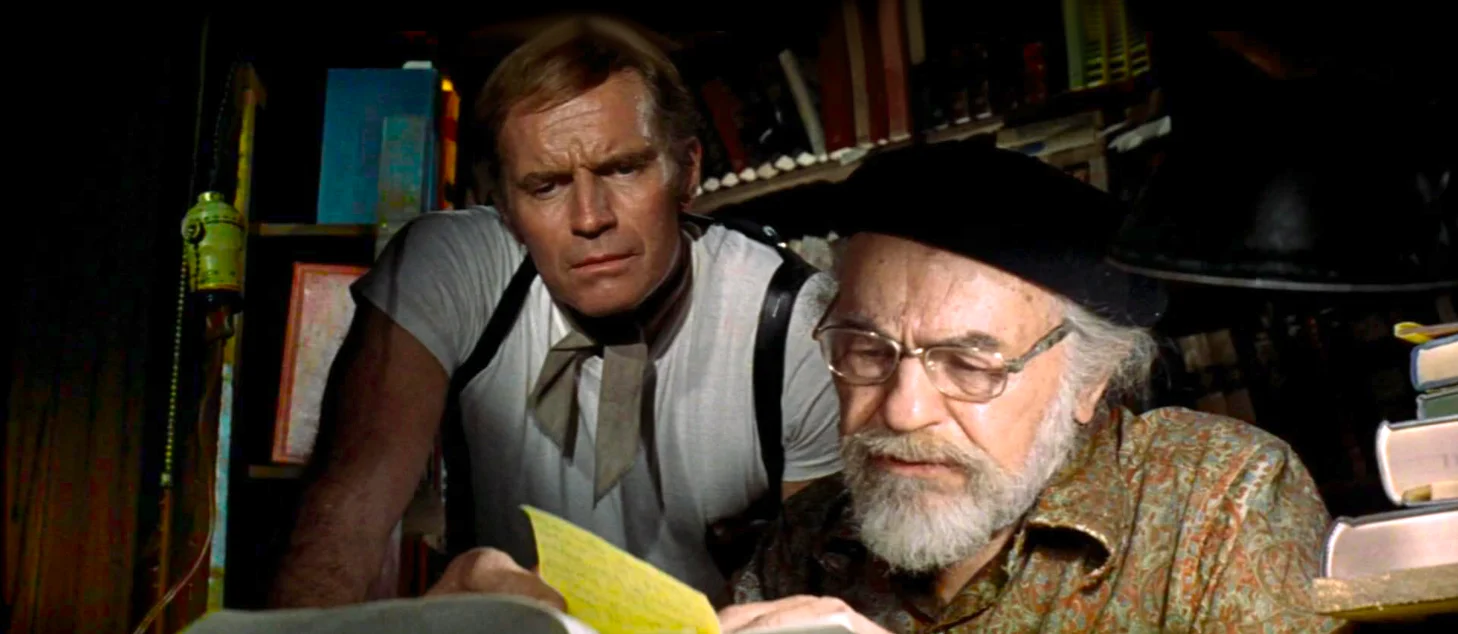
Manhattan of 2022 is home to 22 million people, most of whom are homeless and live in abject poverty. With the collapse of the environment, organic food is a luxury enjoyed only by the wealthy. The Soylent Corporation has stepped in to find ways to feed the population. A heavy seller are Soylent Orange wafers, made from plankton. The few citizens with jobs cling to them in desperation, including Detective Thorn (Charlton Heston), who lives with his elderly partner and crime researcher Solomon Roth (Edward G. Robinson, in his last role).

Thorn welcomes the opportunity to investigate a murder in the lavishly wealthy Chelsea West apartments, isolated from the rest of Manhattan behind security gates: it allows him to raid the rich victim’s larder of fresh organic foodstuffs. The dead man is bigwig William Simonson (Joseph Cotten). To get useful information, Thorn intimidates Simonson’s bodyguard Tab Fielding (Chuck Connors) and his live-in concubine Shirl (Leigh Taylor-Young). She comes with the apartment and is therefore considered ‘furniture.’
Thorn thinks the case is a murder but political pressure is applied to his police Chief Hatcher (Brock Peters) to stop the investigation. The detective is pulled off the case for a day, to serve as an ordinary riot policeman: supplies of the new food Soylent Green have run out. Sol’s investigative research continues while Thorn begins an affair with Shirl. Their plans are cut short when Sol discovers the secret behind Simonson’s murder, and decides that he no longer wants to live. Without telling Thorn, he starts off for one of the city’s communal suicide parlors, which are open 24 hours a day.

“I was there, I can prove it! When I was a kid, you
could buy meat anywhere! Eggs they had, real butter!”
Soylent Green is definitely a split decision movie: the parts that work are very well done, even inspired. Other aspects of the production can only be listed as an honest try under difficult conditions. Charlton Heston plays the policeman Thorn as one of his standard brawny heroes, and impresses as a normal guy stuck in a lousy situation. Everything is rationed, and the only reason anybody can take the crowding and discomfort is because few people remember when things were better. Heston and Edward G. Robinson make a fine team … Robinson’s Sol keeps harping on how wonderful ‘real food’ was, complaints that Thorn ignores until he breaks into his confiscated wares — fresh fruit, strawberry jam, real beef. Heston mimes the wonder of discovering these heavenly tastes for the first time, and makes us feel the joy.
That strawberry jam is just a bit of taste left on a spoon that Thorn steals from bodyguard Tab Fielding’s apartment. Since it costs $150 “D’s” per jar, it indicates that Tab may have been paid off to conspire in Simonson’s death.
The norm in depressed economies is that the law becomes lax, and people subsist by ‘creative improvisation,’ which in more prosperous places is simple corruption. Public employees are paid so little that most forms of cheating are allowed. Soylent Green shows the cops surviving by confiscating what they can; the payola is institutionalized up and down the ranks of civil servants, and Thorn has to pay a percentage to his Chief. Yet they’re all behaving within their ethical standards.

In a place where prostitutes come with an apartment lease, it’s also credible that cops would take advantage. Shirl doesn’t bat an eye when Thorn shows up ‘to ask questions’ and then calmly instructs her to go to bed with him. The film makes a backhanded feminist statement when Shirl accepts the arrangement as a matter of course. Hollywood values peek in when the pair makes plans to become a couple. The question is, how accustomed is Shirl to the high life, with decent food and her own private space away from the homeless mob in the street. Will she be willing to live in Thorn’s cramped and ugly apartment?
The movie is a gift to Edward G. Robinson, and Robinson is a gift to us. Solomon Roth makes a Jewish toast to Thorn with every meal, and his nostalgic reveries remind us of what we have but could lose, should the environment deteriorate and civilization collapse. Clearly not in the best of health, Robinson gives the part his all. Neither he nor director Richard Fleisher milk the melodrama of the already-charged situation. Except for a teardrop or two (“old people tend to cry a lot”) Sol experiences the death parlor as just another surplus body in the Malthusian imbalance. Soylent Green was the fine actor’s last film, and he was almost stone deaf when he filmed it..

“You maniacs! You blew it up!” — oops, wrong movie.
Clearly an actor with a lot of influence on his projects, Heston steers the movie to a conclusion that affords him a big scene, one comparable to the classic finale of his Apes film and the embarrassing crucifixion that finishes The Omega Man. Thorn exits like Dr. Miles Bennell, screaming “You’re next!”
We’re not broadcasting the big surprise. Every twenty years or so, a new generation comes along that might know nothing about Soylent Green. Well, maybe. Next to Charlie Kane’s flexible flyer, it’s the most frequently spoiled film surprise of them all.
Most filmed Sci-fi before Star Wars had difficulty affording futuristic special effects and settings. Cost cutting doesn’t cripple Soylent Green but it doesn’t help, either. Besides hiring hundreds of extras for a few days to shoot all those crowd scenes, the movie is pretty cheap. A few Matthew Yuricich matte paintings barely sketch in the contours of the stagnant city, and even those aren’t integrated well — at one point Detective Thorn runs ‘behind’ a background building when rushing to save his buddy Sol. We can also see that the ragged MGM New York Street exterior set is barely strong enough to stand up — the sheets of fake brick cladding look ready to peel off and fall.
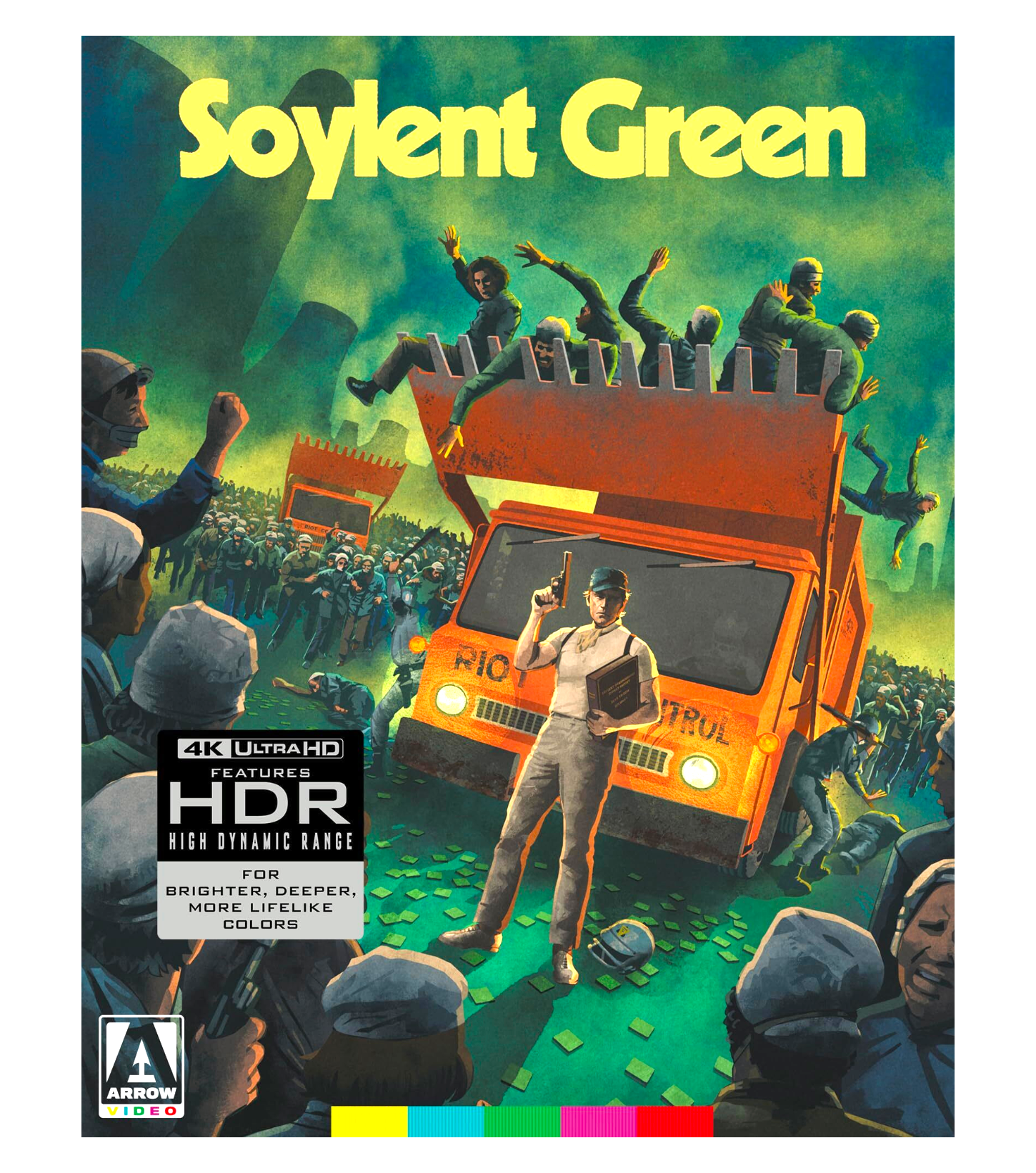
The production design is okay, but some ideas are pretty pitiful. The poster graphic of dozens of people being scooped up by enormous tractor scoops doesn’t prepare us for the sight of a pair of standard, unimpressive garbage trucks, and the sight of a few daring stuntmen allowing themselves to be hoisted into the air. Would it have broken the budget to modify or dress up a skip-loader to look futuristic? The ‘riot cleanup’ scenes never fully convince.

Other details seem lazy. After the lame garbage trucks, my 1973 audience laughed to see that the special riot gear worn by Heston’s Thorn was just a standard football helmet. The audience laughed again at sight of the upright arcade video game that Shirl plays in Simonson’s apartment. It’s the original ‘futuristic’ Pong game that showed up in 1973 in Westwood’s upscale movie theaters. No Sci-fi film equalled that lame move until 1976, when the abysmal Logan’s Run passed off an ordinary shopping mall as the interior of a City of the Future.
I was too young to see for myself, and always want to ask one question: did early ‘Space Patrol’-type TV shows do things as cheap as utilizing ‘hand communicator’ props that were ordinary desk staplers?
Ya gotta show a movie at a suicide, it’s a Hollywood Law.
In keeping with its theme of environmental collapse, the movie has an intentionally unappetizing appearance. Manhattan exteriors are a sickly greenish-yellow. The exception to the icky image texture is the suicide salon scene. Volunteer suicides are treated to a few minutes of Human Kindness, and take their exit while watching what is basically an MGM two-reeler travelogue in CinemaScope and beautiful color. With vibrant classical music playing, we see beautiful views of verdant forests, happy wildlife, etc.. — everything the world has lost. Cynical moviegoers with good memories may realize that the editors did a major raid of the MGM stock footage library. We see deer from The Yearling and an aerial shot of sheep from Far from the Madding Crowd. Someone with a sharper memory could identify which MGM westerns of the ’50s and ’60s provided the outtakes of idyllic cabins and mountains.
We don’t know who edited this film within a film, but the movie’s opening montage is by Chuck Braverman. It is accompanied by increasingly sinister music that reminds us of the ‘assassin audition film’ from The Parallax View.

The movie has some fine supporting actors. Brock Peters played a soldier under Charlton Heston’s command in Major Dundee while Paula Kelly had a standout part in The Andromeda Strain. The leader of Sol’s group of information activists is Celia Lovsky, a wonderful face familiar from many movies and TV shows since 1930 — and the widow of star Peter Lorre.
The film’s future dystopia is just credible enough to make viewers think. It’s similar to Blade Runner in that a cop hero chases and shoots bad guys while uncovering a ‘shocking’ conspiracy. The awful New York of Soylent Green is a reality for the worst parts of our big cities; the crumbling infrastructure and the denial of social services is making that part of the picture come true soon enough. The film’s hell-city isn’t much different than many places written off as ‘bad investment risks’ — or purposely being squeezed by strangleholds military or economic.
Perhaps the sad thing about liberal warning/exposé filmmaking is that Informing people about a problem so rarely results in any meaningful action. And neither is seeing our progressive biases confirmed on the big screen very fulfilling. But the show did point its predictions in the right direction. Couple this feeling of just-around-the-corner Future Shock with the strong performances by Heston and Robinson, and Soylent Green still stands up as a Sci-fi thriller with integrity.


Not to be pedantic but that’s a Space War machine not a Pong machine, just though i’d mention that.
Great review as ever, keep ’em comin’ 🙂
Just thought i’d point out that it’s a ‘Computer Space’ machine not a ‘Pong’ machine, sorry to be so pedantic!
Great review as ever. 🙂
The same shape console was a Pong game in our theater lobby! (i’m sure you are right)
Gene Wilder paid for an admission and then spent two hours playing the Game we called ‘Pong.’ It was very interesting.
I saw this on 1st release and have enjoyed it ever since. What a way for Edward G to go. So moving. At the time Chuck was king of sci-fi to this teen because of Apes and The Omega Man and could do no wrong
As long as we don’t have to wear scarves, I’m good with the “future”.
“I was too young to see for myself, and always want to ask one question: did early ‘Space Patrol’-type TV shows do things as cheap as utilizing ‘hand communicator’ props that were ordinary desk staplers?”
I was watching a 1964 episode of Doctor Who the other day, The Keys of Marinus, and the characters in the futuristic city of Millenius use phones that are obviously hair curling tongs!
I knew about the twist before I saw the movie.
i always took the scene where she gets the Space War game as if she was getting, not something futuristic but a relic from the past that was rare.