

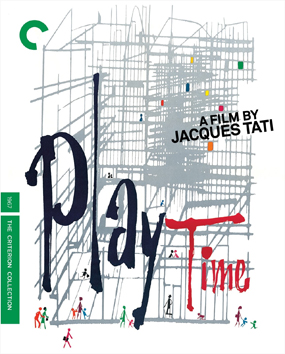
PlayTime is work. Work for the audience who must adjust their own understanding as to how a movie should move, and work for the man who conceived the film, Jacques Tati. It’s also work for any writer reaching for new superlatives—this movie, released in France at Christmas time in 1967, has survived more studio interference than The Magnificent Ambersons, Brazil, and Blade Runner combined. Yet it thrives as a reminder of our past discontents and our present horrors. The ghosts of Lang’s Metropolis and Chaplin’s Modern Times haunt this film, their theme, a dehumanized society polluted by progress, is timeless enough to support many more films. Artificial intelligence is nothing new, just reimagined for each generation.
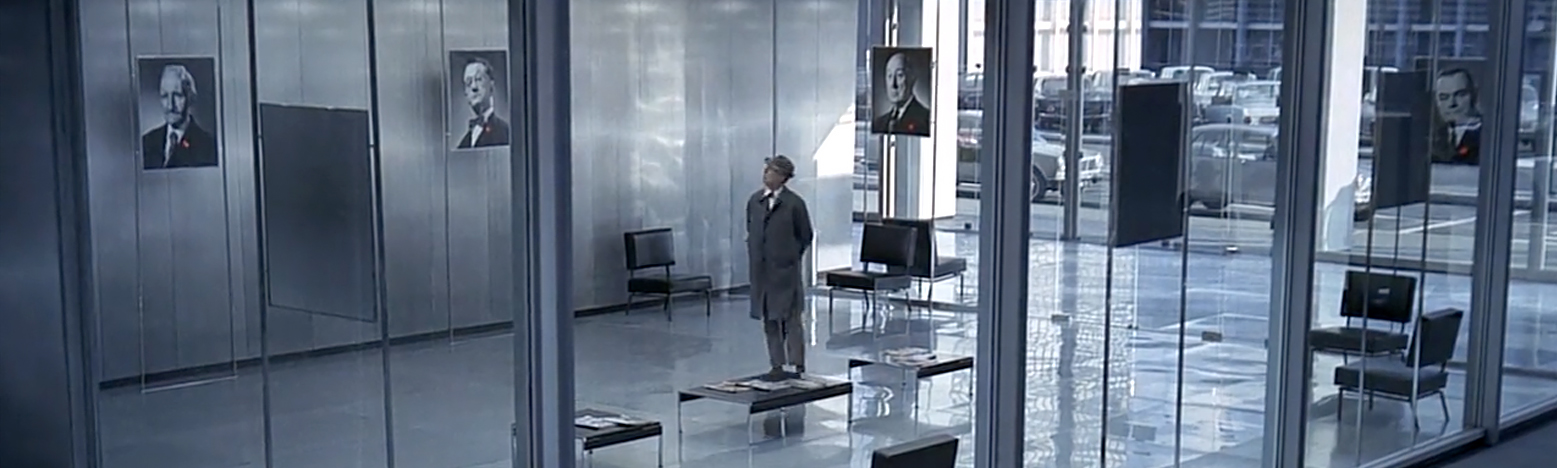
Tati and his many crews spent three years building PlayTime’s set, a steel and glass mousetrap/hamster wheel for the characters to play, work, and suffer in—as an actor Tati assumed the role of his beloved character Hulot, a shy, pipe-smoking pilgrim, as the director he assumed the role of God like so many mad scientists have done before him, from Frankenstein to Dr. Mabuse (plus Hitchcock, Welles, and a score of other filmmakers).
The film began production in September of 1964 with the construction of “Tativille,” a Godzilla of a set that took up the whole of a city block in Saint-Maurice (perhaps most famous as home to the Charenton psychiatric hospital where The Persecution and Assassination of Jean-Paul Marat as Performed by the Inmates of Charenton Under the Direction of the Marquis de Sade was set). The structure both embodies and satirizes the guiding principle of the Swiss-French architect Le Corbusier: “A house is a machine for living in.” Shooting of the film proper began in April of 1965 and lasted till October of 1966 due to bad weather and bad luck (Tati, Ala Welles, was continuously raising money throughout the production).
The movie opens with a vision of Tativille and what an imposing, beautifully sinister sight it is; the architecture is representative of Le Corbusier’s “International Style” with “glass curtain” walls that make the facade come alive, and not in a good way. To add to the unease, the kindly Hulot only appears sporadically, it’s left to his audience to take over for the Frenchman and they pay the price—from the opening frames we’re thrown into the midst of a multi-level beehive along with a boatload of frantic humans, a widescreen Tower of Babel.
It’s as dizzying as when you hit the streets of any unexplored city while battling jet lag—everything seems peculiarly dreamlike and unsettling. Appropriately we find ourselves in an airport terminal where people walk in lockstep and pose on escalators—there is constant movement but no one seems to be getting anywhere. Occasionally an elevator door will slide back to reveal more automatons waiting within. The movie was photographed, by Jean Badal and Andréas Winding, in brilliant 70mm with a chilly, desaturated “black and white” color scheme, but when one of those lift’s door opens, an unearthly orange glow surrounds the occupants—apparently this elevator picks up its passengers from the seven levels of purgatory.
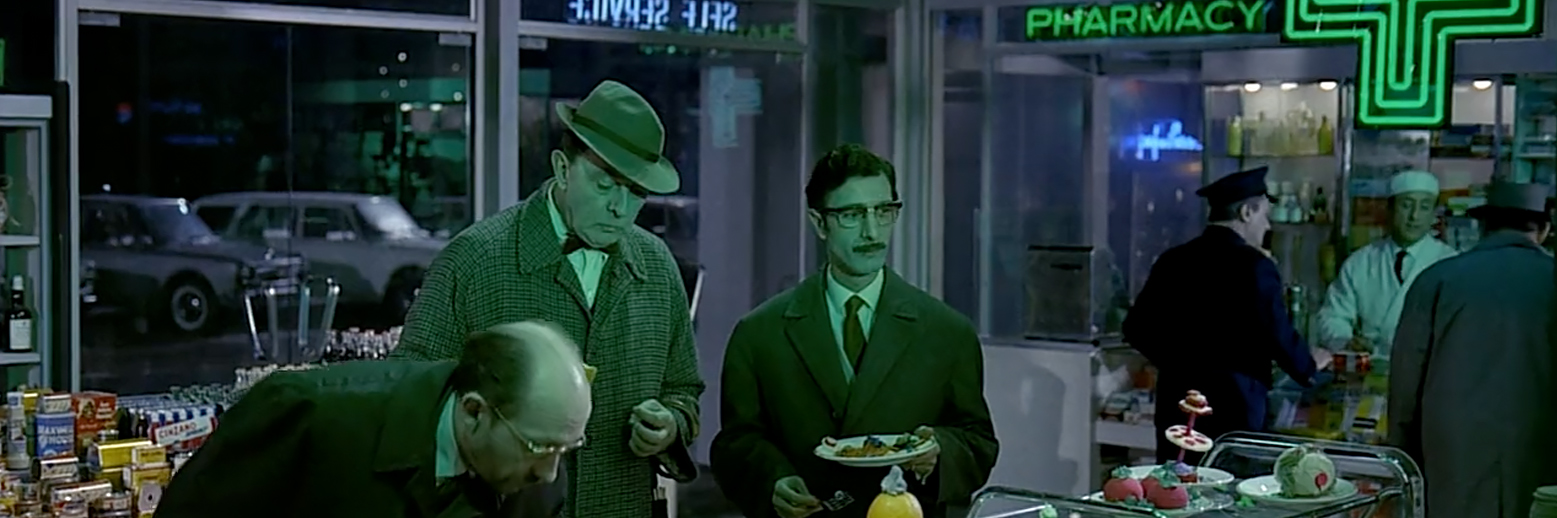
Nabokov and Kubrick envisioned America as a chessboard over which Humbert and Lolita and Quilty play hide and seek, Tati visualizes his playing field in the floor squares of a single edifice, but his invisible chess players are playing checkers, they simply push their pawns in straight lines until there’s a corner to turn. Nevertheless, they remain as helpless as any game piece. For much of its runtime PlayTime is a formalist work of art, didactic, rigidly composed with no room for improvisational spirit. So formal in fact that it threatens to become the very thing its satirizing. Nevertheless Tati’s sheer skill and immaculate technique remain inviting where Godard or Kubrick’s ice-cold world view can freeze us out, even while teasing our senses.
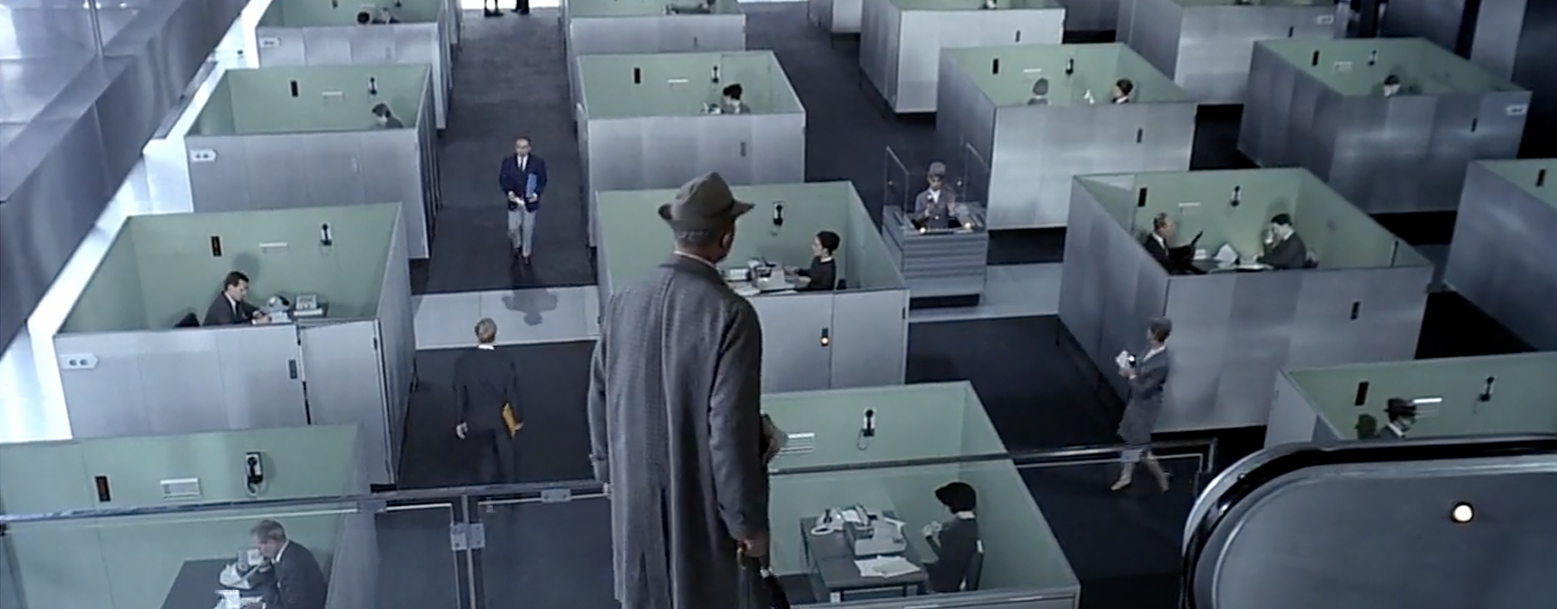
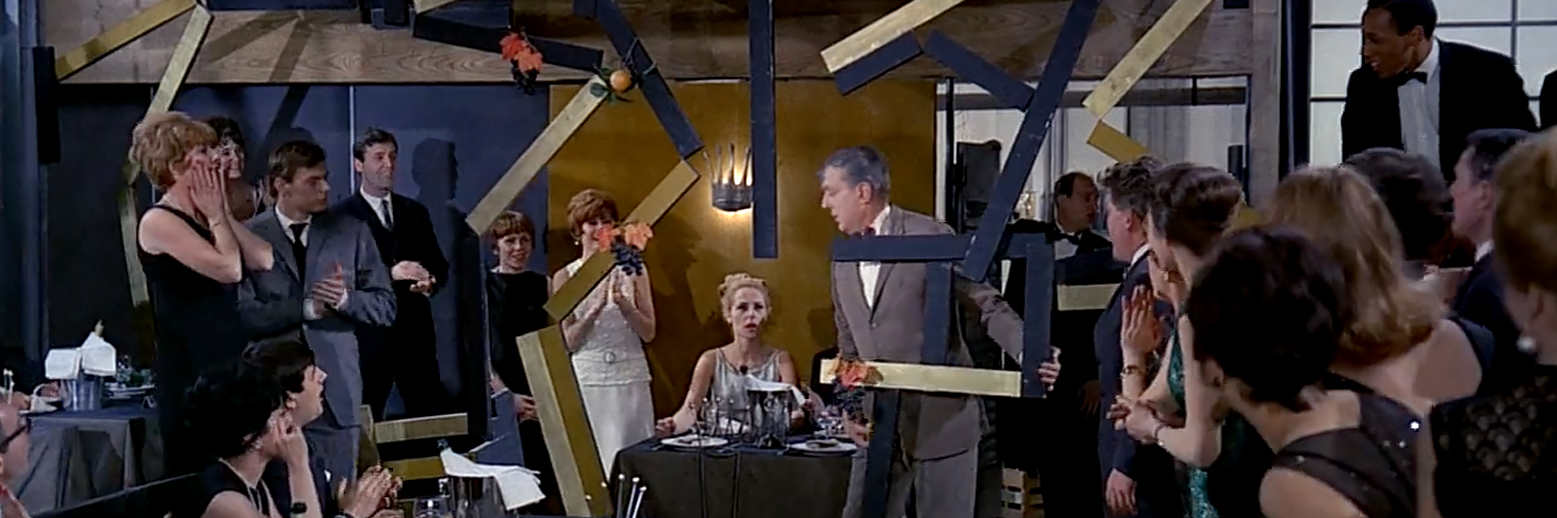
Although Hulot is absent for much of the film, his comforting presence is there when we need him, and not unexpectedly he is the point man for some of the funniest scenes: a maze of offices more prison than work space, and a trade fair promoting new gadgets for a better life (they do the opposite). Hulot becomes fully “Hulot” in the final sequence after night falls and the film morphs into a Parisian Midsummer Night’s Dream: the formerly robotic cast find themselves in The Royal Garden, an exclusive restaurant just waiting to be dismantled: the automatons shed their inhibitions and have their revenge (Laurel and Hardy would be pleased by the destruction).
His herculean task behind him, the real work began; to appease the studios and theaters, Tati was forced to cut twenty minutes from the original runtime of 140 minutes. The press was not kind (“where is Hulot?” was their battle cry). Tati would be bankrupt by the end of the year. In a valiant effort to right past wrongs, Criterion has done their best to salute the director and his film. They succeed. The 4K Blu ray is a stunner, one of most beautiful examples of what home theater can do. Tati’s obsessions are represented in superb fashion, the ultra-vivid imagery and grand color schemes couldn’t be better realized. Criterion has added a second disc full of extras including:
A loving introduction courtesy of the late Terry Jones and three commentaries on select scenes from film historian Philip Kemp, theater director Jérôme Deschamps, and Tati expert Stéphane Goudet. Also included is “Tativille,” a 1967 television program featuring an interview with Tati from the set of PlayTime and Beyond PlayTime, a short documentary with behind-the-scenes footage from the production.
Other highlights include an audio interview with Tati from the U.S. debut of PlayTime at the 1972 San Francisco International Film Festival, two documentaries about Tati himself; Tati Story, a short film by Goudet and Monsieur Hulot’s Work, a 1976 television program about Tati’s beloved character. Last and far from least, inside the keep case is a print essay by the fine critic Jonathan Rosenbaum.