

Screwing around with Death is even riskier
than double-crossing Mother Nature.
Not quite accepted as a genre or a style is the kind of movie called Film Blanc — fanciful tales that invent a continuity between our here and now and the Afterlife. Heaven is real and various kinds of waiting rooms exist before you can get in; often there’s an amusing bureucracy to send people where they’re supposed to go. Molnár’s Liliom can’t be the first example; Dickens’ A Christmas Carol has major elements. Placing the sober subject of life and death in a fantasy context can feel liberating, especially when done in good humor. We love the impish comedy in the musical Cabin in the Sky.
Before Film Blanc, ‘Death’ was usually personified as a ghost-like creature in a shroud, maybe even a skeleton with a scythe. The granddaddy of stories with an ‘elegant’ Death figure is the celebrated Italian-sourced movie Death Takes a Holiday. Death is a noble called Prince Sirki, who falls in love with a mortal in a marble villa. Should he take her with him into the realm beyond? A morbid situation results: while Sirki loiters in human form, nobody on Earth can die.
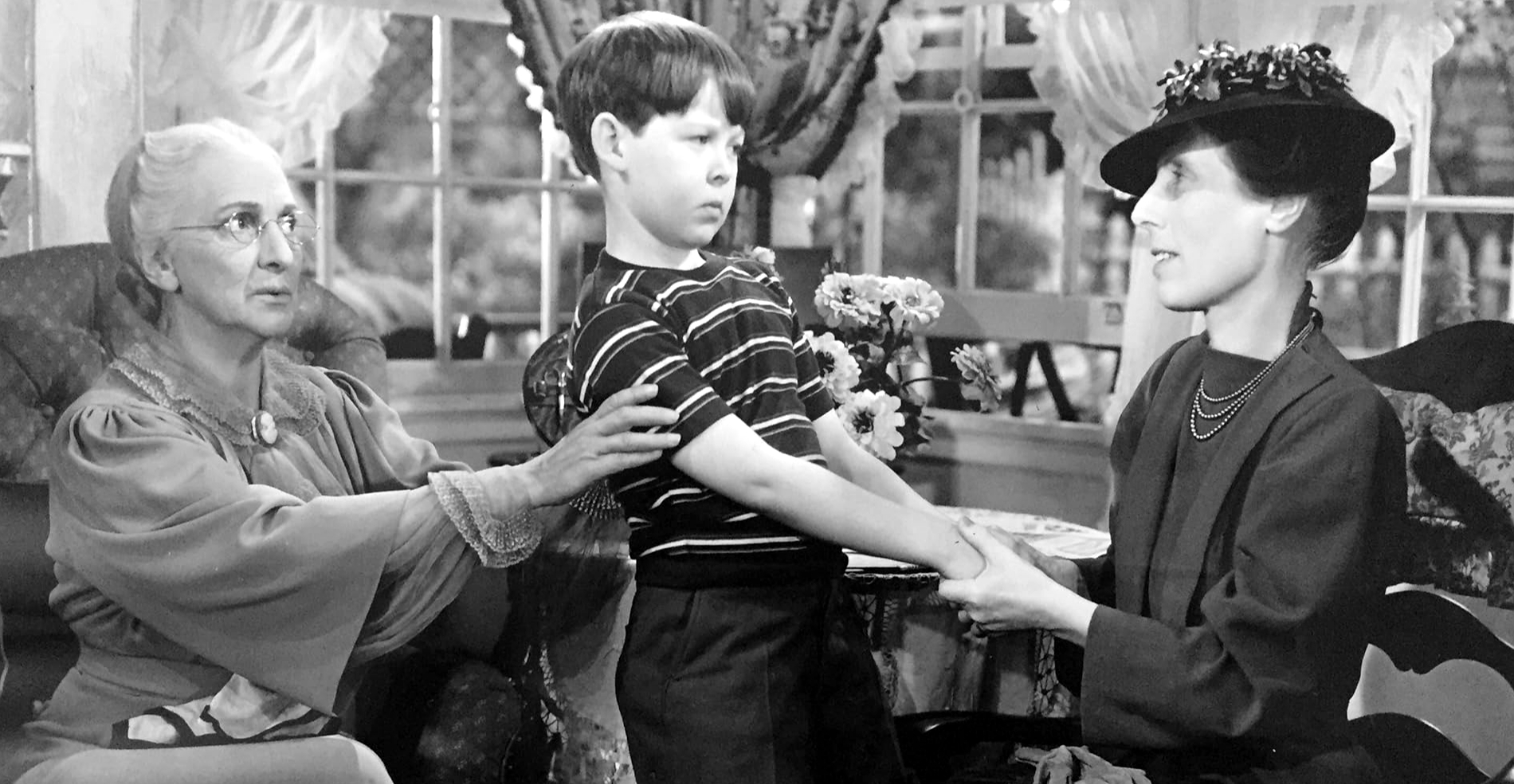
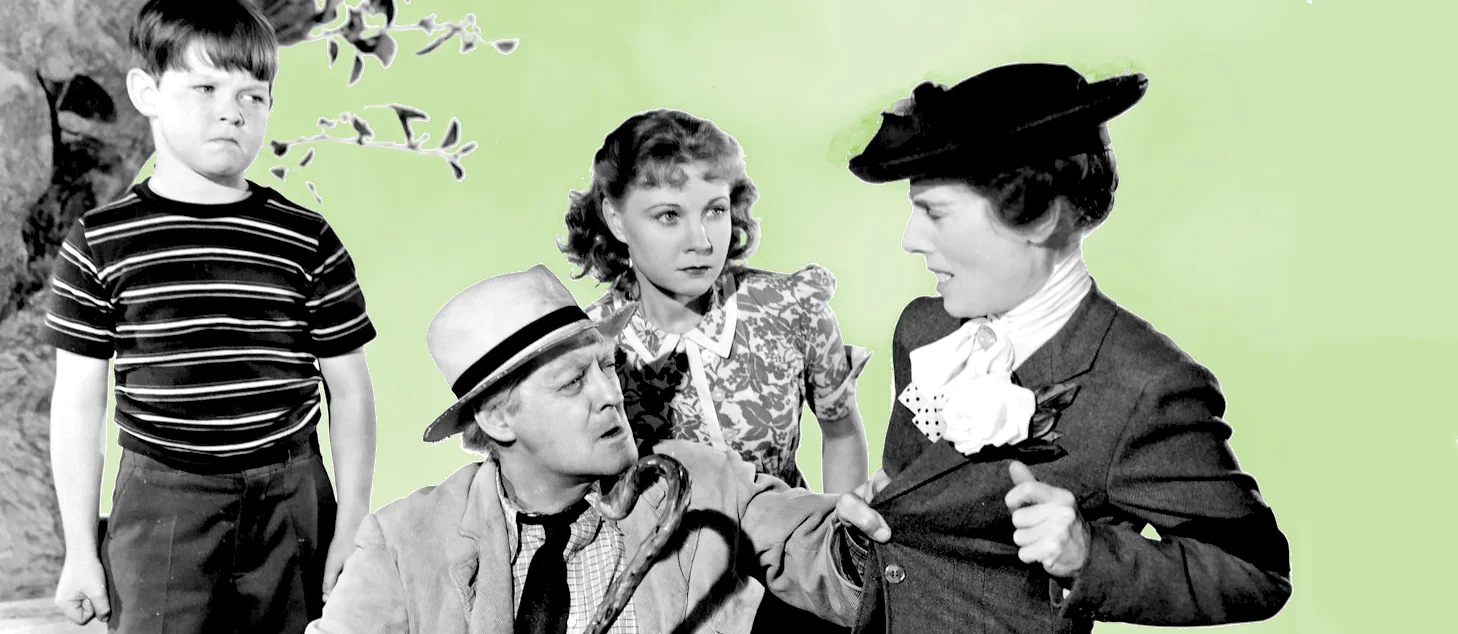
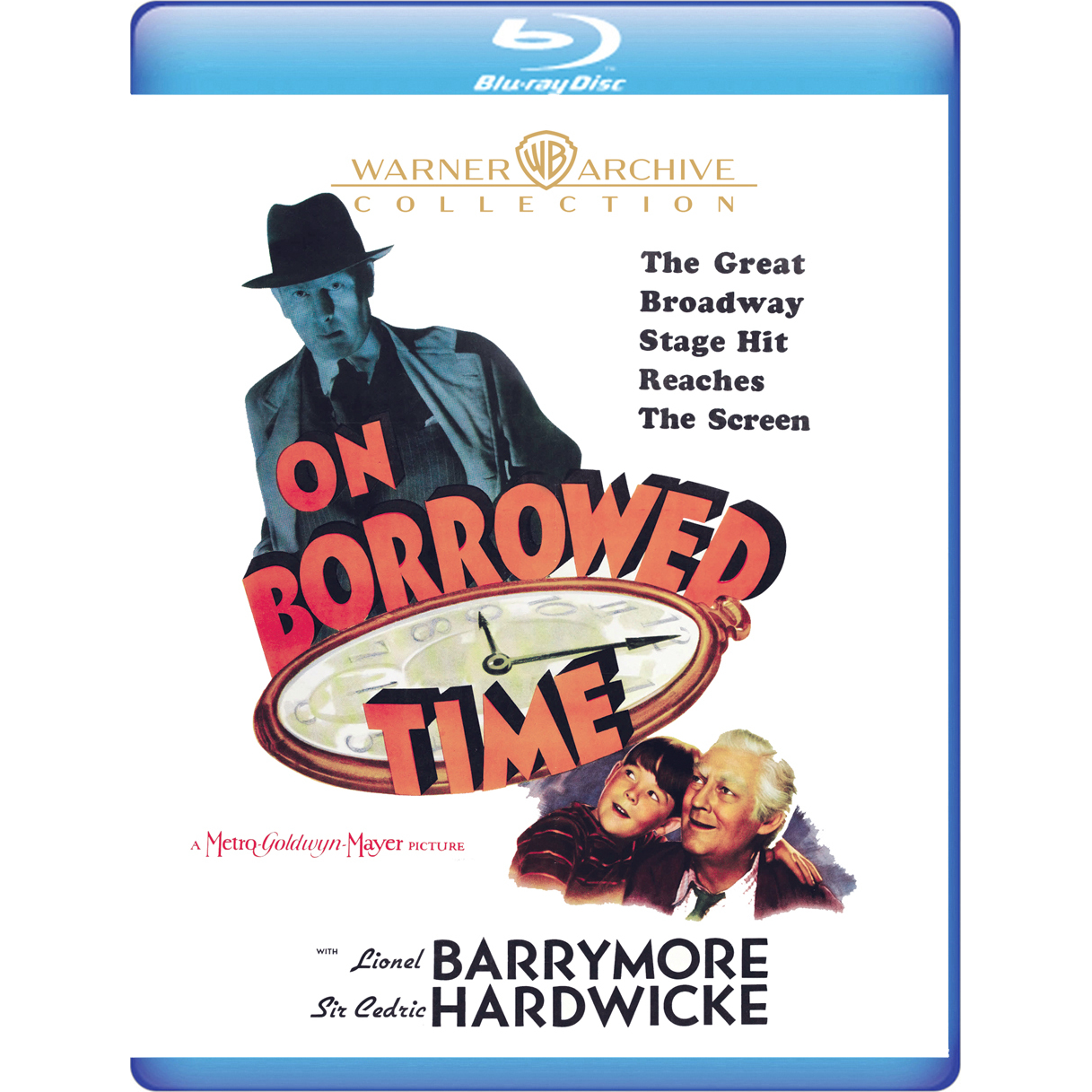
In the 1938 play On Borrowed Time, the grim reaper has no noble title but is still our social ‘better.’ He’s Mr. Brink (Sir Cedric Hardwick), a refined, aloof gentleman who shows up at deathbeds and fatal accidents. The setting is rural Americana. Instead of a romantic triangle, we have a family that must struggle with a terrible loss. A doctor Northrup and his wife die in a car crash, which is shown to be Fated: Mr. Brink literally hitches a ride with them before the accident. That leaves only old Gramps (Lionel Barrymore) and the sickly Grandma Nellie (Beulah Bondi) to protect the newly orphaned Pud (Bobs Watson) from the avaricious relative Demetria Riffle (Eily Malyon), who wants Gramps declared insane so she can take charge of the boy’s inheritance.
Mr. Brink comes to take Nellie, which reduces both Pud and the maid Marcia Giles (Una Merkel) to tearful despair. But when Brink returns for Gramps, the cranky old guy is prepared. The cranky old coot is determined not to die, because he needs to be there to protect Pud and guide him to adulthood.

It seems that Gramps has a ‘Magic Tree.’ Because he once ‘did a good deed,’ anybody who climbs his tree can only come down if Gramps lets him. Brink ends up trapped in the tree and unable to perform his natural function. Gramps won’t relent, even though he’s condemning millions of humans to untold suffering — the sick and gravely injured endure constant agony without the merciful release of death.
But Mr. Brink’s cosmic duty is to stay on the job. He can still kill anything that touches the tree. Gramps won’t budge, so Death goes to work on somebody who will listen to him … Pud.
We love the film’s first dialogue exchange — Mr. Brink passes up the chance to claim a motorist coughing with a lung ailment — Hans Conreid! The actor looks impossibly young.
Films Blanc are supposed to be uplifting but is this one even good for one’s mental health? The drama is given the MGM aura of ‘quality,’ that already presented a sanitized view of life. Gramps supposedly talks with unfiltered vulgarities, but they’ve all been euphemized, as in “Well, I’ll be dipped in gravy.” Gramps keeps referring to the despised Demetria Riffle as a ‘pismire’ … a word carefully chosen because it sounds obscene. Very clever.
On Borrowed Time pushes maudlin sentimentality to the limit. Everybody cries. Beulah Bondi is almost painfully endearing as the universally identifiable mother figure; Una Merkel and Bob Watson’s sobs never stop. The show could induce depression in sentimental people; it might be traumatic for a child who hasn’t yet thought out the difficult issue of mortality. *
The ‘magical’ tree is a story element we just have to accept — Mr. Brink is all but omniscient, so we wonder why he can’t appeal to his superiors to override Gramps’ infernal meddling. The story element of an anti-death tree may come from Greek myth, and a preamble alludes to Chaucer’s The Canterbury Tales. It seems related to the Garden of Eden, somehow.
The play is a good fit for the MGM Tradition of Quality — all the nice people are noble and deserving, the greedy relative is evil, and various experts mean well, including the kindly Dr. Evans (Henry Travers), who conducts experiments to verify the power of Gramps’ tree. Just as the phrase ‘cabin in the sky’ somewhat condescendingly describes a Heaven for American blacks, Mr. Brink tells Gramps that he needs to stop his interference and accept his proper fate, to go to “where the woodbine twineth.”
The dying in this movie affects us more than that in the average annihilating Film Noir. It’s Maudlin In Extremis — almost to the point of being unhealthy. Bobs Watson is an old fashioned ‘movie child’ who projects his emotions at all times; the little brat sobs so much that his nickname ought to have been ‘Waterworks.’
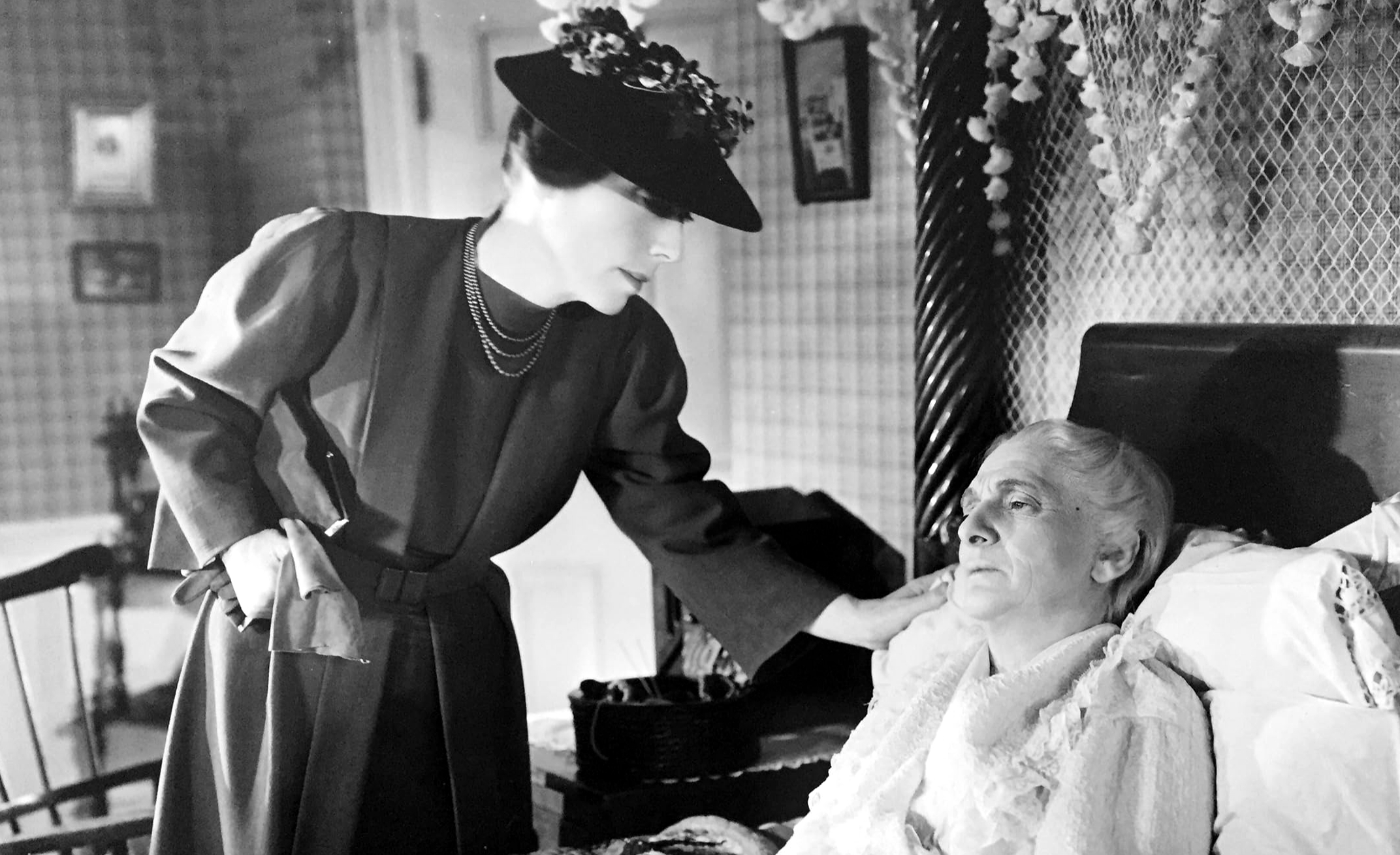
It’s a Horrible, Miserable Life! But we all love each other, so …
Reviewers point out that the film features three stars from It’s a Wonderful Life, and that the ‘pause’ put on death is a bit like George Bailey’s cosmic time-out, projecting him into an alternate reality where he was never born. Here in On Borrowed Time, the terrible effects of Gramps’ actions aren’t depicted. It feels a little sick to be invited to imagine tens of thousands in agony and still conscious. The vision belongs in the horror tale The Monkey’s Paw.

In both this tale and Death Takes a Holiday the Grim Reaper is a dapper gent one can reason with, which doesn’t at all align with the reality of the Human Condition. The fairy tale complications are dramatically balanced, but they kind of clog up one’s perceptions of how existence works. That’s for everyone to decide for themselves, we should hope.
Perhaps On Borrowed Time does have its finger on a bit of truth. The overall message is that Life is a painful process in which one must watch everything important being ripped away. Old people try to instil courage in children. Young people’s dreams are deferred. Una Merkel’s adorable Marcia is heart-wrenching as well. She loves her employer-friend Nellie; the morose attitude almost takes us to the negative mindset of characters in Val Lewton’s The Seventh Victim, most of whom consider themselves unhappy, unfulfilled failures.
Bizzare deals with Fate didn’t begin with Fritz Lang’s silent classic Destiny. We know Mr. Brink will find a way to free himself. We expect Gramps to make some kind of compromise with destiny, but screwing around with Death is even riskier than double-crossing Mother Nature. If It’s a Wonderful Life concluded like this movie, Harry Bailey’s airplane would have crashed into George’s house on Christmas Eve, wiping out half of Bedford Falls. On Borrowed Time sells its leap to oblivion as a glorious happy ending.
Louis B. Mayer liked tearjerkers and was committed to actor Lionel Barrymore. He let the actor take on the role even when he had to perform in a wheelchair. Gramps really is a miserable old crank. He thinks it’s not his business to worry about anybody besides his immediate family. He boasts about fighting at Bull Run and San Juan Hill, which makes him at least 85 years old. We wonder if Gramps’ pro-Republican, anti-Democrat dialogue was part of the original play, or something the writers added to keep Mayer happy.
Director Harold S. Bucquet already had experience directing Barrymore in a wheelchair, on a pair of Dr. Kildare movies. We’re big fans of Bucquet’s crazy wartime movie The Adventures of Tartu, a forerunner of 1960s super-spy spectaculars.
One drawback — when we showed this in the UCLA dorm, the screening became an unintentional laugh riot, just because of the name given Bobs Watson’s character. And they were a pretty respectful audience. It shouldn’t deter one’s appreciation of what’s good about the movie.
MGM had a tendency to take mawkish, maudlin movie material too far. Getting fully into the ‘spirit’ of On Borrowed Time seems neither particularly constructive nor healthy. Taken in perspective, the film’s attitude has to be less harmful than today’s onslaught of movies that condone and glamorize aggression and killing. Maybe ‘having a good cry’ is a positive thing in itself. If so, boy have we found the right movie for you.

1 comment