
 I’ve written about my admiration for writer/director Damian McCarthy’s two previous films, Caveat and Oddity, in this column before. From the very beginning, his work had a personal style that separated it from the general horror film pack, combining a dark visual palette with a love for haunted-looking objects, all set in a modern Ireland in which the supernatural isn’t as absent as people might assume it is. I had high hopes for his latest movie, Hokum, and I’m pleased to report that it delivers on every level. It’s gloriously spooky, very funny, and, most surprisingly, emotionally moving.
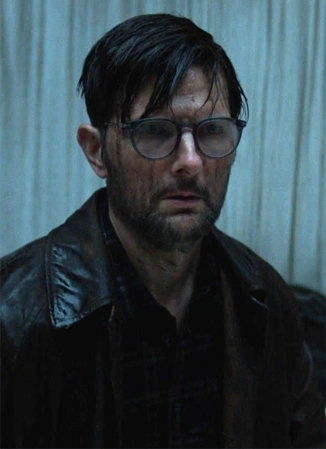
Ohm Bauman (Adam Scott) is a bestselling novelist, stuck on the conclusion of the third book in a trilogy. After seeing what seems like the ghost of his mother in his home, he decides to travel to the hotel in rural Ireland that his parents had honeymooned at to spread their ashes there. Ohm is miserable for reasons of his own, and he’s rude to everyone he meets at The Bilberry Woods, including manager Mal (Peter Coonan), but he manages not to drive bartender Fiona (Florence Ordesh) or local kook Jerry (David Wilmot) away.
Ohm is informed that the owner of the hotel trapped a witch in the honeymoon suite, and that it’s locked up permanently. Ohm doesn’t believe in such hokum, but after a traumatic event and somebody going missing, he decides he wants to investigate this disappearance. This involves breaking into the honeymoon suite on the evening that the hotel has closed for the season. It’s completely empty. Well, not completely…
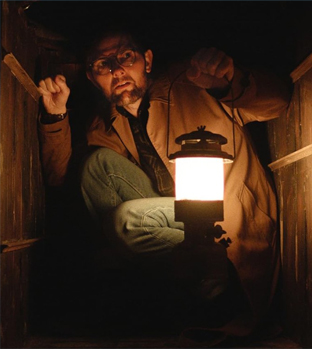 Scott gives a terrific performance as the complicated Ohm, whose prickly demeanor is a defense against revealing tremendous guilt and despair. He’s amusing in his mean dialogue, but Scott impresses more in moments of resourcefulness and vulnerability. Coonan is quite good as Mal, attempting to be hospitable to his difficult celebrity guest, and Ordesh makes a good impression in a short amount of screen time as the kind Fiona. Wilmot is quietly charismatic as Jerry, who lives in his van in the woods and happily takes magic mushrooms but turns out to be more than he initially appears.
McCarthy’s direction displays a mastery of spooky atmosphere (a cool mixture of autumnal colors and cozily sepulchral production design) and a patient buildup of suspense that pays off brilliantly. Joseph Bishara’s thumping and wailing score conjures up a host of hidden horrors. McCarthy’s dialogue is smart and mordantly amusing, as in this throwaway line from a children’s tv personality – “What dies, kids? Everything!” Also, he manages to fit in a perfect gag involving a goat tripping on mushrooms, which is a nice bonus.
One of the things I most enjoy about McCarthy’s films is that he always manages to include references to his earlier work, creating a sort of shared cinematic space. Here he includes a call bell (not unlike the haunted one in Oddity), chains and a bunny suit (recalling the harness and supremely creepy rabbit toy in Caveat). Beyond the expertly crafted scares and laughs, however, this time McCarthy is also going for emotional resonance. The story is haunted by dead wives and mothers and shows how the guilt over their loss can forever affect a life.
Hokum is the work of a great horror filmmaker firing on all cylinders, and I recommend it enthusiastically.
 Terry Morgan has been writing professionally since 1990 for publications such as L.A Weekly, Backstage West and Variety, among others. His love of horror cinema knows no bounds, though some have suggested that a few bounds might not be a bad thing.
Good one. I especially enjoyed it, having gone to Ireland last year.