

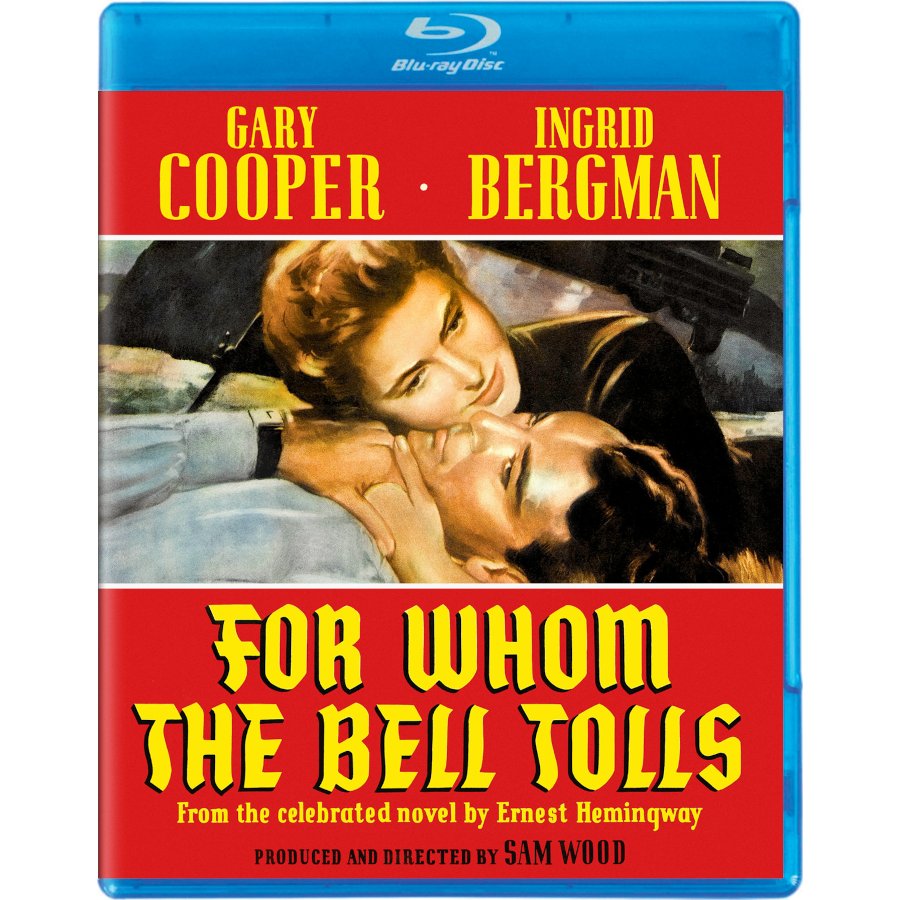

“Whatever Hollywood’s bell tolled for, she rang it.”
For Whom the Bell Tolls was a gigantic Road Show attraction in 1943, one with a controversial subject. The Spanish Civil War had ended only four years before. Franco was sitting out WW2 as a neutral leaning toward Germany, and America was strongly divided on the issue. Film critic James Agee was incensed by the film’s attempt to downplay the politics by blurring the official names of the combatants. Yet there is no question which side Hemingway’s American hero is fighting for: the enemy, Franco’s rebels, wear German-style helmets.
The picture was a big undertaking in wartime, a Technicolor epic with Hollywood’s biggest stars, partly filmed on location. It was originally released in exclusive runs as a Road Show with an intermission, and just two showings a day. The trouble began when the film was cut down for general exhibition, with the full-length film left unprotected. For Whom badly needed a digital restoration, but the film elements to rescue it may no longer exist.

Dudley Nichols’ screenplay closely follows Hemingway’s book. In the middle of the Civil War, American volunteer Robert Jordan (Gary Cooper) lends his engineering skills to the Republicans. He’s sent into the mountains to enlist a band of guerillas led by the murderous Pablo (Akim Tamiroff) to dynamite a strategic bridge during an all-out attack. Jordan befriends the aged guide Anselmo (Vladimir Sokoloff) and Pablo’s former woman, fiery guerilla Pilar (Katina Paxinou). The others (Arturo de Córdoba, Mikhail Rasumny, Fortunio Bonanova, Victor Varconi) are a selection of amusing and sentimental cutthroats. 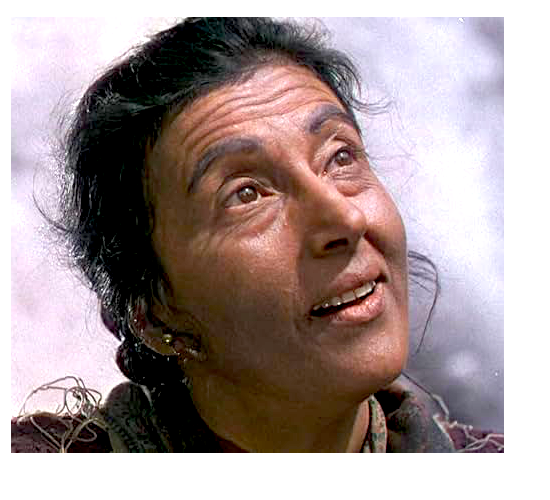 Pilar and Jordan solicit help from a neighboring village, in the person of chieftain El Sordo (Joseph Calleia). But the real prize for the Yankee is María (Ingrid Bergman), a young massacre survivor helped through the trauma by Pilar. Encamped in the rugged mountains, ‘Roberto’ and María become lovers.
The wartime easing of censorship restrictions gave For Whom the Bell Tolls a generous boost in the excitement department, with the mildly controversial ‘sleeping bag scene.’ The lovers are so gone on each other that Pilar runs down the hill laughing for them. It’s easy to conclude that they are making love during every fade or discreet cutaway. Greek actress Katina Paxinou steals the film, hands down. The camera loves her as much as it does Bergman. The dawn of the final day is first seen on Pilar’s face as she lies on a rock, waiting to begin a guerilla attack. Paxinou took home a Best Supporting Oscar for her work, the film’s only win.
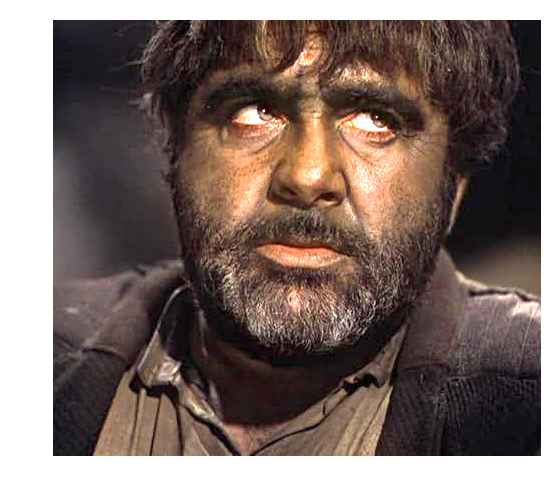
Akim Tamiroff’s Pablo causes serious problems in the guerilla group because he resents Jordan’s taking over command. Pilar never trusts Pablo. He undergoes a change of heart and joins the battle, yet remains a selfish and ruthless killer. Tamiroff, Paxinou and Joseph Calleia would all become favorite actors for Orson Welles; each has a great, outsized character to play. Vladimir Sokoloff is an old softie with a kind heart. Mikhail Rasumny’s foolish gypsy hunts rabbits during a battle. Fortunio Bonanova was the Opera coach in Citizen Kane and the Opera fan in Kiss Me Deadly. He has some good scenes as a maddeningly non-committal comrade.
We suspect that Ernest Hemingway had Gary Cooper in mind when he formulated the Robert Jordan character. He says he’s fighting Fascists in Spain so he won’t have to fight them at home, which may have been a way to pre-empt thoughts of communist ideology. Cooper projects Hemingway’s macho-humanitarian masculinity, adding a dash of ‘Cooper Cutes’, pixie-ish Frank Capra moments where he breaks character to flash boyish smiles and rub noses with María. The action stops more than once to allow Cooper and Bergman ‘special’ moments together. A couple of these appear to be retakes, adjustments to up the romance quotient.

For Whom is Ingrid Bergman’s first feature film in color. A ragged head of short hair transforms her enough to take on the character of María, a coltish youngster learning hard lessons about life, love and war in just a few days up in the Sierra de Guadarrama. The Swedish actress is of course the number one reason to see the movie; she glows with life. Cooper wisely gives her the spotlight. He hangs back with he-man poses and returns her girlish gushing with soulful, conflicted looks.
That short curly hairdo made the cover of Time magazine. Bergman said that women rushed out to get that haircut after seeing the movie — and then complained that they looked like drowned rats. The caption on the magazine cover reads,
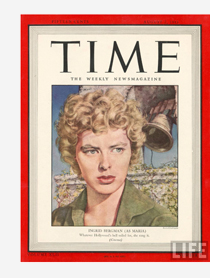
Ingrid Bergman (as Maria)“Whatever Hollywood’s bell tolled for, she rang it.”
For Whom the Bell Tolls is also the pinnacle of a certain kind of Hollywood artifice. Sam Wood directed the star performances, but the camera direction was fully the work of Production Designer William Cameron Menzies. The movie is designed down to the last detail of each shot. Most every scene that’s not a close-up or doesn’t take place in a cave seems to be a special visual effect. Countless tight angles use matte paintings for part of the frame, often wedging a sliver of blue sky up in a corner somewhere. Elaborate scenes are designed almost as would be an animated film, sometimes with cheated perspectives: a flight of planes taking off, a train being dynamited, a convoy of trucks climbing switchback mountain roads.
The ‘formal’ visuals mix location shots with a great deal of studio work, on elaborate sets and the process stage. Little or nothing was improvised; most shots are tightly composed and locked-down static. The matte effects mostly require that the camera stay still, which sometimes makes the show feel like a sophisticated silent film, but in full Technicolor. In general, Menzies seems to prefer static shots over a moving camera anyway.
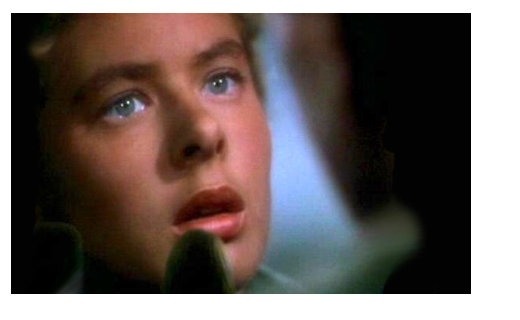
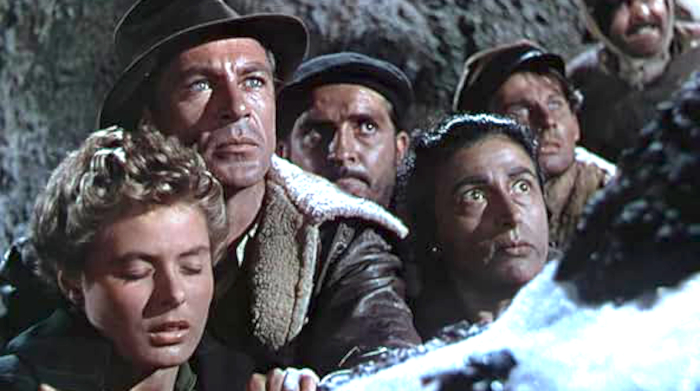
Menzies was also fond of big close-ups, far more intense than the norm. Cooper and Bergman are given many huge choker close-ups, with a field of focus so shallow that the glints on their eyes are sharp but their ears are soft. Since Menzies wasn’t at all a director of actors, perhaps he wanted to ‘direct’ the intensity of his actors with his camera.
The way people are framed informs our understanding of them.
We can easily spot William Cameron Menzies’ personal design predilections: high horizons, odd fences in silhouette, and deep-focus stylized sets stand out sharply in movies as different as Kings Row, Address Unknown and Invaders from Mars. In For Whom he uses eccentic compositions to telegraph impending doom. He essentially squeezes his characters into extreme parts of the film frame. In the very first scene with Roberto and his comrade Kashkin, Menzies masks away a big piece of the screen with a large, dark rock. Key images of Roberto and María are likewise all but blocked off the screen by rocks that obstruct our view. If the lovers don’t dominate the image, they can’t control their lives; it’s Menzies’ semaphore signal for death.
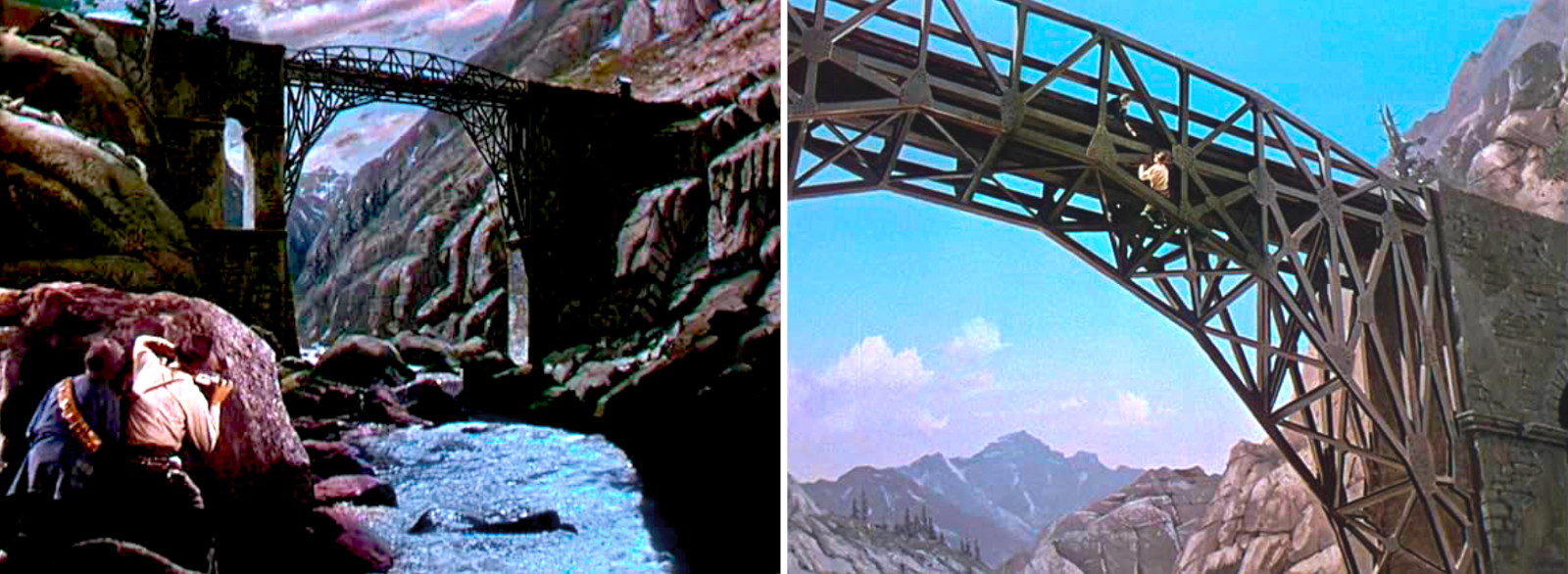
The big battle at the bridge is practically a movie-within-a-movie, an extended master sequence carefully worked out through all production departments, under designer Menzies’ direction. The stages of the attack establish spatial relationships between various guard shacks, the attacking guerillas and a road down which advances a line of armored enemy vehicles. A Cooper stand-in climbs onto the bridge’s superstructure for long shots. We realize how much of the location is being faked when troops crossing the bridge partly disappear behind a matte line. Any composite effect in Technicolor had to be done in triplicate. The effects men and lab experts must have needed a factory system to grind out all those near-perfect visual illusions.
The big bridge scene is an historical ‘event’ placed evenly between Buster Keaton’s silent The General and David Lean’s Bridge on the River Kwai. It is capped by a ‘moment of truth’ challenge that pushes the limit of dramatic contrivance – and succeeds. To escape, Pablo’s guerillas must race their horses across a gap that for several seconds exposes them to enemy fire, like ducks in a shooting gallery. It’s as ritualized as a bullfight or a game of Russian Roulette. It seems unlikely that any of the guerillas could run the gauntlet without being hit. Thus we are set up for Hemingway’s intense emotional finale.
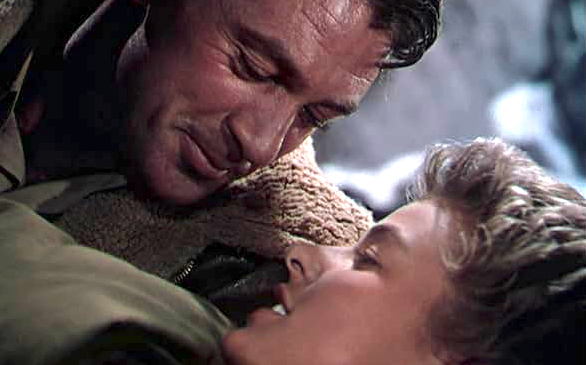
“You are all there will ever be of me . . .”
The ending leaves such an indelible memory, the film’s soundtrack album had no text on its cover, just a close-up of an anguished, tearful María, listening to Roberto’s heart-wringing farewell. Ms. Bergman becomes the Technicolor queen of the bleary, soggy-eyed monster close-up. The trembling María seems ready to explode from the screen.
The emotionally-overpowering sequence also slip in more ‘censor forbidden’ content from the book, which tells us that María believes she has conceived Roberto’s child. The movie can’t say that directly, but it does retain an earlier speech by María’s dialogue about ‘a dream in which she meets Roberto’s mother, carrying a baby.’ Roberto’s delirious farewell to María, with its incoherent repetitions, implies that she has a responsibilty to live, to give birth to his child — “You are all there will ever be of me.” Unlike other movies under the Production Code, For Whom does not offer an alternate ‘chaste’ explanation for that time spent together in a sleeping bag.
Sometime after the end of its Road Show run For Whom the Bell Tolls was heavily edited for general release. The missing scenes for the Road Show version were only recovered years later, and then they had to come from Technicolor prints left on deposit in film archives. What’s obviously indicated is a full digital recomposite from color separations. If they still existed, we’d put this picture at the head of the line for a major digital restoration.
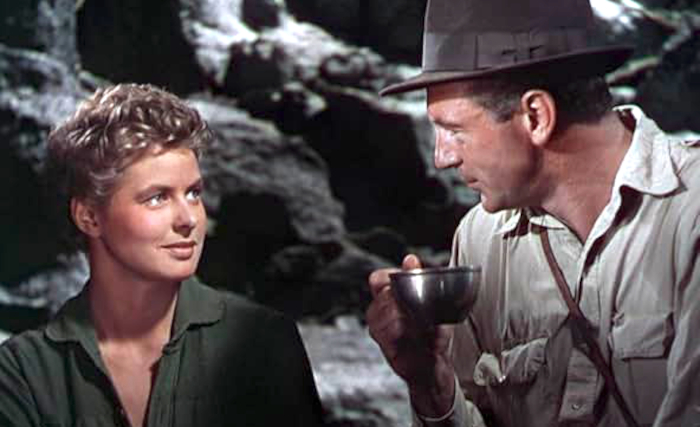
The cut-down shortened the movie by a full 34 minutes. A substantial part of that gap comes from Overture, Entr’acte and Curtain music, all played over black. Cuts to dialogue scenes were made throughout the movie, removing explanations for character relationships, as well as some of the best acting from Katina Paxinou, Akim Tamiroff and the supporting cast. One deletion removes several shots of Tamiroff’s lip dripping blood — those censors really had an aversion to showing blood on the screen, especially in Technicolor.
The film’s single main deletion is an extended flashback sequence. Pablo seems like little more than a surly cutthroat, but Pilar explains that was was once a great guerilla leader. Seizing a town held by the Fascists, Pablo personally executes a quartet of villains. The killing then gets out of hand — Pablo’s mob of farmers torments the rest of the prisoners and then throws them from a high cliff, one after another. Pilar remembers that some of the victims weren’t bad men at all. The sequence was dropped for time but possibly for content as well: it’s both unsually brutal and uncomfortably political. The moment the war ended, elected conservatives would go on the political attack against ‘premature anti-fascists’ — the main focus being the Spanish Civil War.

A sad irony was that the right-wing director removed the references to Franco.