

Burden of Dreams — 4K
Is that Werner S. Herzog, for Sisyphus? What filmmaker goes out of his way to make his work impossibly difficult? Werner Herzog did just that on Fitzcarraldo and filmmaker Les Blank documented the entire frustrating, risky process, which included the insane engineering feat of hauling an enormous steamboat over a hill. Herzog chose to shoot in an absurdly remote jungle, where warring tribes forced a location change. We see bits of the aborted first try with Jason Robards and Mick Jagger; Klaus Kinski and Claudia Cardinale are great replacements. But nothing matches Herzog’s ‘fornicating jungle’ speech, or Kinski’s panic on a runaway ship rushing down a river gorge. Extra fun: the legendary short subject Werner Herzog Eats His Shoe.

Burden of Dreams
4K Ultra HD + Blu-ray
The Criterion Collection 287
1982 / Color / 1:33 flat full frame / 96 min. / available through The Criterion Collection / Street Date November 11, 2025 / 49.95
Starring: Werner Herzog, Klaus Kinski, Claudia Cardinale, Mick Jagger, Jason Robards, José Legoy.
Cinematography: Les Blank
Film Editor and sound recording: Maureen Gosling
Interviewer: Michael Goodwin
Written by Michael Goodwin
Produced by Les Blank, José Koechlin von Stein
Directed by Les Blank
 Three months ago CineSavant reviewed an excellent 4K disc for one of the two best documentaries ever about the making of a movie. Today we have a 4K review for the other one.
Both making-of documentaries chart the ordeal of an adventurous, risk-taking movie director filming a demanding drama on a far-distant location. The somewhat better-known Hearts of Darkness sees the the creative powerhouse Francis Coppola taking a huge production to the Philippines, where he’s all but driven to madness by production setbacks caused by bad weather, and a monumentally troublesome actor, Marlon Brando.
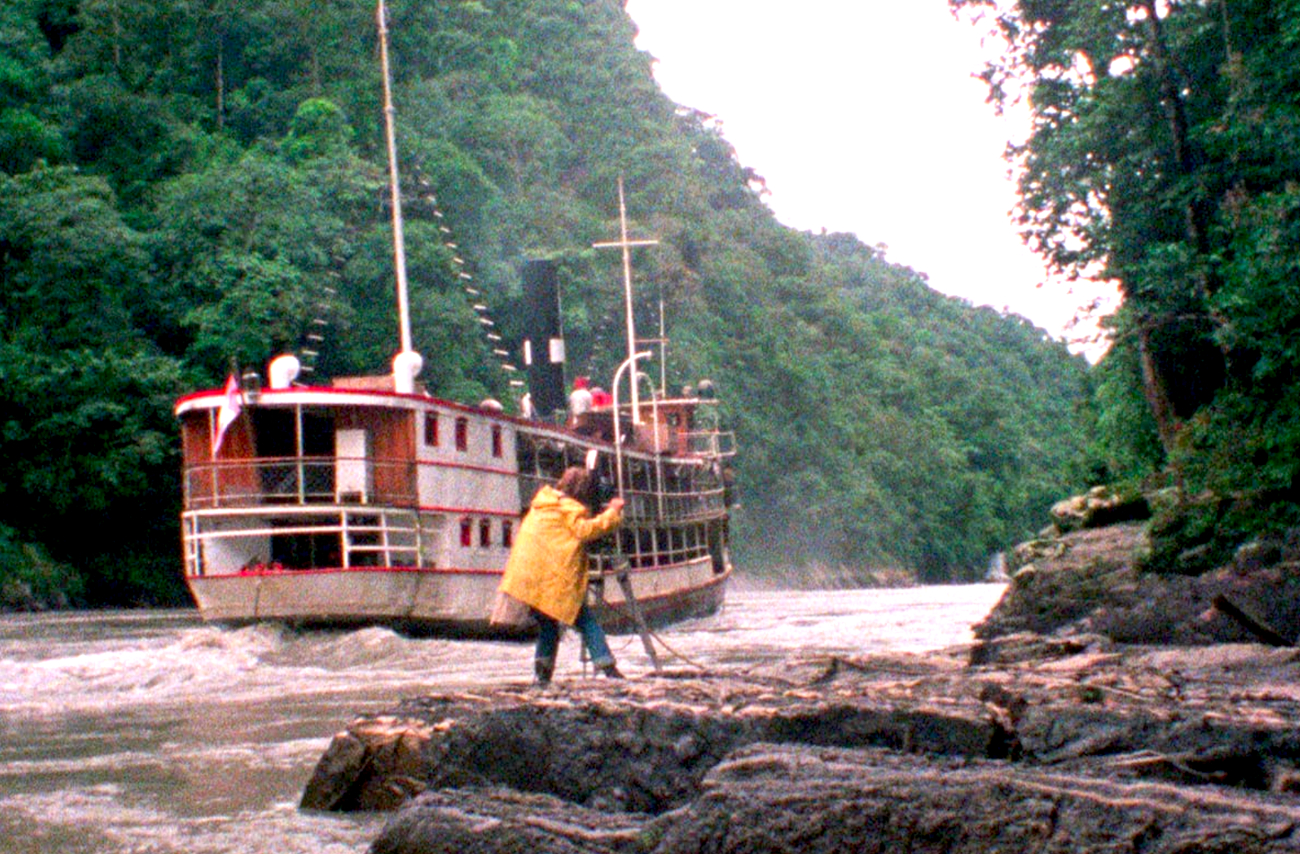
Les Blank’s Burden of Dreams is an account of the filming of Fitzcarraldo, a much smaller production trying to achieve the impossible in an almost absurdly remote location. Its director is the German independent Werner Herzog. Beginning as a leading figure in the New German Cinema movement, Herzog had climbed to a high roost as an international filmmaker. His fascinating Aguirre, the Wrath of God was so popular that it almost moved from the art film category to the commercial mainstream. He broke that barrier with Nosferatu the Vampyre, an updating of the silent Murnau classic. Both of those films and Herzog’s Woyzeck starred Klaus Kinski, a ‘problematic’ actor whose tantrums and on-set violence became legendary.
Documentarian Les Blank ( A Poem Is a Naked Person) was on Burden of Dreams for months. He captures the utter wildness of the distant location in the oriente of Peru, and also director Herzog’s running commentary on his state of mind. Herzog seems almost perverse in his desire to put his cast and crew through the same ordeal suffered by his fictional characters. With an army of local tribesmen as labor, far away from civilization Herzog’s experts try to perform an ‘impossible’ engineering feat.
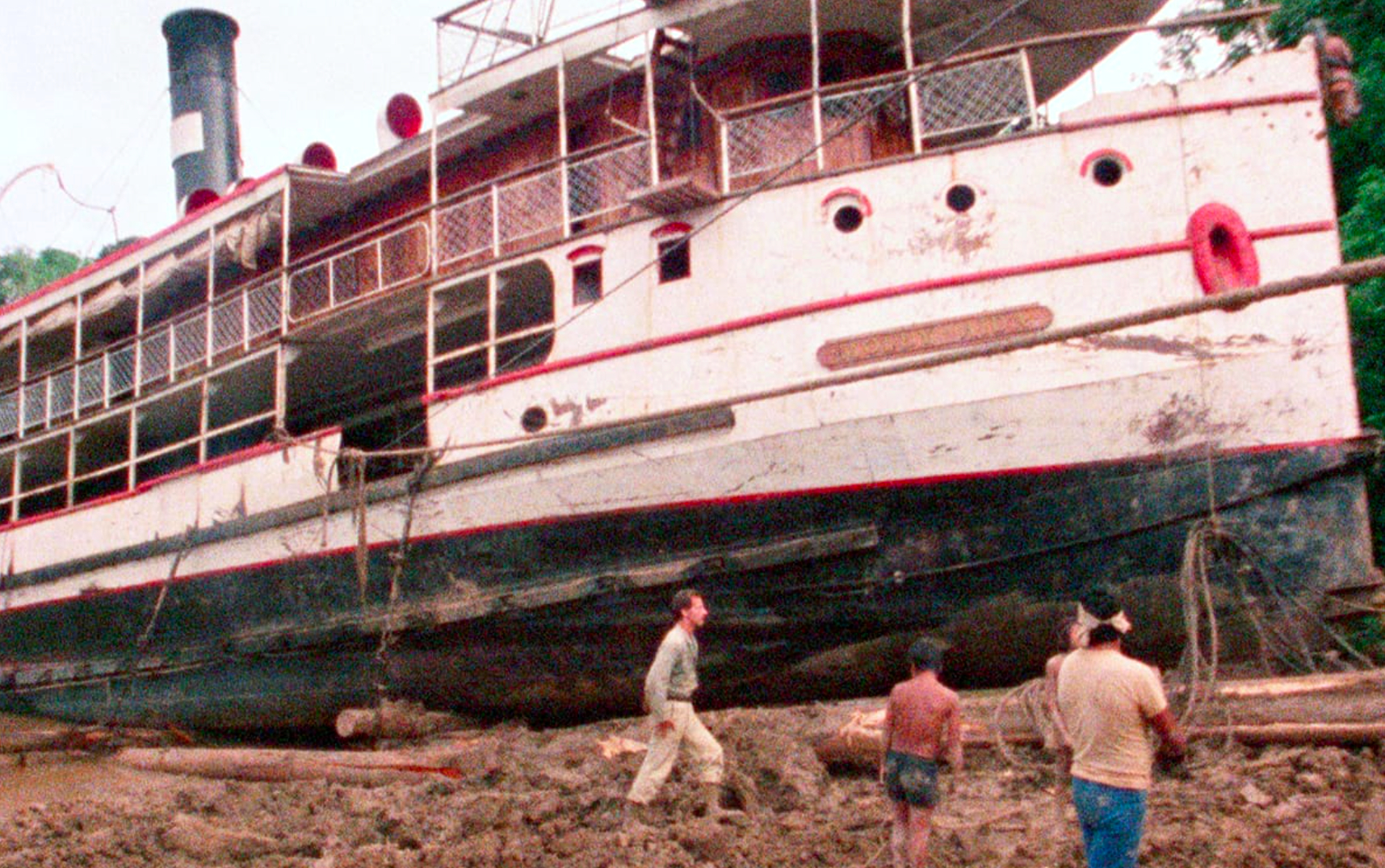
The short explanation: Burden of Dreams is about an inspired (read: crazy) German filmmaker leading an obsessive (read: crazy) German actor and a hardy filmmaking crew into the jungle to make a movie … about an inspired Irishman leading a crazy group of men into the jungle on a quest for riches. Director Werner Herzog would seem to be obsessed with obsession itself: his movies about manic characters taking wild trips into the wilderness appear to be a pretext to undertake mad filmmaking adventures of his own. Burden of Dreams documents the filming of Fitzcarraldo in the headwaters of the Amazon. The only Yanqui who even attempted such folly had been another maverick filmmaker, Samuel Fuller … in in anamorphic 16mm! In the end Hollywood wouldn’t let Sam him do it anyway.
Les Blank’s unique documentary has been praised by many as being better than Fitzcarraldo itself. The ‘interviewer’ on location Michael Goodwin was part of Herzog’s creative posse on location. The over-qualified Goodwin had also been the first film critic for Rolling Stone magazine. Criterion’s special edition disc comes with plenty of documentation, enough evidence to convince us that Werner Herzog must have been a fanatic Conquistador in some past life.
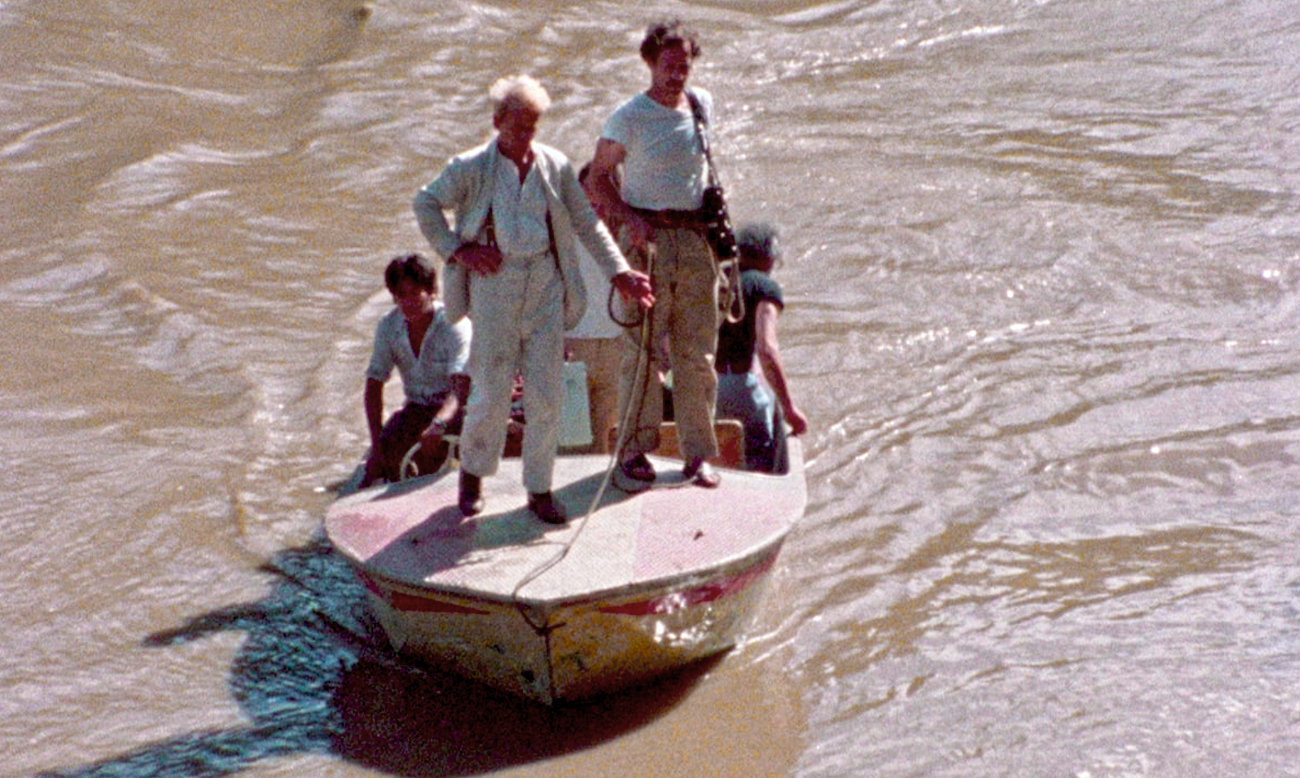
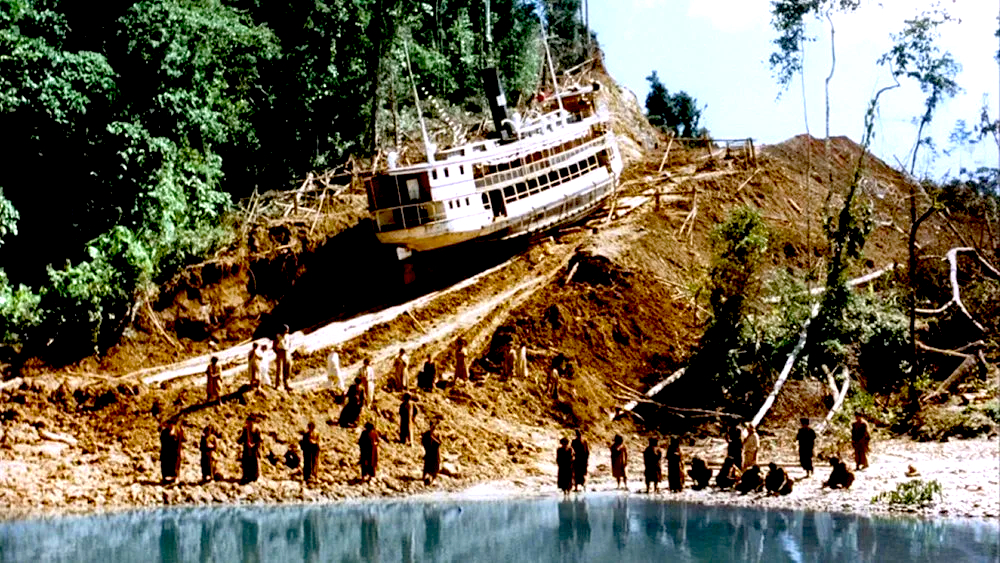
Burden of Dreams puts us on edge from its first shot, when we see a small plane land on a hazardous muddy field. Driven to shoot his movie far away from civilization where conditions will give his actors a feeling of authenticity, Herzog must start his film project twice. The first time out Indian activists threaten his crew and burn down his work camp, so the company moves even deeper into the forest. He needs a place that has dangerous-looking rapid water, and two navigable rivers separated by a narrow strip of land. For Herzog, the whole point of Fitzcarraldo is to actually haul a giant steamboat across an isthmus of land, a real-life engineering feat to give the picture undeniable authenticity -= and danger.
Les Blank’s docu covers the filming from every angle except the experience of the actors. Viewers looking for behind-the-scenes gab about personalities are going to be disappointed to see only a couple of shots of Mick Jagger and Jason Robards, the original stars that Herzog lost when he had to start his film afresh. Herzog abandons the role intended for Jagger; to replace Robards, he once again taps Klaus Kinski, who at least has experience on this kind of wild location. Kinski has his manic moments, but he seems to believe in his character. He also gets to play opposite Claudia Cardinale.
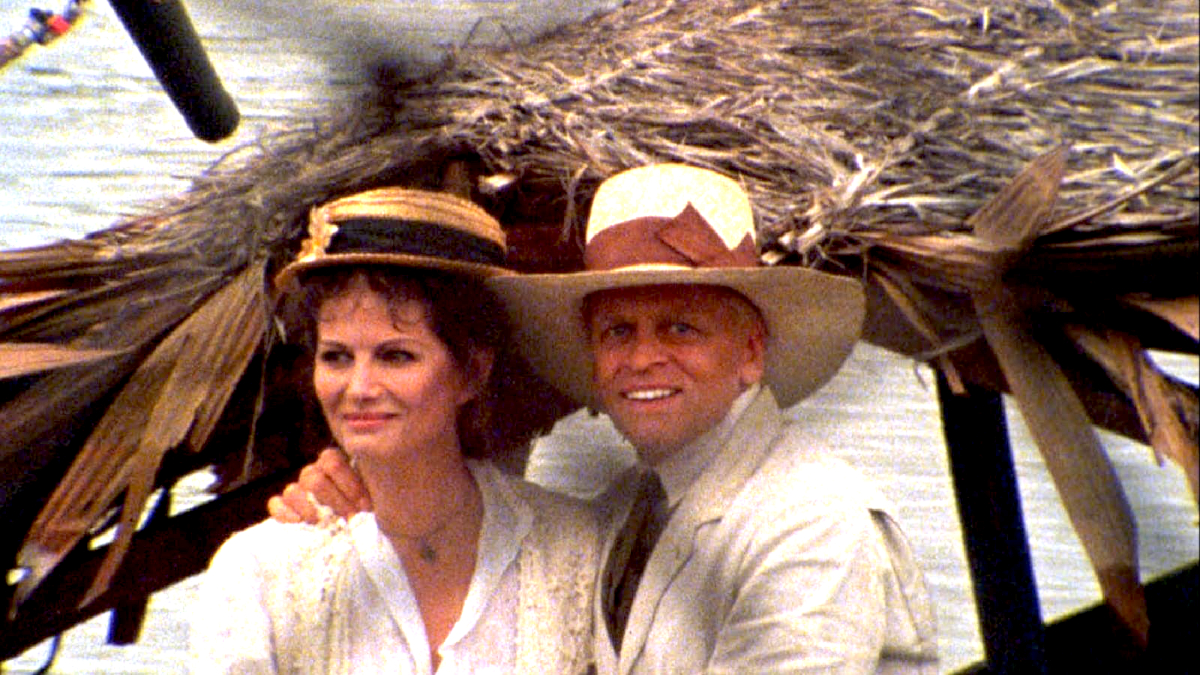
The filming is certainly a trial for everyone present. We see a couple of situations where Kinski looks about to go all Tasmanian Devil on Herzog, but Les Blank’s camera focuses only so much on personality conflicts. The love-hate relationship between Herzog and Kinski is charted mostly in Herzog’s narration. He reports that one of the tribal leaders offered to help out by killing Klaus Kinski for him. The director declines on moral principle: he needs Klaus alive to finish the movie.
The film’s real focus is the overwhelming physical ordeal that Werner Herzog has got himself into. We get an in-depth chronicle of the perils and difficulties, ironies and absurdities of filming “800 miles from a place where one can buy a flashlight battery.” We see danger all around, with talk of murderous insects and small cuts that attract life-threatening infections. Indians hired to work on the picture are attacked by enemy tribes; we see Herzog’s doctor sewing up some serious-looking wounds. The next day, Herzog watches as his best ‘actors’ leave in canoes to take revenge, with rifles they have bought with their earnings. The narrators wonder if the camp will be overrun by a warring tribe.

Claudia Cardinale travels into the Amazon interior too, if not as far as the location for the ‘steamship portage’ project. Significant potential medical risks are associated with the jungle — if Cardinale knew of the Mexican experience of poor Jane Greer, she might have refused to leave Rome.
Herzog has daunting responsibilities to manage. His Indian extras can’t swim, yet his script puts them in dangerous places on the river. The method of hauling the steamship up a hill is straight from the 19th century. A bulldozer prepares a ramp, but as soon as the topsoil is scraped way, all that’s left is unstable clay on which the caterpillar treads slip and slide. We see the construction of an elaborate winch system to haul the boat up the incline. If one of the anchor beams should break down, steel cables would fly every which way. A Brazilian engineer quits, predicting that twenty or thirty people could be killed in a single accident. A few work-related injuries are incurred. Herzog rationalizes them against the many lives that have been saved by the jungle clinic. The local Indians come for help for all kinds of health issues.
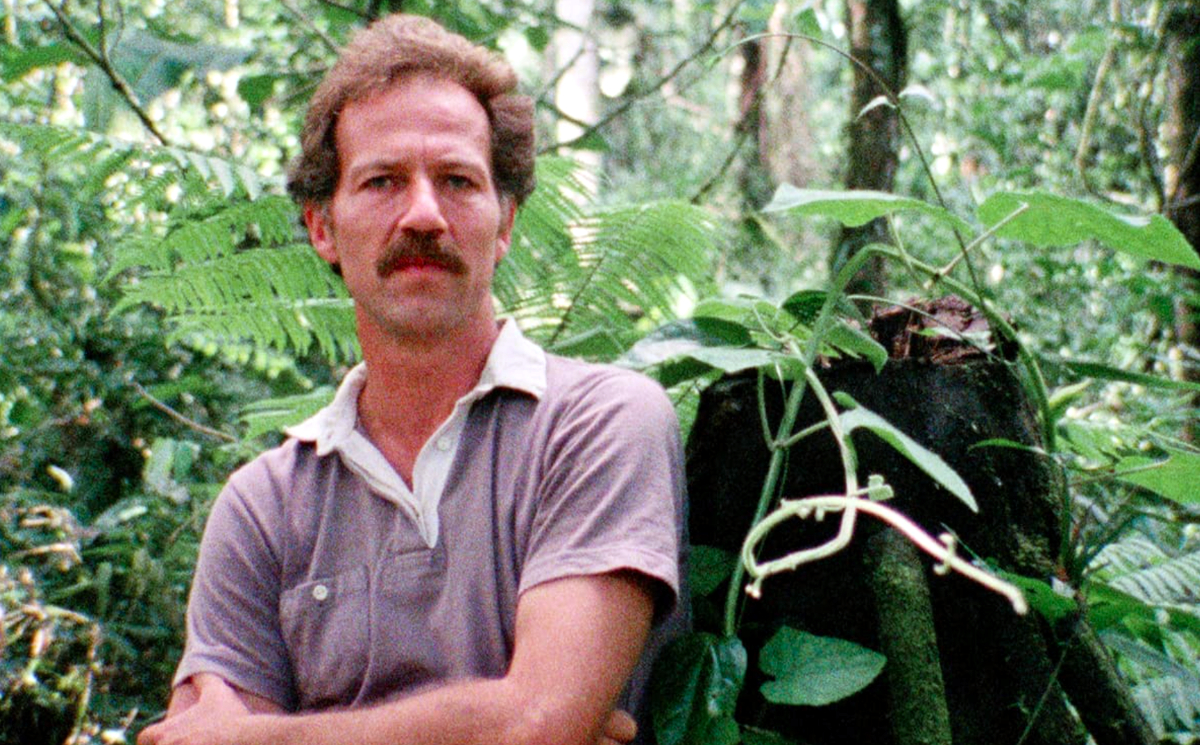
The film records frequent on-camera interviews with Werner Herzog, who comes off as increasingly anxious. At one point he says he should never be allowed to make a movie again, that when he finishes he should check himself into an asylum. Later on, the director gives forth with an extended speech that almost immediately made Burden of Dreams a must-see movie experience. In a German-accented deadpan monotone, Herzog spews forth a warped discourse on the jungle, saying it not a garden of delights but an obscene death trap oozing with rotting flesh and infested with aggressive life forms. He must repeat the word ‘fornication’ three times.
Blank’s camera illustrates this with various freaky flora and fauna. We see a dead parrot (no joke) followed by the image of an ant carrying one of its red feathers like a battle flag. Both Fitzcarraldo and Burden of Dreams share the great theme of Latin American literature, La Selva. The interior rain forest is a place of great beauty, a seductive wonderland where the adventurous go to find their fortune. But most of them are swallowed up, never to be seen again.
Although Burden of Dreams shies away from depicting outright crazy behavior by the notorious mad-dog actor Klaus Kinski — those antics are seen only in outtakes. We do get a good taste of Kinski’s fervor in coverage of him performing with the Indians. The action climax of the documentary shows part of the filming of a sequence where the steamship is swept downstream, un-guided and out of control. Herzog’s obsession with realistic risk is all there — they really don’t know what will happen when the rudderless boat is allowed to drift into a narrow gorge, to bounce violently against the rocks. Herzog gets what he wants when Kinski ‘performs’ real fear — he seems convinced that his director his trying to kill everybody aboard. The actor dashes about like a madman while the cameraman hangs on for his life. The canyon walls spin by in the background, and loom forward on a collision course with the ship. What is thrilling in Fitzcarraldo is even more amazing to see in Burden of Dreams, with Herzog and his cameraman scrambling to get their shots in what must be a situation of real danger.

The Criterion Collection’s 4K Ultra HD + Blu-ray of Burden of Dreams makes good use of 20 years’ worth of improvements in digital technology in its remaster of this eye-opening making-of documentary. A 4K scan of a 16mm original sounds like overkill, but we admire the result … the texture now seems part of the image rather than a drawback of the format. The colorful picture is stable and sharp and evokes a vivid ‘you are there’ vibe — these people were way out on a limb, ‘adventuring’ through some scary hardships. We even admire Klaus Kinski for committing himself to the project. The insane look on his face says,“Why did I ever let that *%^#@ Herzog talk me into coming here?”
Supervised by Les Blank’s son, the new 4K digital restoration also sports a 5.1 surround DTS-HD soundtrack in addition to the uncompressed mono original.
Much of the soundtrack is music recorded on location — some of it is really good.
As is the custom ‘down Criterion way,’ the feature is on both the 4K UHD disc and the Blu-ray ray, and the video extras only on the Blu-ray. in this case The lineup is identical to disc producer Kim Hendrickson’s lineup from 2005. Not everything convinces us that Werner Herzog is a crazy man, no matter how much he works to project that impression.
Herzog speaks out in a long selection of new interviews, and joins director Les Blank and Maureen Gosling on a fascinating commentary track. Two deleted scenes show Klaus Kinski going berserk on the set, shots later used in Herzog’s film about the actor, My Best Fiend. The extras also feature interesting set and location photos from Ms. Gosling. Packed with the keep case is a book with the journal entries of the filmmakers from their time in the oriente of Peru.
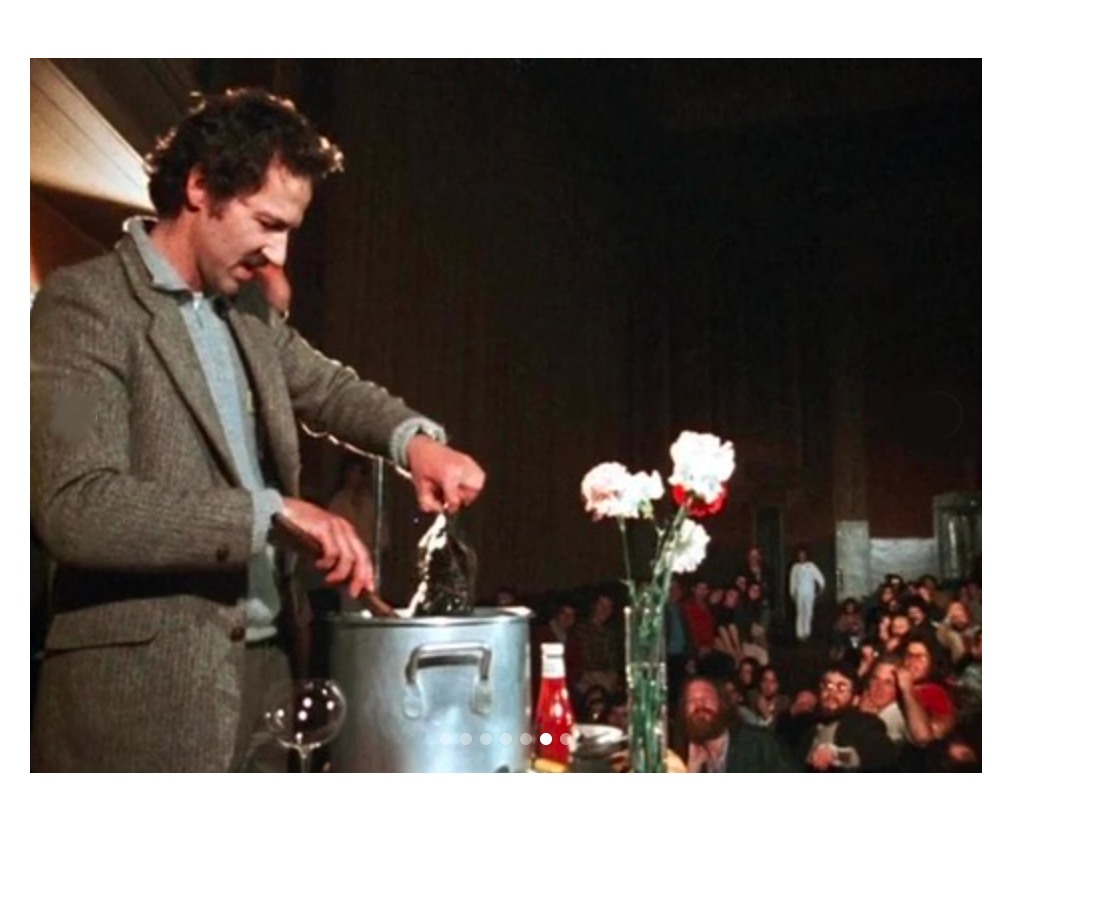
← Les Blank’s legendary film Werner Herzog Eats His Shoe is here; it’s a 20-minute docu about the director doing exactly that to pay off a bet he had with filmmaker Errol Morris. It’s at least partially a plug for Morris’ film Gates of Heaven and shows the director to be a master of the double-dare.
Burden of Dreams belongs on the shelf right next to Hearts of Darkness — they are alike in some ways and very different in others.

Burden of Dreams
4K Ultra HD + Blu-ray rates:
Movie: Excellent
Video: Excellent
Sound: Excellent
Supplements:
Audio commentary with Les Blank, editor and sound recordist Maureen Gosling, and Fitzcarraldo director Werner Herzog
Interview with Herzog
Werner Herzog Eats His Shoe (1980), a short film by Blank
Deleted scenes
Maureen Gosling’s photo gallery
Trailer
Insert folder with an essay by Paul Arthur
86-page book with excerpts from production journals.
Deaf and Hearing-impaired Friendly? YES; Subtitles: English (feature only)
Packaging: One 4K Ultra HD + Blu-ray in Keep case
Reviewed: November 22, 2025
(7425burd)
Visit CineSavant’s Main Column Page
Glenn Erickson answers most reader mail: cinesavant@gmail.com

Text © Copyright 2025 Glenn Erickson
About Glenn Erickson

Glenn Erickson left a small town for UCLA film school, where his spooky student movie about a haunted window landed him a job on the CLOSE ENCOUNTERS effects crew. He’s a writer and a film editor experienced in features, TV commercials, Cannon movie trailers, special montages and disc docus. But he’s most proud of finding the lost ending for a famous film noir, that few people knew was missing. Glenn is grateful for Trailers From Hell’s generous offer of a guest reviewing haven for CineSavant.