
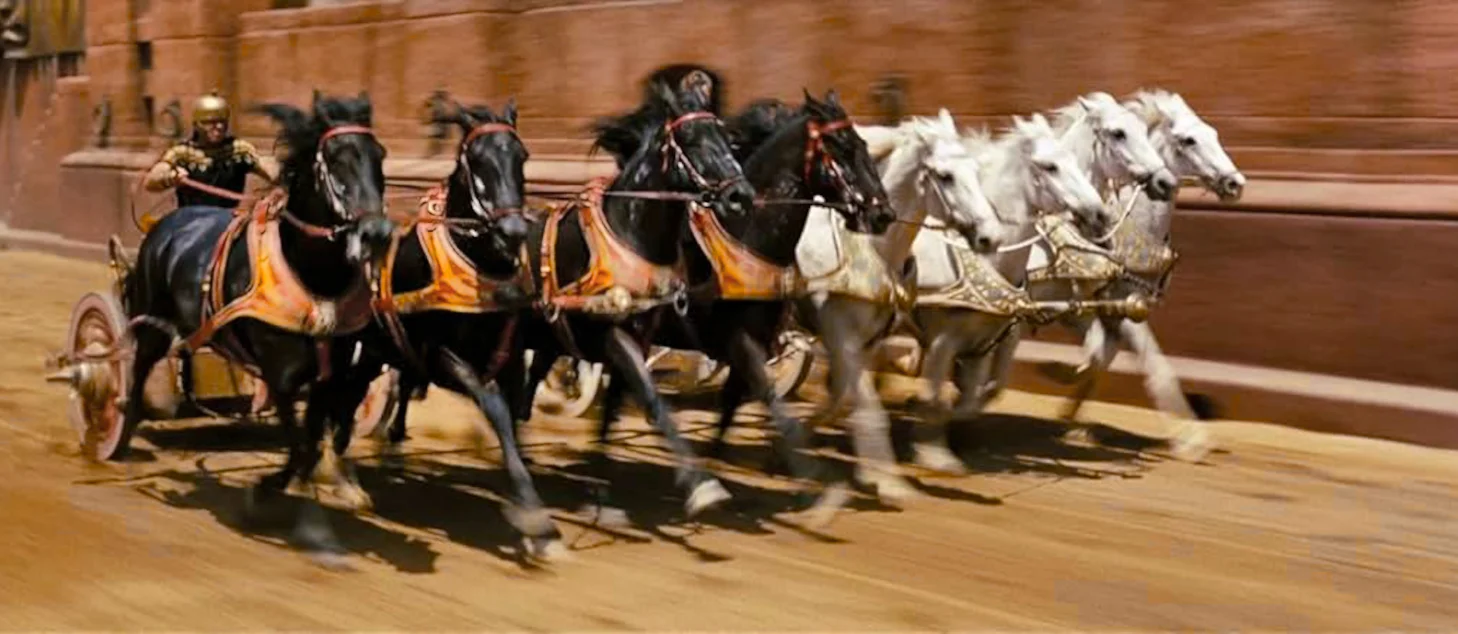


We caught our share of reserved-seat Road Show screenings in our time, but William Wyler’s spectacular epic was not one of them. Catching up with Ben-Hur happened on a VHS tape on a 24-inch TV screen. Previously all I’d seen were excerpts on Johnny Carson’s The Tonight Show: every few years Charlton Heston would show up to screen a clip of the chariot race (Johnny loved it) and make jokes about parting the Red Sea. Heston said that many fans acted like he was a close relation of God.
Ben-Hur on VHS? It was like putting Picasso’s Guernica on a postage stamp.
On VHS, Ben-Hur was pan-scanned until the chariot race, at which point the image shrunk to letterbox proportions. Originally filmed in ultra-wide Ultra Panavision (2.76:1), the movie became a ribbon across my ‘glowing Sony’ monitor, then one of the best choices for NTSC home viewing. The letterbox slot was so narrow, one felt like pressing one’s nose into the TV to see better.
That problem is no more with this 4K remaster of MGM’s blockbuster. It looks sensation on our 65″ LG TV; on a home projection setup it could hold its own against a theatrical experience. Well, it would be in the near neighborhood … 70mm on a big screen was something to see.
Ben-Hur was big news in 1959. Colorful ads were up months before it arrived. It seemed to be in release forever, almost into 1961. I wonder if that created a marketing logjam for MGM’s next 70mm offering, 1960’s King of Kings. Since we never see Jesus’ face in Ben-Hur, some enterprising editor could conceivably cobble together a 6-hour conflation of the two movies. The music would match, as both scores are from the hand and baton of the great Miklós Rózsa.
The years 1955 through roughly 1968 were the heyday of the grand Road Show presentation, that exalted tier of movies presented in exclusive reserved-seat engagements, with overtures and intermissions. They sold souvenir books at the door, usually for a dollar. Theaters like the Warner Hollywood might play a Road Show attraction for months before it was finally printed in normal 35mm and put in general release. Going to one of these movies was a special occasion. How the West Was Won was my first exposure to a genuine ‘picture palace,’ on a 6th-grade field trip from a hundred miles away. I remember dressing up, with a bow tie. I couldn’t find the restroom until a uniformed usher pointed to an elevator that delivered me to the enormous “men’s lounge.”
Ben-Hur is perhaps the ultimate Road Show epic. It lasts the better part of four hours, includes enormous set-piece action scenes and deals with a ‘big’ topic. Governor Lew Wallace of New Mexico claimed not to be particularly religious when he wrote his novel Ben-Hur, A Tale of The Christ. The 19th century publishing blockbuster lays down the template for all devout fiction to come: be reverent, be sentimental, and be violent. MGM’s 1925 silent film version is rightfully considered a classic, a grandiose spectacle to out-do earlier Italian epics in size and scope.
MGM in 1958 had already stopped functioning as a self-sufficient movie factory. Most of its in-house productions were subject to stringent budget tightening. They pretty much bet the farm on this lasive remake of their silent hit. The success of Ben-Hur pulled Leo back from the brink, and gave a big boost to the Italian film industry.
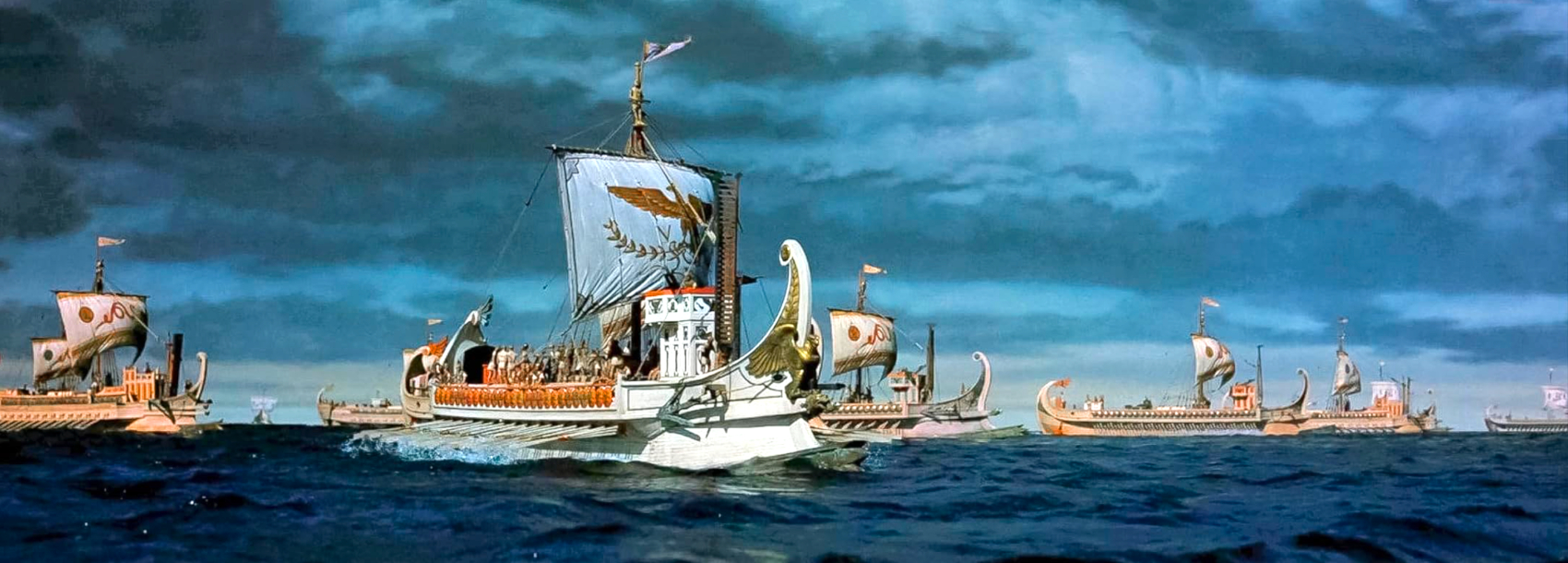
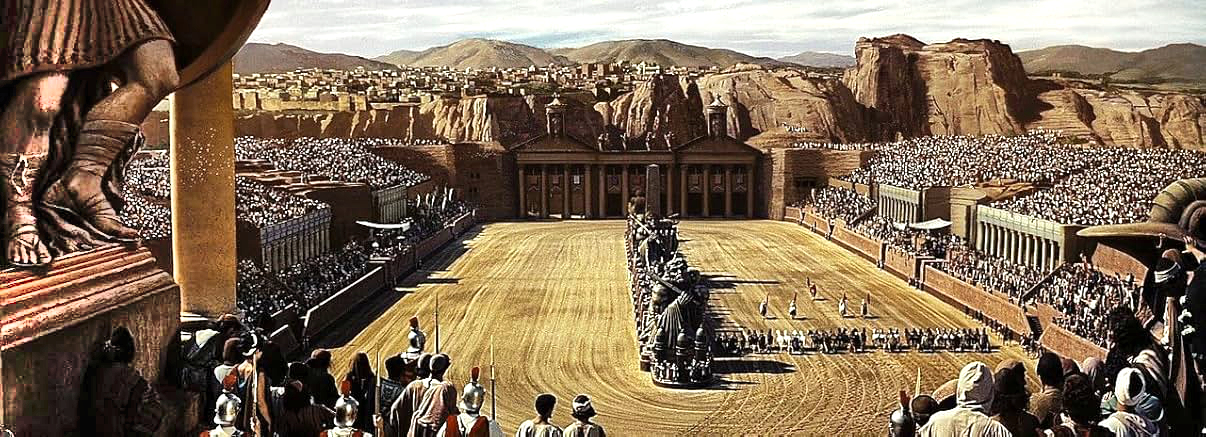
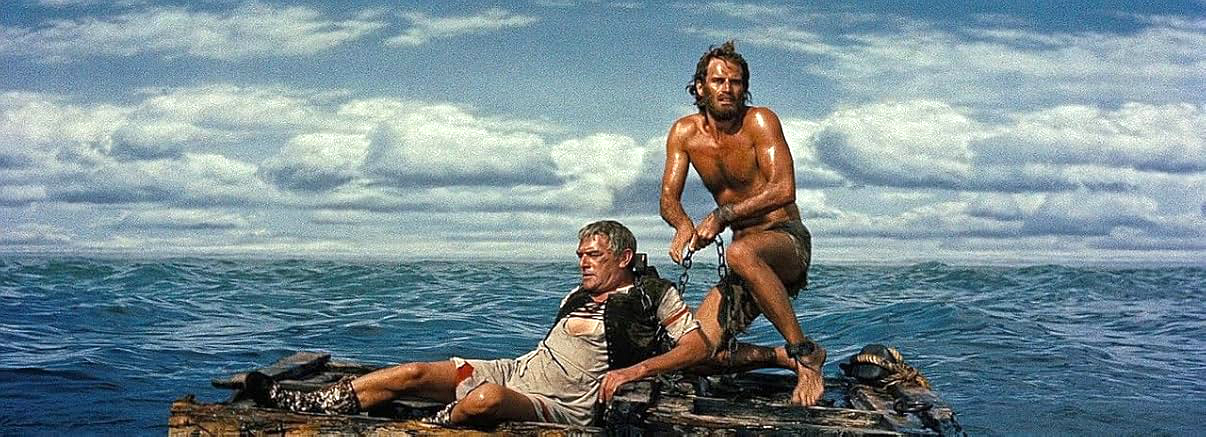
As these images show, the Super Panavision 70 film format was w – i – d – e.
One of the most tasteful and sensitive directors from Hollywood’s Golden Age, William Wyler was likely looking for a good retirement project. His sure hand guided the production into exactly the movie MGM wanted: big, bold and emotionally moving. Karl Tunberg’s script is a smart update of the original, in stark contrast to the laughable pageant pap of C.B. DeMille.
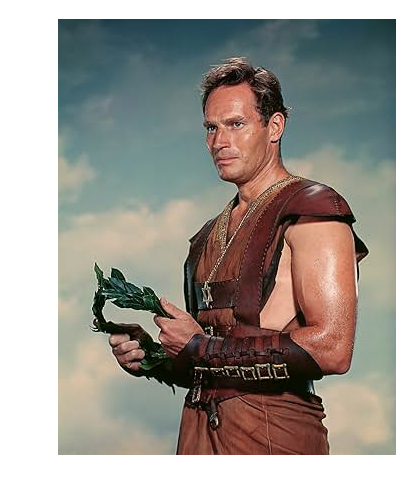
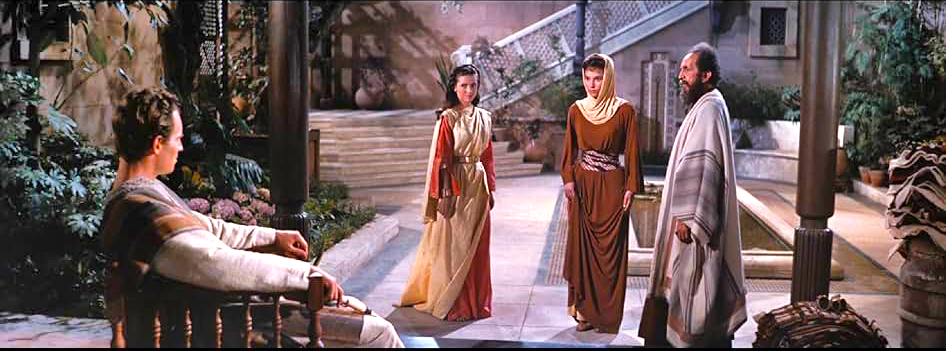
The Hebrew prince Judah Ben-Hur (Charlton Heston) is now a more complex character. He supports the Judean people’s opposition to the Roman occupation, but is himself a slave owner. His initial behavior toward Esther (Haya Harareet) is almost oily, what with his mention of the fact that not long ago his legal rights might have included the privilege of sleeping with her. “If only you would” appears to be Esther’s unspoken but heavy-breathing reaction.
These questionable entitlements are offset by Judah’s loving relationship with his factor Simonides (Sam Jaffe) and the high measure of respect granted him by his mother (Martha Scott) and sister Tirzeh (Cathy O’Donnell). The tragic events that follow are caused by an old friend. The Tribune Messala (Stephen Boyd) is now Judea’s new Roman military leader. Messala makes friendly noises but expects Judah to betray his own people by naming names of those disloyal to Caesar. When Judah angrily refuses to fink on his friends, the ambitious Tribune decides to make an example of him. An unfortunate accident gives Messala the opportunity to have them all arrested as terrorists.

With his mother and sister dispatched to an unknown fate, Judah is sentenced to death as an oarsman on a Roman galley. But his defiant spirit and knack for survival win him a new father in Roman General Arrius (Jack Hawkins) and his skill with powerful horse teams make him the favorite of the Arab Sheik Ilderim (Hugh Griffith). Crossing barriers of race and creed, Judah Ben-Hur becomes a man for all seasons.
Fortitude, determination and good luck turn Judah’s fortunes completely around. Yet his new status as a Roman citizen won’t help him find his lost family members. To do that he’ll have to return to Judea and face the now entrenched Messala. As it so happens, their chosen arena of combat is an enormous, brutal chariot race.
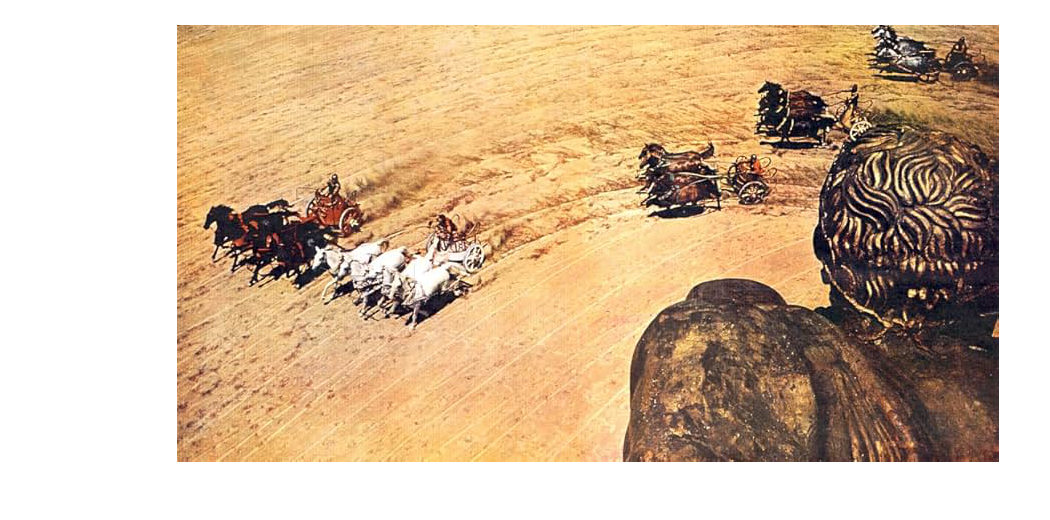
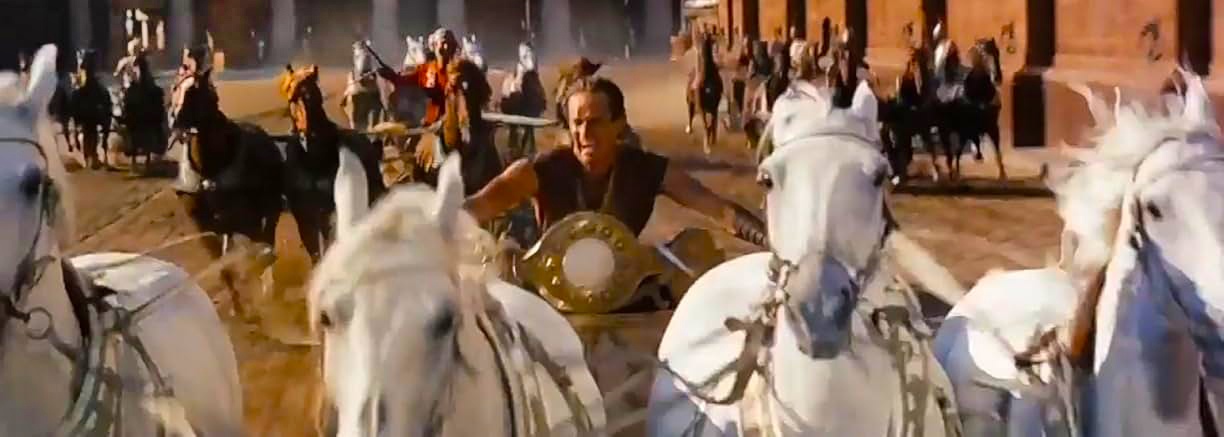
That race comes early in the second half of Ben-Hur. By that time we’ve already been knocked out by an exciting naval battle with Roman Tiremes, achieved through elaborate model work and traveling matte effects. The chariot race is achieved through live-action filming by second unit director Andrew Marton and the legendary stunt whiz Yakima Canutt.
We can tell that for most shots it’s actually Heston and Boyd out there clashing, racing at speed. No matter what ‘cheating’ was going on, it’s clear that the two actors were in the thick of it. The horse action never looks sped-up and the stunts are particularly gory. If Heston or Boyd were to fall, they could easily be injured by the teams of horses running directly behind. We feel the it’s-really-happening physical immediacy of the chariot race. It’s a sensation that the movies have lost. Insert generic anti-CGI rant here.
Today, of course, we wonder why the rules permit Messala to outfit his chariot with tire-ripping 007 wheel hubs – one would think that those cutters would chop up horses left and right. Judah’s sainthood is cinched by his warm relationship with his horses. Heston nuzzles his matching quartet of white chargers as if they were gentle puppies.
Keeping Ben-Hur on its emotional rails and guiding it around the pitfalls of lame faux-Biblical epics is the wise director William Wyler, fresh from two noted pacifist epics, the Civil War show Friendly Persuasion and the range war western The Big Country. Ben-Hur’s side concern is promoting peace in the Mideast, what with Judah’s warm relationship with Sheik Ilderim. With his personal grudge already resolved in the circus, Esther succeeds in persuading him to abandon his vengeance against Rome. Judah’s most political act is to return Arrius’s ring, renouncing his identity as a ‘galvanized‘ Roman. Those empire-building bigots back on the Tiber will have to respect Judea’s demand to keep its own national identity.
This brings us to the Biblical content of the story, the ‘hook’ that author Wallace so cleverly worked into his tale. Jesus gives Judah water when he’s dying of thirst. Later, an unhappy Judah doesn’t hang around to hear the Sermon on the Mount. Finally, as Jesus struggles through town toward his crucifixion, Judah realizes that he’s the same man who helped him five years before. So long as he maintained respect for his Christian readers, Wallace could interweave Judah’s destiny with that of the Christ without giving offense. It worked, as the book Ben-Hur became practically a second Bible in many homes.
William Wyler handles all of this with remarkable good taste. He films familiar Bible tableaux (the sermon, the trial) from a distance and doesn’t oversell any of the reverent moments. Author Wallace’s big finale, retained for all versions of Ben-Hur, is the only divisive element in the movie. After four hours of a realistic ancient world, we’re given a full-on miracle. No matter how you cut it, the miracle (I won’t divulge its exact nature) is directly related to Judah’s relationship with the Son of God. Wyler’s direction and Heston’s performance are so good, that the potential offensiveness of this (presuming on holy scripture) is largely neutralized. Judah is present for the crucifixion, and can honestly say, “I knew him when.”
What isn’t neutralized is the implied object lesson for Jews. King of Kings gives the Christian version of events from a Christian viewpoint, for a Christian audience. Fair enough. Ben-Hur preaches that Jews can only find true happiness by embracing Jesus Christ. Even given the story’s subtitle — “A Tale of the Christ” — I’ve always been surprised that Jews are not offended by this.
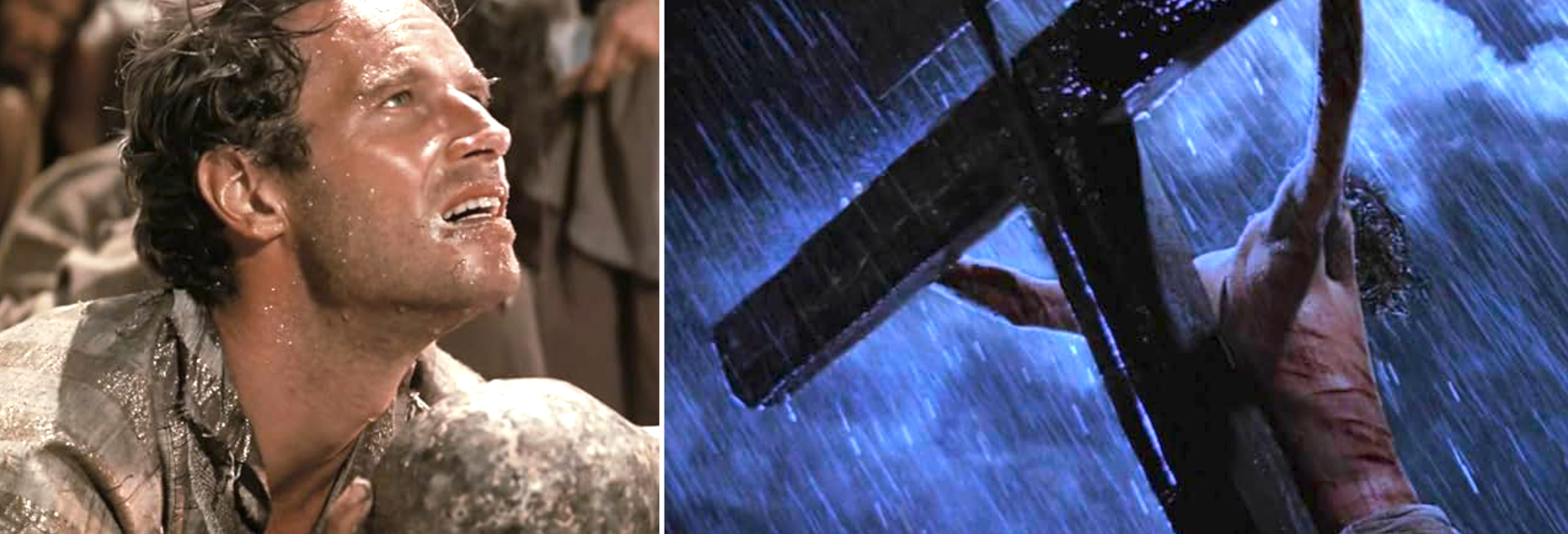
Ben-Hur is Charlton Heston’s biggest career role, the one that cemented him as the go-to guy for period picture heroes. Not the most humorous of personalities, Heston joked endlessly on Johnny Carson about playing Moses, and much later in his political career tried to act the part in real life. But that bearded waxwork with the big voice can’t hold a candle to the flesh, blood & sweat Judah Ben-Hur. Heston is perfect for the role because he’s big and lanky and physical, yet no monument to physical force. Bruises and wounds have a real effect on him. Ady Berber’s Maciste- like Malluch easily blocks Judah’s way. Can we picture John Wayne being knocked on his tail in a similar situation, and just taking it? Heston can approximate humility in a way shared by few Hollywood stars.

And why did we even remember the modest Austrian actor Ady Berber? Berber’s picture was plastered all over issues of Famous Monsters magazine, that’s why, as the star of a movie called The Dead Eyes of London.
→ Haya Harareet gives her one lasting performance here, oozing suppressed passion for the mighty Judah. Her followup picture Journey Beneath the Desert was unfortunately a rush job by Edgar G. Ulmer, and didn’t make the grade. Martha Scott (Our Town) and Cathy O’Donnell (They Live by Night) are saddled with roles that seem fit for a much less sophisticated actresses. We have the feeling that all of the film’s performances were improved by William Wyler’s expert direction. Stephen Boyd (The Man Who Never Was) has perhaps his best role as Messala, a preening, calculating corporate climber. He’s much more interesting than a typical sword ‘n’ sandal villain.
The other major character actors are brash and colorful. The older names (Hugh Griffith, Finlay Currie, Frank Thring) are happy hams in showcase roles, and Sam Jaffe is wonderfully modulated as the faithful retainer. We just wonder how Simonides kept Judah Ben-Hur’s fancy home intact for the five years that its owner was blacklisted exiled as a non-person — didn’t the Romans have real estate agents and property tax collectors?
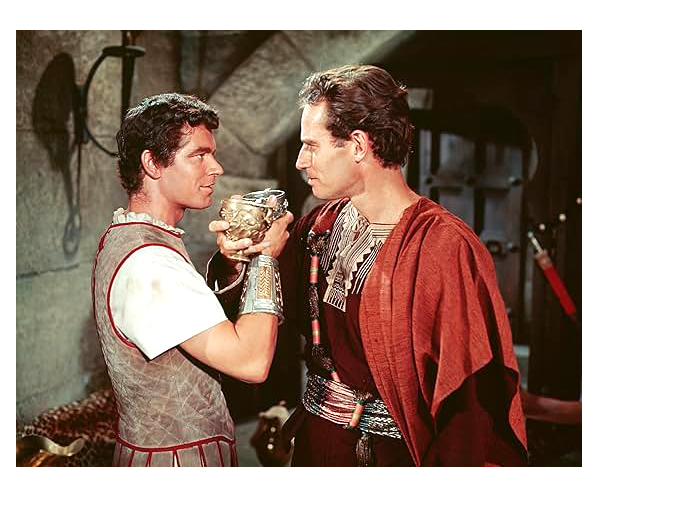
← The buzz a while back was that Gore Vidal talked William Wyler into inserting a homosexual subtext into the relationship between Judah and Messala. Thus the friends’ spirited meeting and exchange of affection is now commonly interpreted as a series of coded signals — specific lines, specific physical gestures and eye motions. As their relationship is already weighted with Messala’s desire for Judah to help him hunt down Judean malcontents, the subtext seems an unnecessary sidebar to the film’s main themes and a parlor game for revisionists. Not that the Vidal interpretation isn’t valid.
This is probably the best deal in the history of 4K. I got it for 20 dollars and the set is priceless. The quality of the transfer is as good as it gets. I noticed that it was coming back to a local Cinemark theater on March 29th, so people might want to look out for it next month.
I saw this on the big screen not long ago and I was shocked at how poor it was. Talky, stagy and mostly indoors. Little spectacle. The sea battle is OK but not as good as the silent version. Too obviously models. The chariot race is absolutely sensational though
Ben Hur defines boredom and self-importance. Pass.
I thought the ship models on the remake looked great on the big screen but the flying projectiles hitting the ships were laughable and destroyed the whole effect. My God, the silent version must have spent a mint on their battle scene!!
Every time I see the chariot race I’m amazed that no one was killed. There’s a scene where Heston’s stunt double (Joe Canutt, I think) flips almost completely out of the chariot that could’ve easily resulted in serious injury or death.
Yakima Canutt gives high praise to both Charlton Heston and Stephen Boyd in his autobiography ‘Stunt Man’. Both Heston and Boyd trained hard to realistically handle a 4 team chariot. And Boyd was actually pulled on a transparent ‘body sled’ when dragged by his horses. Joe Canutt’s flip out of the chariot was his own idea. Finally, Boyd’s ‘007 chariot’ was kind of explained when one of the spectators exclaims that it’s a ‘battle chariot’. I also first saw it on a school field trip, though only a few blocks away; first grade 1959 (yikes!).
Saw this in a huge Cleveland theatre when it came out (I was a 13 year old from the sticks visiting cousins and I was amazed). Wrote a report for my Latin class (remember those?).
Do you remember which theater? My guess is one of the Playhouse Square theaters like the Palace.
Sorry, Jeff, I just don’t remember. It was a palace, though.
The 70mm version was in release way into 1961 in New York City. It didn’t come to the neighborhood theaters in 35mm until July 1961, which is when I saw it at age 6. I still remember that show.
I think it is trireme and not tireme! Not a big deal…but I live in a boating town!
Thanks Tony… my ignorance is showing. Next trime I will trry to srpell irt correctly!
I know this trivial spelling because of an odd event: I was working at the Anthropological film archives in The Smithsonian Museum about 30 years ago (preservation uber alles), and suddenly EVERYONE was talking about the astounding discovery of a Roman trireme…off the coast of Brazil! A much-discussed topic…but after a week there was no more info available, and whole “rumor” faded away. I sometimes wonder if the story had any factual basis…
Good story, thanks for the correction!
I remember when MGM/UA released a two-VHS set of the letterboxed version and in the two years I frequented one video rental store, I was the only one who rented it, while the pan-and-scan set was regularly checked out. Finally, the manager of the store sold me the widescreen version for $2.
Back when I was eleven, my friend came over, so I rented it for us to watch. After getting to the point where Judah saves the Roman soldier on the trireme, we felt like it was moving too slowly, so we ended up skipping to the chariot race.
My friend’s mom recalled having seen it in the theater, and during the chariot race (where Judah gets whipped and bleeds) thinking to herself “It’s just ketchup!”