
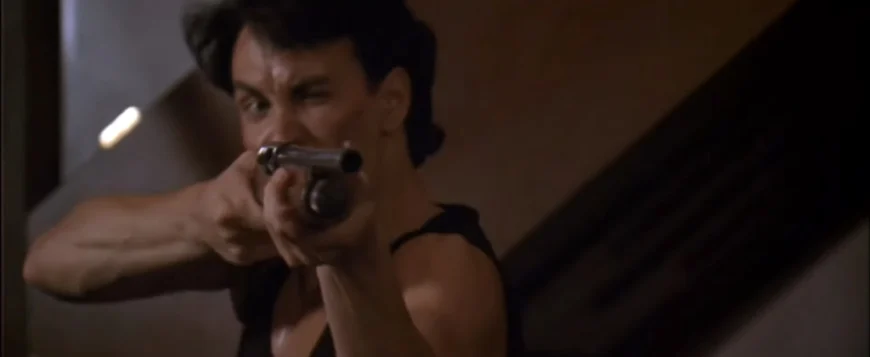
Action cinema, that most kinetic of genres, arguably reached its absolute U.S. cultural apex in the 1990s.
While muscle-bound strongmen in the ’80s vein (Arnold Schwarzenegger, Sylvester Stallone, Jean-Claude Van Damme, Dolph Lundgren, and even Chuck Norris — though Norris’ impact was declining) continued to pack a box office punch into the succeeding decade, a headier brand of hero also began to emerge (Bruce Willis, Kurt Russell, Harrison Ford, Keanu Reeves, Wesley Snipes, Kevin Costner, Nicolas Cage, Steven Seagal, Brandon Lee). That’s not to say this was entirely a brains vs. brawn dichotomy, but a clear divide certainly began to emerge between these two generally parallel sensibilities.
At the time, there was enough real estate for all of these stars to carve out their own niches at the domestic box office.
The genre as we know and love it today kicked off with the adventures of Steve McQueen, Sean Connery, Clint Eastwood, Burt Reynolds, Bruce Lee and Gene Hackman in the 1960s and early ’70s. By the ’80s, it had gotten a shot in the arm (as well as shots elsewhere) thanks to the growing stardoms of Schwarzenegger, who propelled Stallone to new extravagant heights of grisly excess, and Norris. Jackie Chan infused a balletic grace and an utter fearlessness to his fantastic output during this period, especially with the first few entries in his essential Police Story series.
By the ’90s, action movies were thoroughly dominating Hollywood, thanks in part to a surplus of genre superstars. The decade proved to be a fruitful time for innovative visual stylists behind the camera.
Director Dwight H. Little was at the helm of several great action pictures and thrillers in this era. After kicking off his career with ’80s indie action-adventures, he hopped over to horror, directing 1988’s exquisitely creepy Halloween 4: The Return of Michael Myers and 1989’s The Phantom of the Opera remake with Robert Englund. Little recently spoke with Trailers From Hell about his transition into action.
His first big budget foray into that world arrived with a pair of delightfully raucous Chicago-set star vehicles, the Steven Seagal picture Marked For Death (1990) and the frenetic Brandon Lee adventure Rapid Fire (1992).
“At that time in the ’90s, there were five to seven legitimate action stars. And so, on a studio level, it was Russell, Stallone, Costner, and Snipes. But then there was also Steven Seagal and Van Damme… and I helped break Brandon, so there was a way to put movies together ’cause there were action stars. There weren’t really horror stars,” Little told Trailers From Hell. “There was one, Robert Englund, because of Freddy [Krueger]. There was one horror star. So that’s really why I wanted to do Phantom is because Robert was just a cultural thing, then and now. That just seemed like a great opportunity. Also, Steven Seagal had asked me to do his second movie, but the studio blocked it. So I couldn’t do Hard to Kill [also 1990], so I left to go do Phantom. And when I was done with Phantom, he was kind of mad with Warner Bros., because he wasn’t happy with Hard to Kill, so he came back to me and I was able to do it that time.”
That film became Marked For Death, Seagal’s third starring vehicle after the slick Andrew Davis Chicago adventure Above The Law and the extremely goofy-but-quite profitable Hard To Kill.
“When I had Steven, he was on his way up,” Little noted. “And in fact, Hard To Kill opened while we were shooting, so his stock while we were shooting [improved]. ‘Cause Above The Law, people thought, ‘Wow, this guy’s pretty interesting.’ But it didn’t do any business, really. It sold later on VHS, it blew up on VHS. But Hard To Kill opened, so he was really on the rise.”
Seagal, who began his Hollywood career as a fight coordinator on The Challenge and Never Say Never Again, developed a reputation for being a tough customer on sets, although Little contends that their creative time together proved quite rewarding.
“He’s a challenging guy but he was not in any way impossible [as a collaborator]. You could talk to Steven and figure things out. He’s misunderstood because of his persona,” Little noted. “He’s very intuitive, very clever… He has this screen persona of [being] almost like a thug… You want what Steven has to offer, because his marksmanship and his aikido and his instincts about action are unbelievable. There’s actors who are good with action. I mean, Kiefer Sutherland is good with action… But in civilian life, he’s not that guy. He’s an actor. But Steven actually is a fighter and a marksman and all the things that go [on the screen]. Part of his persona is wildly embellished, but there’s plenty of truth there as well.”
Marked For Death is a rollicking good time. It skirts the silliness of Hard To Kill, instead returning Seagal to a grittier Above The Law sensibility, importing that film’s locale of Chicago (although much of it was filmed in L.A. doubling as the Windy City) and its emphasis on Seagal as a tough army vet-turned-family man who finds himself in over his head with a local outfit.
This time, Seagal is joined by his old army buddy Max Keller (the always-great Keith David), now a youth football coach, as they attempt to root out the band influence of a Jamaican gangster operation led by the seemingly-unkillable Screwface (Basil Wallace).
Little actually decamped to the Second City itself for the majority of production on his next Chicago-set actioner, Rapid Fire — this writer’s favorite of Little’s films. L.A. art student Jake Lo (Brandon Lee, son of Bruce), who conveniently happens to dabble in martial arts and motorcycle riding on the side (both skills that will come in handy later), finds himself an inadvertent witness to a murder at the hands of mafia drug kingpin Antonio Serrano (Nick Mancuso), and soon has been brought to Chicago to testify against Serrano in a federal case.
Many of the attendant agents entrusted with his safety are actually on the take. After evading their homicidal intentions he soon links up with grizzled police lieutenant Mace Ryan (Powers Boothe) and his comely partner Karla Withers (Kate Hodge), who are hellbent on putting away a Serrano associate, Kinman Tau (Tzi Ma).
Rapid Fire, like a lot of Little’s work, is a terrific visual entertainment loaded with great action setpieces. The other element that elevates a Little project is Rapid Fire‘s refreshingly dimensional characterizations and interpersonal relationships. Here the shifting dynamics between Jake, Karla and Mace are particularly affecting. But Rapid Fire never loses sight of its beating action movie heart.
“Brandon also was unique because he grew up at the foot of this world,” Little said. “He was not only doing some very early stuff with his dad, but later all of his dad’s guys, Bruce’s guys, were around him. He didn’t have to be trained as an actor in martial arts. He had Jeff Imada with him, who’s a world-class fight coordinator, and they were personal friends. You want to listen to Brandon Lee about this stuff. He grew up at the seat of the godking of martial arts!”
Little went on to helm Murder at 1600, a political thriller in the Pakula/Pollack mold — seasoned with a bit of ’90s action given that it was a star vehicle for Wesley Snipes. At that point, Snipes was performing at the absolute peak of his powers.
Snipes brings the physicality of martial artist to bear in what is fundamentally a Three Days of the Condor/The Conversation-esque D.C. conspiracy yarn. He’s also a remarkably charismatic actor, and he can sell the scenes where he isn’t kicking ass and taking names. Snipes is homicide detective Harlan Regis, the man assigned to investigate the murder of a secretary (Mary Moore) in the White House. Regis and Secret Service agent Nina Chance (Diane Lane), a former Olympic sharpshooter (that backstory will pay off) soon realize that the rabbit hole goes deeper than either of them could have reasonably suspected.
“Wesley’s really good at action,” Little said. “He didn’t take full advantage of it, but his combination of gun work and martial arts [made him a unique talent in the genre], and he’s a really good actor. I know they wanted him to pop off the Sean Connery movie [Rising Sun], they wanted him to pop off the De Niro movie [The Fan], so he had a bunch of bites at the apple, but I think the one that actually made money was Passenger 57,” Little said. “He had a big run on Blade… He’s a great screen presence.”
A key piece of action movie filmmaking language that peaked in the ’90s and seems to have gotten somewhat lost in the shuffle during the 21st century is choreography. Little has always had a deft hand at relaying fight scenes within even his most complicated setpieces. That utter command of scene space feels like it is more of an optional feature than a mandate in modern genre fare, which has saddled us with an influx of semi-incoherent action movies.
Little cautioned that, in one critical recent case, storytelling via chaotic, handheld action sequences did work — but it came at a high cost for the genre’s stylistic future.
“[Paul Greengrass] came out of documentaries. It was his instinct, it was his natural, inhabitable space. And it worked for Bourne because it’s a crazy thing, right?” Little allowed. “But all these directors saw Bourne and they aped his style. So now you’ve got two people talking over coffee, and it’s shot [with a wild handheld approach] and it’s ridiculous. And it’s not helping anything. That’s petered out now. But there was a lot of that, where people were forcing [a style]. When you force a style onto something to the point where it’s so cutty that you don’t know where you’re looking at, then it’s not involving. It just isn’t. Also it just becomes a cheat because you’re building these things in the editing room. Some of it you’ve got to do for real.”
When it comes to singling out the action stars of the modern era who are still carrying a torch for the genre’s prime era, Trailers From Hell and Little are in agreement that Gerard Butler is among the best in the current game. Jason Statham is another Trailers From Hell favorite. Both have managed to avoid the trap of CGI overreliance that befalls many straight-to-streaming original actioners.
“[The Butler-starring] Plane‘s a very old-school, almost like an ’80s movie. But it’s rock solid… For sure that’s a throwback-looking movie,” Little said. “He is grounded, Statham too. [The Beekeeper] is rock solid because you’ve got Jeremy Irons being a bad guy, the whole thing is what it is, but it was very entertaining.”
By contrast, Little called out a new problem in a lot of the current competition: the weightlessness of the animation-heavy streaming movies that aren’t curated by the likes of a Butler or Statham.
“They open some of these Netflix movies now with a car or a truck chase and the whole thing is CG, and you can feel it. So you’re really watching a video game at that point. No one went out and shot this. This was made in a computer.”
By the turn of the century, Little had begun working steadily in big-budget network television, often on action-heavy programs like 24, Prison Break, Bones, Nikita and Sleepy Hollow. A lot of these projects’ stylistic sensibilities and even behind-the-scenes approaches were ported over straight from the ’90s action playbook.
“The skillset we had to make ’90s action movies kind of translated into what became television,” Little said. “It was still a network world primarily when I was doing it… We had money. These weren’t threadbare [productions]. We had truck after truck after truck, it was huge. They spent big time money on those shows.”
What action movie most inspired one of the great action directors?
“So for action, I have to go for French Connection, that’s to me the granddaddy,” Little said. “The whole [grittiness] of that, the original French Connection. So that’s an action favorite.”
When talk turned to Little’s top political thrillers, he cited a clear inspiration for Murder At 1600, the wonderfully paranoid CIA extravaganza Three Days of the Condor.
“One of my favorite all-time thrillers is Three Days of the Condor, because it’s so smart as just a mystery/thriller,” Little told Trailers From Hell. “And the cast in it, besides Redford, they have so many great actors. And that’s a classic Sydney Pollack ’70s [film]. It’s not an art movie, it’s not a popcorn movie. It’s a mainstream Hollywood movie. Michael Clayton is a perfect movie for me, because it’s Hollywood stars, it’s a slick movie.”
For fans interested in even more great filmmaking anecdotes, Little’s rave-reviewed 2023 memoir, Still Rolling: Inside The Hollywood Dream Factory, takes readers through his Hollywood escapades in film and TV.
“I got asked to give a couple of these evening guest lectures down at UCLA,” Little said when asked about his inspiration to write the book. “And I thought, ‘Okay, there’s gonna be maybe 30 kids here or something.’ And the place was completed packed, a pretty big auditorium. I was like, ‘Wow, ego aside, I don’t think they’re all here for me.’ There’s just so much interest in filmmaking and getting into the business and all that.”
“I thought, ‘Well, maybe if I write some of this stuff down, I could get in the conversation in a useful way.’ So I started writing and it came pretty easily,” Little relayed. “And as I was writing, I realized that I had this very unique POV because I had done [12] movies, five of them studio movies, most of them wide releases, and then I had also done 25 years of network television, so not every director has had a ringside seat to both worlds. So I thought I had an interesting perspective.”
I like to think of the ’90s as the golden age of indie cinema. I saw Blue in the Face, Big Night, The Ice Storm and Henry Fool in the theaters.