
Stavisky
Alain Resnais’ historical drama of the notorious l’affaire Stavisky is one of his most accessible movies. Producer-star Jean-Paul Belmondo was fascinated by the story of a swindler who conned half of France in the early 1930s, igniting a scandal that almost brought down the government. His Serge Stavisky projects the charisma of a grand conman, Anny Duperey is his fashion plate muse, and Charles Boyer is the good friend who never realizes the depth of Stavisky’s betrayal. Renais concentrates on beautiful period recreations of a long-gone past. With excellent extras that illuminate the between-the-wars French political context.

Stavisky
Blu-ray
Powerhouse Indicator
1974 / Color / 2:35 widescreen 1:85 widescreen 1:66 widescreen 1:37 Academy / 117 min. / Street Date July 20, 2026 / available from Powerhouse Films UK / £21.00
Starring: Jean-Paul Belmondo, François Périer, Anny Duperey, Michael Lonsdale, Roberto Bisacco, Claude Rich, Charles Boyer, Pierre Vernier, Marcel Cuvelier, Van Doude, Jacques Spiesser, Michel Beaune, Maurice Jacquemont, Gérard Depardieu, Nike Arrighi, François Leterrier.
Cinematography: Sacha Vierny
Production Designer: Jacques Saulnier
Costumes: Jaqueline Moreau, Yves Saint-Laurent
Film Editor: Albert Jurgenson
Music Composer: Stephen Sondheim
Written by Georges Semprún
Produced by Jean-Paul Belmondo, Georges Dancigers, Alexandre Mnouchkine
Directed by Alain Resnais
 Alain Resnais didn’t direct very many features, but each is an engaging work of art. At least four of his dramas investigate (as the critics say) the nature of time and memory through progressive cinematic constructions. We may be stuck in a perpetual present, but for Resnais our consciousness is forever re-processing the past. Memory constructions are treated as a romantic mystery, a puzzle of unknowable relationships, and a science fiction dilemma. His less fractured films are of course more accessible. His story of a Spanish exile uses simple-enough flashbacks and an episode or two of heightened erotic tension. The perfect balance plays out in his stunning first feature, in which a romantic experience covers two kinds of war memories that together carry the conscience of the world.
Made after a five-year break, 1974’s Stavisky is a surprise, a richly appointed period piece that takes us to a complicated era in 20th century French history. It’s remarkably apolitical, considering that its focus is corruption threaded through businesses, government ministries and the police. Screenwriter Georges Semprún’s second script for Resnais indicts a conman, but also a wide swath of dishonest Frenchmen that enabled his sprawling confidence scheme.

The lavishly filmed Stavisky tackles historic corruption in a way that few French films have attempted. Most films deal with Stavisky-like schemers in hyperbolic terms, such as Fritz Lang’s Dr Mabuse films. Semprún, Resnais and Belmondo instead focus on the personality of a specific high-stakes swindler. The resulting scandal helped to unbalance the French Government, aggravating conditions that led to WWII. It is a story for grownups, as topical as the financial scandals which still make our headlines.
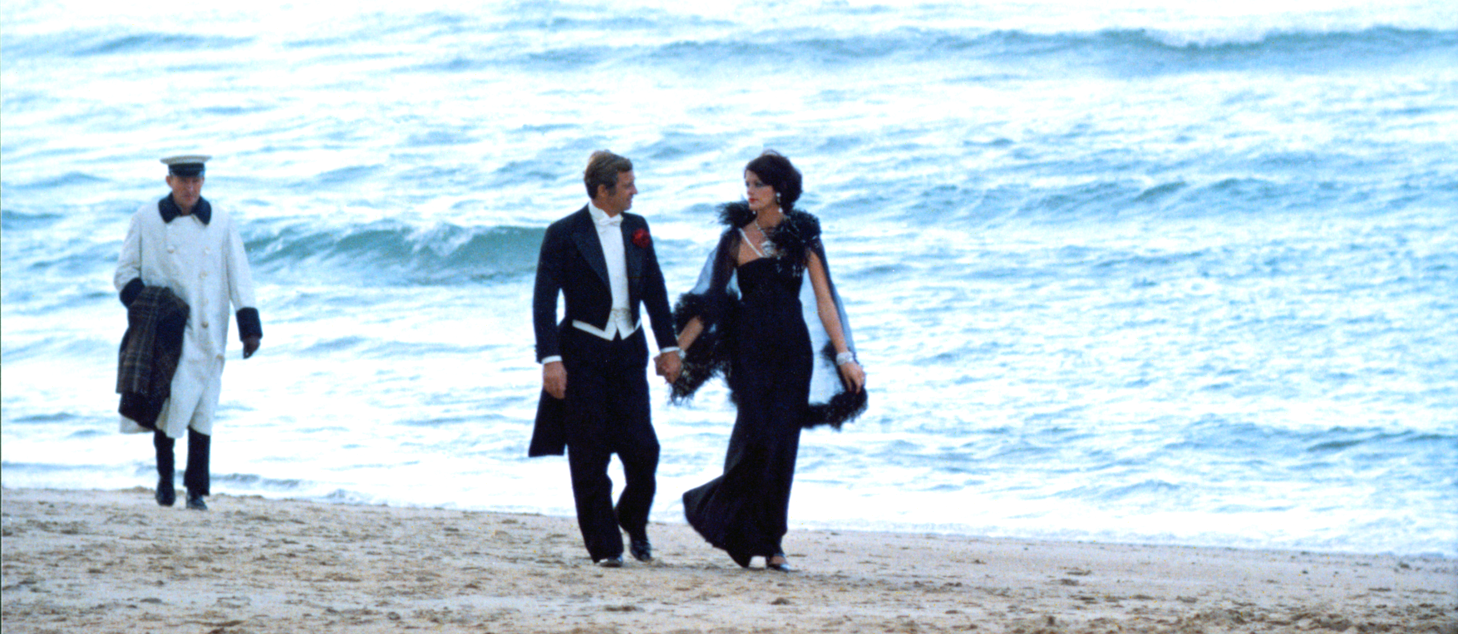
Alain Resnais does not fixate on his expected cinematic time experiments. A third viewing makes us think that he sought to please his producer instead. His flashbacks are usually cued by voiceovers, so there’s less of a chance to get lost in a Marienbad maze. The focus is instead on precise period reconstruction to evoke an elegance lost in time. Every other scene poses the leading lady in yet another Yves Saint-Laurent fashion statement, on the golf links, with her touring car, boarding a fancy passenger biplane with an Art Deco design.
In France of 1933, Serge Alexandre (Jean-Paul Belmondo) is a grand impresario and financier. He runs a glamorous theater, stays at the ritzy Hotel Claridge, and is promoting the formation of his own multinational bank. Serge can boast a beautiful wife, Arlette (Anny Duyperey) and a loyal friend, the Baron Jean Raoul (Charles Boyer). He tips madly and loses fortunes at casinos, all of which add to his mystique.

But Alexandre’s flamboyant lifestyle fronts a mountain of duplicity that reaches into many corners of France, then ‘between wars’ and insecure. Constant infusions of bribes to policemen and officials in the liberal government allow Serge to suppress the fact that he is indeed the notorious Stavisky, a con-man and gangster who once served time in prison. Some of Serge’s close friends do not realize how crooked he is. His few close associates seem to stay in his hire only to see how long he can keep up his grand deception.

Alexandre’s fraudulent finances were initiated with false loan vouchers that a simple audit would uncover. But the key gendarmes that could expose Serge’s ruinous schemes also keep it a secret. They keep his criminal file locked away, waiting for the moment when a giant scandal will work for their personal career benefit.
Stavisky focuses on the lavish lifestyle of a rogue, faux-aristocratic adventurer whose champagne-and-payoff scheming is a daring high-wire act. We see the handsome and charismatic charmer stave off attacks by the press with bribes, a practice he calls ‘watering the plants.’ Alexandre cannot stand to be confronted with the facts of his previous identity, the criminal Stavisky. His closest retainers Borelli (Francois Périer) and Doctor Mézy (Michael Lonsdale) are convinced he’s a megalomaniac with a dual personality. Yet they are mesmerized by his nerve and self-confidence. His personal Empire has a beautiful facade, yet is no more solid than a house of cards.

The filmmakers infuse their story with details that make us want to know more about the period. France in the ’30s was a mess of governmental scandals and private profiteering in a hopelessly splintered political environment. The conservatives were obsessed by consolidating power and keeping out communists, and incapable of properly acknowledging the growing threat of fascism.
Threaded through Stavisky/Alexandre’s story is a major subplot concerning the exiled Russian communist Leon Trotsky, who is seen being granted asylum in France, provided he stays out of national politics. Trotsky is monitored by Inspector Bonny (Claude Rich), the same policeman who keeps Alexandre under observation. Comparing the two ‘fugitives’ have qualities in common. Both are Russian in origin and both were born Jewish. Both are national problems that cause the government to reveal its corruption and incompetence. Serge’s finance-oriented bribery compromises and corrupts many French officials, yet the relatively helpless Trotsky is considered the bigger threat to the nation.

The screenplay gives Serge every benefit of the doubt. He is devoted in marriage to the dazzling Arlette, yet openly beds other women as an expression of his (semi-controlled) megalomania. Unlike the stuffy status-quo aristocrats and bureaucrats around him, Serge is a fresh breeze of innovation. He’s receptive to new ideas, such as the invention brought to him by a young supplicant (Gerard Depardieu, in an early bit part). His wild banking plan might very well work, if the needed funds come through. But Serge suffers mood swings that point to a fundamental instability. He must lie to himself to believe that his rule-bending is harmless. His swindles do have victims, and his dishonesty betrays even those closest to him.
Alexandre is counting on a specfic deal to legitimize his finances. Spaniard Juan Montalvo de Montalbán (Roberto Bisacco) becomes part of Serge’s entourage to be near Arlette. Juan is an hidalgo who wants to recover his family’s name and fortune through a major deal of his own, an arms deal with Mussolini to ignite a monarchist rebellion against the fledgling Spanish Republic. Alexandre offers to launder Spanish money for Italian arms, safeguarding Montalbán’s millions in his Swiss accounts. We know that he intends to leverage Juan’s money to cover his own crimes. Was Alexandre/Stavisky caught up in the pre-history of the awful Spanish Civil War?

The pervasiveness of French antisemitism is always an issue. In reading up on Alexandre’s name-drop of an influential conservative, we learn that one Charles Maurras was a conservative who based his radical nationalism on his stance as an anti-Dreyfusard, a bigot still blaming France’s woes on a non-existent Jewish conspiracy.

The threat to all European Jews is introduced through the character of Erna Wolfgang (Silvia Badescu), a young Jewish actress. → Expelled from Germany, Erna interacts with Serge in an excellent scene at Serge’s theater, The Empire. The screenplay also uses her to deftly connect the Trotsky sub-pot, when Erna becomes a German translator for Trotsky. At one point Alexandre’s entourage makes a casual visit to the countryside. Charles Boyer’s Baron Raoul recognizes Erna on a bicycle; he walks over to ask if she’d care to join their aristocratic country drive. The Baron doesn’t understand how utterly incompatible are Serge’s upscale cronies with Trotsky’s young idealists.
Alain Resnais’ smoothly directed film makes a restrained use of his cinematic time-twisting techniques. Some close-ups of characters addressing the camera are eventually revealed to be testimony given at a later investigation. A few flash-forward shots are introduced as the story nears its ending. They don’t disrupt the narrative, as happens in Sidney Lumet’s genre picture The Anderson Tapes. They instead emphasize the mystique of Stavisky over the plain facts of his downfall.
Resnais can’t resist a sneaky trick or two. He establishes that Serge in the 1926 flashbacks wears a moustache, while the Serge of 1933 does not. A new scene shows Belmondo with a moustache, so we figure it’s 1926 – until he pulls it off. It’s a disguise to deceive a doctor when he’s being examined.

Stavisky is more proof of Jean-Paul Belmondo’s stature as a great actor — the portrayal has little in common with the physical rogues he plays in his action films. Charles Boyer seems content to carry his key role, considering all of the pointless cameo parts he played in his later years. Anny Duperey is stunning as Serge’s trophy wife, living an unending pageant of luxury, while Roberto Bisacco is properly determined as the Spanish nobleman. Claude Rich, from Resnais’ Je t’aime, je t’aime and Michael Lonsdale ( Day of the Jackal) have fine turns as Stavisky’s foe and friend. Along with the interesting stage audition by Silvia Badescu, we’re treated to a second stage bit with actress Nike Arrighi, of Terence Fisher’s The Devil Rides Out and Truffaut’s Day for Night.
We were surprised to discover that Hollywood long ago produced a romantic thriller based loosely on the Stavisky Affair. 1937’s Stolen Holiday is directed by Michael Curtiz and co-stars Kay Francis and Claude Rains, whose duplicitous financier is named Stevan Orloff. What strikes us now about l’affaire Stavisky is that the government stayed together because the policemen, politicians and financiers that colluded with Stavisky were able to deflect blame to their liberal enemies. In today’s America, corporations and governmental cronies can misappropriate billions, with nobody in a position to bring them to heel, or to even ask where the money went.


Powerhouse Indicator’s Blu-ray of Stavisky is the fine-quality rendering of Alain Resnais’ movie we were looking for. Such a sharp, accurate image brings out the beauty of the locations and the period decor, plus those startlingly gorgeous images of Anny Duperey.
The picture looks immaculate. Resnais avoids opticals so everything looks pristine. A passage in the middle does have more contrast. It may have been intentional, or Studiocanal’s 4K restoration may have had to access a dupe section.
Resnais was clearly taken with the period recreations, many of which are truly impressive. The more we see of Jean-Paul Belmondo’s work, the more of a class act he seems. He could have bankrolled ‘That Man from Rio Part 6’ but chose to do this less commercial story that critiques key aspects of French history and politics.

Stephen Sondheim’s elegant music score comes across very nicely. It’s used mainly for transitions and wordless passages. If Sondheim was indeed fascinated by puzzles and games, he would surely have admired the films of Alain Resnais … it’s easy to imagine the two creatives as having a lot to talk about.
The extras help us Americans navigate an unfamiliar part of 20th-century history. Disc producer Anthony Nield assembles some great extras, both video and text. From 1974 come two TV ‘reports from the set.’ A longer piece called Pour le cinéma lets Belmondo, Boyer, François Périer, and I think the voice of Resnais sketch a quick background for the Stavisky scandal, a big hope for those less informed. We also get a brief interview in color with Anny Duperey, apparently filmed at a festival not long afterwards.
Also present are long post-screening audio interviews with Alain Resnais and Stephen Sondheim, that are sources of key information. In addition to the usual galleries is a ‘script gallery’ that’s not an as-produced script, but a timing listing of all the dialogue, for subtitling purposes.
Reviewed by Glenn Erickson

Stavisky
Blu-ray rates:
Movie: Excellent
Video: Excellent
Sound: Excellent
Supplements:
National Film Theater audio: The Guardian Interview with Alain Resnais (1982)
National Film Theater audio: The Guardian Interview with Stephen Sondheim (1988)
Original theatrical trailer
Image gallery: promotional and publicity materials
Limited edition insert booklet booklet with writing by Jonathan Rosenbaum, an analysis of Stephen Sondheim’s music, and an overview of critical responses.
Deaf and Hearing-impaired Friendly? YES; Subtitles: English (feature only)
Packaging: One Blu-ray in Keep case
Reviewed: July 12, 2026
(7548stav)
Visit CineSavant’s Main Column Page
Glenn Erickson answers most reader mail: cinesavant@gmail.com

Text © Copyright 2026 Glenn Erickson
About Glenn Erickson

Glenn Erickson left a small town for UCLA film school, where his spooky student movie about a haunted window landed him a job on the CLOSE ENCOUNTERS effects crew. He’s a writer and a film editor experienced in features, TV commercials, Cannon movie trailers, special montages and disc docus. But he’s most proud of finding the lost ending for a famous film noir, that few people knew was missing. Glenn is grateful for Trailers From Hell’s generous offer of a guest reviewing haven for CineSavant.
France in the 1930s was crippled by corruption scandals, economic hardship, and deeply divided politics. Conservatives feared communism, the left feared fascism, and frequent political infighting left the government unable to respond effectively to the growing threat of Nazi Germany. Trotsky’s presence reflected the broader ideological struggles shaping Europe at the time.