


Here’s something interesting, an Israeli-Polish co-production with a generous assist from various Colombian companies. Many movies today are group efforts with scores of production entities, almost as if they were crowdfunded. We’ve grudgingly become accustomed to shows that begin with long strings of company logos. To that end we’re grateful for logos that don’t include 20 seconds of animation.
The multi-logo opening for My Neighbor Adolf at least gives us somehing to listen to behind the first two minutes of company logos. We hear audio from the first scene, a backyard picnic ‘somewhere in Eastern Europe’ in 1934. We learn that his happy Jewish family is proud of its roses. A fussy young man considers himself an expert at chess, not photography. We see just enough to think, ‘hmm, will this be another movie where we’re introduced to group of nice people, only to see them suffer?”

Is it a case of ‘unsentimentalized’ humor?
Dmitry Malinsky and Leonid Prudovsky’s film respects its serious subject but maintains a somethat detached, light tone throughout. Judging by the ‘comedies’ of Roman Polanski, I’d say it has an Eastern European sense of humor — very dry, very aware that the ultimate joke is being played on all of us.
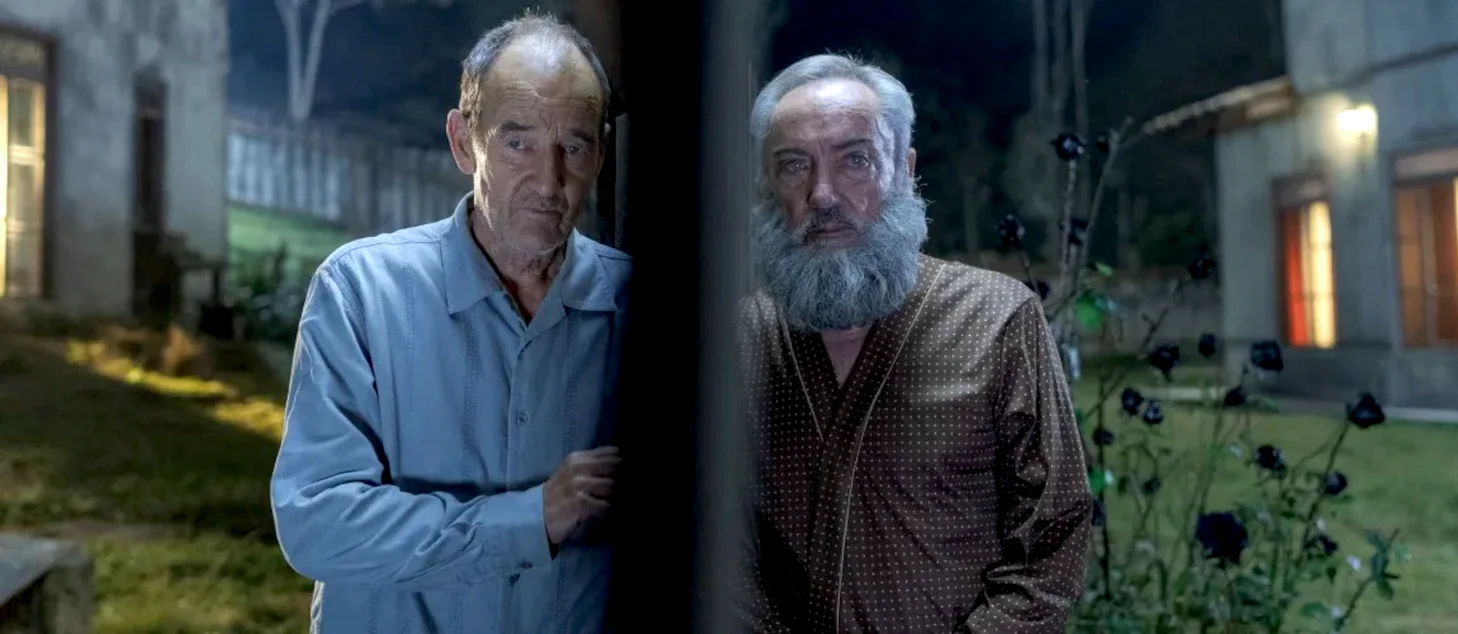
In 1960, that young man from the prologue is revealed to be Malek Polsky (David Hayman), who is now a 55-ish man who looks ten years older. He’s the only survivor of his entire family — we never learn how — and he emigrated to South America, where he lives in a bare house on a ragged lot on a country road. He has some kind of income; it’s possible that he’s living on an Israeli pension. He’s not far from the capitol. He’s not learned a lot of Spanish. He’s distrustful, a loner, and something of a curmudgeon. His only joy is taking care of his one rose plant.

The conflict comes when a nosy German businesswoman Frau Kaltenbrunner (Olivia Silhavy) moves a quiet, bearded man into the empty house next door. The movers are all blond and speak German. Malek resents the affront to his privacy, and goes ballistic when the German’s dog Wolfie digs through the fence and chews up his black roses. In the ensuing dispute, Malek exchanges several hostile gestures with his new neighbor, Herman Herzog (Udo Kier). When Malek complains to the city council, Frau Kaltenbrunner retaliates with the news that the property line actually puts the rose bush on Herzog’s side of a new fence that is built.
Instead of festering in quiet rage, Malek snoops on Herzog, and is soon convinced that he is Adolf Hitler. Herman has a terrible temper but loves his dog. He paints bad pictures of buildings that resemble Hitler’s work in art books. He has mysterious visitors at night, one of whom gives a Nazi salute (and is reprimanded). ↑ Malek buys a camera and operates a darkroom to take telephoto pictures. Herzog has a large beard that covers much of his face, but not his eyes, which Malek knows well … back at a chess convention in 1934, Malek was momentarily face-to-face with Hitler, and never forgot his distinctive eyes.
Malek takes bus trips to visit the Israeli embassy, but the lady intelligence officer (Kineret Peled) discounts his evidence. Malek makes more contact with Herzog, and tries to get a sample of his handwriting, a subterfuge that leads them to play chess together. Malek finally resorts to burglary, but fails to steal one of Herman’s painting. He instead gets closer to the lonely Herman, who offers to paint his portrait!

Is he or isn’t he? Does the movie get beyond that basic question?
The odd movie feels like a comedy, where events are absurdly amusing, but not really funny. A very careful music score alternates suspense themes with light comedy cues. It’s good to be kept off-balance, yet we wonder if the filmmakers are in firm control. We wish we knew more about Malek. He’s gone through hellish experiences, so we accept his rude, anti-social behavior. He survived a concentration camp, after all. The arguments over the fence get ugly, but the two old men end up bonding somewhat over chess. Do hermits attract? They even swap opinions as to the sexiness of the not-too-seductive Frau Kaltenbrunner.
But the odd non-comedic scenes pile up. A bookseller wonders what’s going on when Malek buys a tall stack of books on Hitler. Malek sneaks into Herman’s rooms, and finds a suspicious locked box in the bedroom. Herman Herzog simply has too many ‘Hitlerian’ qualities for Malek to ignore. The Israeli officer is genuinely concerned for Malek, and uses a cheap trick to connect him with a friendly psychological counselor.

Malek’s investigation becomes an odd friendship. He gets his neighbor Herzog hooked on Vodka during their chess games; as the real Hitler never drank, it’s almost uncomfortable to see Herzog becoming ‘humanized.’ The strongest anti-comedic scene involves the death of a dog. The two men ‘bond’ over its burial.
We’re not going anywhere near the film’s secret reveal. It makes good sense to us … especially in the way it ‘rationalizes’ the idea of humanizing Hitler.
We’re certainly not looking for ‘Big Laughs With Adolf’ and we admire the way that Malinsky and Prudovsky do not trivialize the Holocaust. But the reviewers I’ve read judged My Neighbor Adolf to be something of a misfire. It isn’t conventionally funny, and its ending does not build to a big cathartic shock. Our reaction was more positive: this is one Shaggy Dog story that actually finds a reasonable ending.
Does the movie not give audiences what they want? The film’s personalities are indeed a bit remote. An average audience probably expects a more sentimentalized main character. Malek isn’t above petty malice, like pissing on Frau Kaltenbrunner’s car. Udo Keir’s underplaying is very effective. He’s great in surveillance telephoto shots, railing against whatever bad news Kaltenbrunner is bringing him. He can also generate the furious eyes that Malek remembers so well from his youth.
… or is the ‘eyes memory’ evidence that Malek is psychologically obsessed? To us he comes off as rational. Mean-spirited, but sane.

David Hayman offers a strong character portrayal. His Malek refuses to be lovable, pitiable or heroic … neither the movie nor the character panders. When is the last time we saw a Holocaust survivor play a main role in a movie, and not suffer from horrible flashback nightmares? Malek does not dwell on his lost connection to the people depicted in the 1934 prologue — which some reviewers noted as a ‘fault.’ I suppose that Malek’s lifelong dull rage could be deemed insufficiently dramatic.
To the extent that director Prudovsky stylizes things, My Neighbor Adolf reminds us of Norman McLaren’s classic short subject Neighbours (1952), the part-pixillated symbolist farce about a dispute over a backyard fence that turns to war. They fight over a flower in much the same way that Malek fights over his black roses. Adolf would be a disaster if the rose bush struggle escalated to slapstick, the way Laurel & Hardy go to war over a Christmas tree in the anarchic classic Big Business (1929).
We think My Neighbor Adolf is trying for something different. We’re ready to believe that the filmmakers made the exact movie they wanted to make.

No Spoilers here.
We’re not even going to drop a hint. We thought the film’s ‘surprise’ made good sense. We certainly didn’t want anything as poor-taste crazy as David Bradley’s movie. When the show is over, we wish we could see another movie about ‘Herman Herzog’s’ life story.
Commercially speaking, the critics have a point — a movie as odd as My Neighbor Adolf needs an undeniably memorable ending — a big scene, a shocking revelation, something to cause controversy or start arguments. We like the way it finishes … but we’re not sure how long it will stick in the memory.
The movie never says which South American country is depicted. Just checking up on two newspapers shown on screen. The first scene must take place on May 22 or 23 of 1960, as Malek’s newspaper breaks the news of the massive Valdivia earthquake in Chile, the strongest ever recorded. * Adolph Eichmann was captured on May 11 of the same year, so the timing jibes with that news ‘getting around.’ The world was suddenly aware that more major Nazi war criminals were likely at large in South America.

I don’t remember who it was that said history would be better if Hitler had sat around smoking pot.