
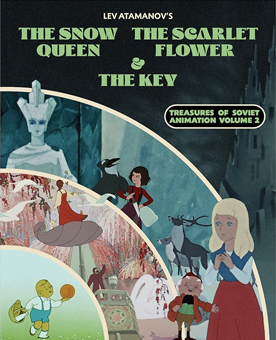
 The Magnificent Ambersons, Blade Runner, Once Upon a Time in America, each a member of an unlucky fraternity: films disfigured by studio interference—never for better, always for worse. Add to those portentous classics a delicate animated fairy tale from the Soviet Union, Lev Atamanov’s The Snow Queen. The film was released in 1957 but it didn’t arrive in American theaters until 1959.
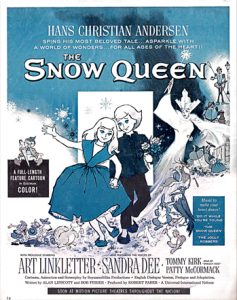
In the late 50s the cold war was in full effect but there were cracks in the ice—fantasies like Ilya Muromets (The Sword and the Dragon) were given an English soundtrack and, with a few trims and Americanized narration, did reasonably well in stateside theaters. Eager to make a dent in the cartoon/kiddie franchise, Universal bought Atamanov’s film and hired current teen queen Sandra Dee and Disney mainstay Tommy Kirk to voice the main characters, Gerda and Kai.
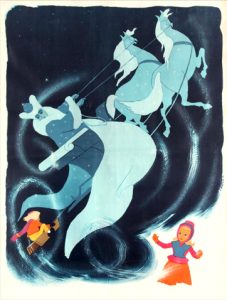 Fair enough but to make the film resemble more typical matinee fare, game show host Art Linkletter was hired to star in a wretched six-minute live-action prologue. Set at a mock Christmas party—the film was released in late November—where Linkletter passes out presents to assembled neighborhood children dressed for a church social. It was a devil’s bargain that actually paid off; supported by a savvy ad campaign and name stars, The Snow Queen was a respectable money-maker. More importantly Atamanov’s poetic short form masterpiece went on to captivate audiences around the world, becoming a TV perennial during holidays. Though the film would continue to be known in America in its impure form, for those lucky few who were able to see the real deal, it’s a pure experience. It turns out that Deaf Crocodile, the boutique Blu ray company, is not that hard of hearing; they’ve listened to fans of Atamanov and Russian animation in general and released The Snow Queen as she should be experienced.
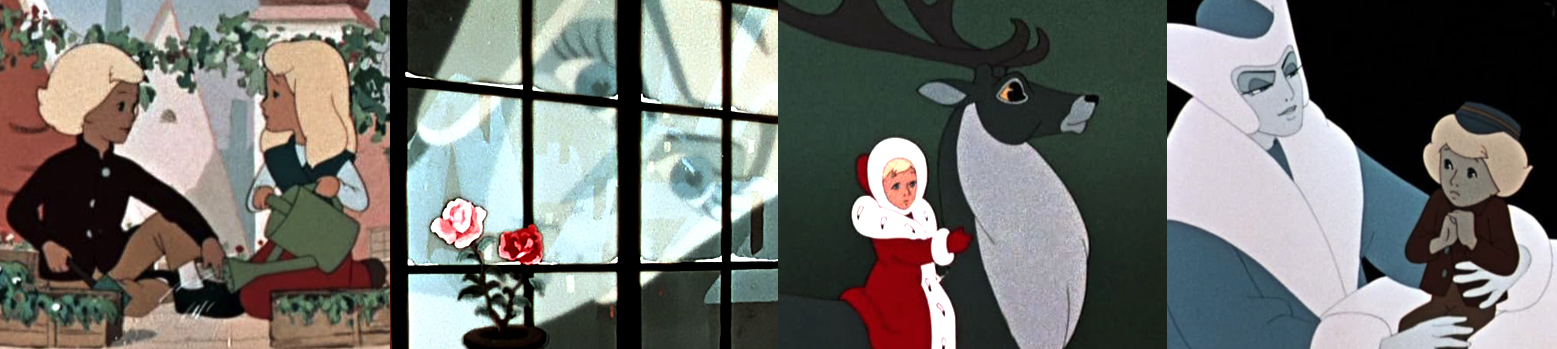
Gerda and Kai seem destined to live out their lives together—even their homes are connected: the children’s bedroom windows are joined by a small bridge. Winter only makes their bond closer; the swirling wind and falling snow seems as serene and comforting as a blanket. As the song says, “winter was warm.” The film was based on the 1844 fable by Hans Christian Anderson and like most of his tales, there is a comforting presence in the form of parent or, in this case, Gerda’s grandmother. The children are curious as to where all that snow comes from so the old lady spins a yarn about “snow bees” ruled by The Snow Queen, an enchantress who lives in a faraway ice palace. When Kai brags he’d melt the icy despot on a hot stove the omnipresent queen makes a startling appearance at their window, stabbing Kai with two shrapnels of ice, one for his eye, and worse, one for his heart. The cold-hearted boy escapes with the Queen to her palace with Gerda in pursuit.
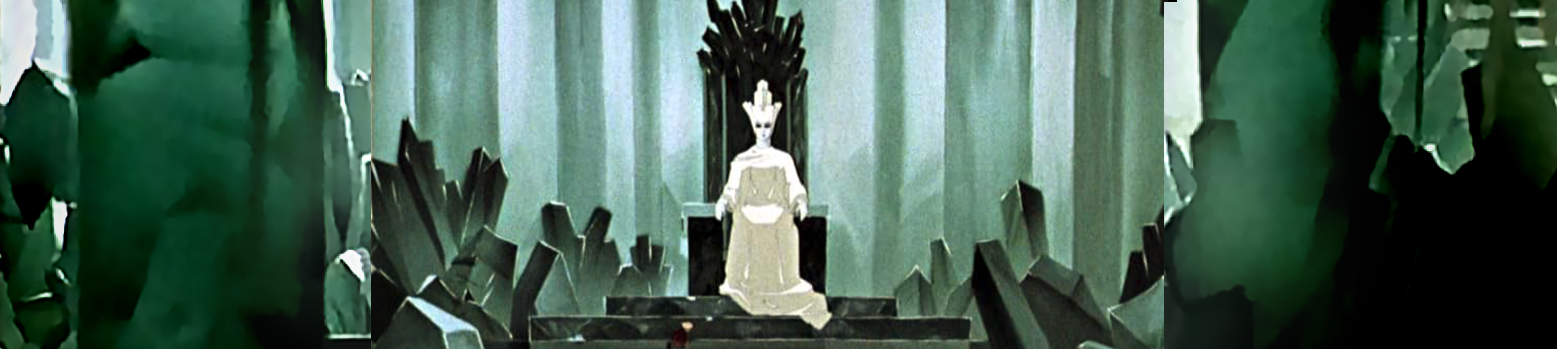
One part of The Snow Queen’s unusual appeal is the use of rotoscoping—tracing live-action footage frame by frame to create to achieve more realistic movement. The process was quite common in Russian animation of the era and many of the short form cartoons they produced became part of a syndicated package in the U.S. (alongside Bozo cartoons—one of these things is not like the other). Animators Alexander Vinokurov, Leonid Shvartsman, and Elizabeth Komova used the rotoscope process sparingly in Atamanov’s film but the effect is still a welcome departure from the frenzied universe of Tom and Jerry. The effect is not so serene that the queen is robbed of her sinister appeal… hundreds of third graders in 1959 would attest to the nightmares she induced.
Still, the movie will be remembered for its unique beauty; the imagery is muted yet the hues are so plentiful, they create a quiet riot of color. The radiant artwork is just one of the highlights of Deaf Crocodiles’s splendid new set: they’ve included two shorter films by Atamanov, each with the same kaleidoscopic color schemes; 1952’s The Scarlet Flower, a Russian take on Beauty and the Beast, and The Key, a Tati-like satire about keeping an industrious attitude toward work and personal responsibility (what would Atamanov have made of AI).
Extras include Written With Ice Crystals: Master Soviet Animator Lev Atamanov and The Snow Queen, a new video essay by film historian Evan Chester, and Innocence & Cynicism: The Snow Queen and Hayao Miyazaki, a new video essay by John Adkins of the indispensable newsletter, Animation Obsessive. Film historian Rolf Giesen is on board with a new commentary track. The films have been released in Standard and Deluxe editions, and in the pricier version, the keep case holds a formidable 60 page illustrated booklet with a new essay by Giesen, and a new essay by film critic Walter Chaw.
There was a soundtrack LP, narrated by Paul Frees.
We’ll never know if Amberson’s changes were for the worse. Robert Wise may have actually saved the film. Just being Devil’s Advocate here. he he.
It would actually be interesting to hear the version dubbed by Sandra Dee. She was one of the most underappreciated actresses.