

Until Dawn
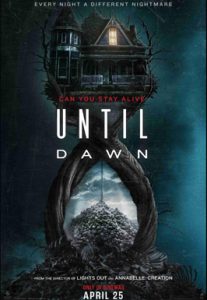 Ten years ago in 2015, a video game called Until Dawn was released to general acclaim, which attempted to place the player inside a horror film to try and attempt to survive a deadly night. The goal of the game was to try to save yourself and your friends by making split-second decisions that would affect the outcomes – a direct challenge to viewers of scary movies who’d frequently criticize some character in a film’s decision to go into a dark basement alone and now find themselves having to make that same choice. Often the decision to do the scarier thing was the right way to go, ironically. The game was written by horror vets Larry Fessenden and Graham Resnik and featured genre favorite performers such as Rami Malek and Peter Stormare. And now a film version is upon us, also called Until Dawn, and although it’s a loose adaptation of the game’s plot, it succeeds as a fun fright flick with an admirable variety of terrors on display.
Clover (Ella Rubin) and her friends are on a trip to try and find her sister Melanie, who went missing some time ago. The last video Melanie sent leads them to a gas station, where the attendant, Hill (Peter Stormare), points out that people often go missing in the defunct mining town, Glore Valley. They head to the town, passing through a storm that ceases in a circular area (the “waterwall”) around a seemingly abandoned visitors center. Inside the center, they discover a wall covered in posters of people who’ve gone missing, including Melanie. Upon discovering a house located beneath the visitors center, a masked psycho with a pickaxe slaughters them all.
 They wake up in the center at the beginning of the following night, an ominous-looking hourglass on the wall suggesting to them that they’re in some sort of recurring time loop trap. Their own pictures are now on the MISSING posters. They begin to look for a way out of their supernatural dilemma, and new problems crop up. Mildly psychic Megan (Jii-young Yoo) is possessed and killed, while Clover meets a witch that tells her, “Survive the night or become part of it.” As they try to escape their trap, the group encounters wendigos, giant monsters, ghost voices, a spooky clown doll (Hello, Poltergeist!) and very bad tap water, and they die over and over again. But soon they realize there’s a limit to this curse, and if they don’t break out of it soon, they’ll be stuck there permanently.
This isn’t the kind of movie in which the characters are especially memorable – it’s all about the various creative ways they’ll be offed. In fact, the characters are all fairly generic, but the actors acquit themselves well regardless. Rubin is suitably strong as the obsessed Clover, who would in most films of this type be the final girl, except that she dies along with everyone else, repeatedly. Yoo registers as the scared but perceptive Megan, and Michael Cimino is suitably distressed as Clover’s ex-boyfriend, Max. Odessa A’zion is fierce as the tough Nina, and Belmont Cameli is good as her selfish boyfriend, Abe. Stormare has fun essentially recreating his character from the game, delivering taunts with ghoulish panache.
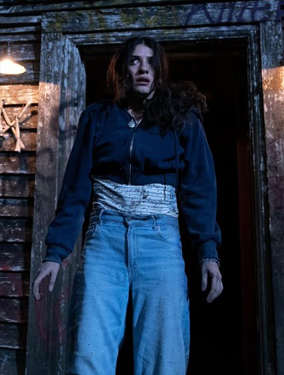 Director David F. Sandberg (who previously helmed the fantastic Lights Out) understands the assignment and delivers creepy atmosphere (credit Jennifer Spence’s outstanding and varied production design) and jump scares galore (many of which are predictable but at least a few that are very effective). Maxime Alexandre’s cinematography makes everything look great, even the decaying mine town, whose houses’ first floor windows are memorably buried as the town has collapsed, showing only dirt behind the glass.
Screenwriters Blair Butler and Gary Dauberman adroitly manage the arcane feat of adapting a video game that was based on trying to make players feel like they were in a horror movie into a horror movie that tries to recreate the sensation of being in a many-branching game. The film lacks the game player’s anxiety about the consequences of their choices but makes up for this by having its characters experience a myriad of creative and dreadful demises. One memorable scene has an especially explosive impact.
The writers also don’t stint on dark humor, having one character opine, “We’re not getting closure,” which refers to the ongoing search for Melanie but also unknowingly presages the group not being able to get any closure to their lives as they’re killed and brought back repeatedly. Also, a scene in which a character thinks vital information will be contained on a VHS tape and then plays it for the group to find that it’s just a porn tape is an amusing surprise.
The reason why all of this supernatural time loop is happening or possible is convoluted and vague, but it doesn’t matter. Until Dawn is an entertaining ride for horror fans, an enjoyable trip filled with killers and monsters and mad doctors, and that’s reason enough.
About Terry Morgan
 Terry Morgan has been writing professionally since 1990 for publications such as L.A Weekly, Backstage West and Variety, among others. His love of horror cinema knows no bounds, though some have suggested that a few bounds might not be a bad thing.
I didn’t know that it was based on a video game until I read reviews.